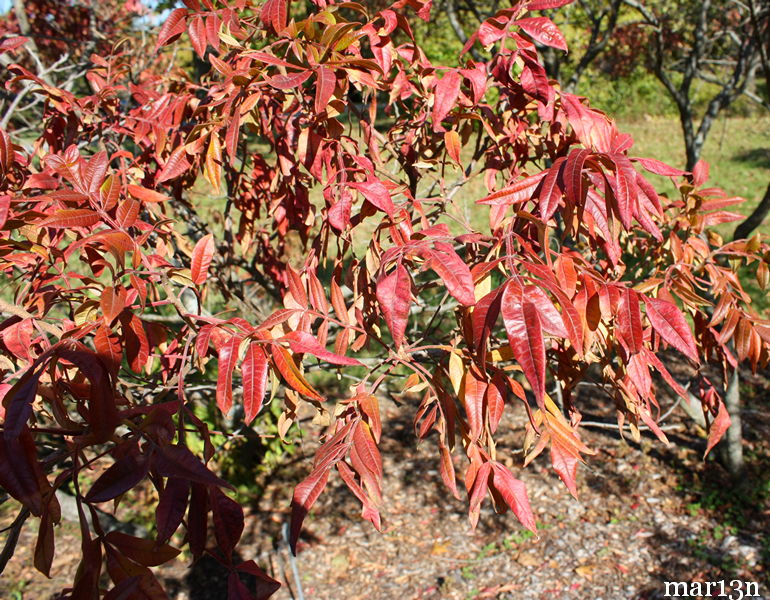
Shining Sumac - Rhus copallina var. latifolia [1]
Citrus or Rue Family: Rutaceae
Shining Sumac or Winged Sumac, is a species of flowering plant in the cashew family, Anacardiaceae, that is native to eastern North America. It is a deciduous tree growing to 3.5–5.5 metres (11–18 ft) tall and an equal spread with a rounded crown [2].
[Cirrus Home]  [Tree Encyclopedia]
 

Shining Sumac - Rhus copallina var. latifolia
These photographs are Autumn colors on October 19th, near Chicago

Shining sumac is often cultivated, where it is well-suited to natural and informal landscapes because it has underground runners which spread to provide dense, shrubby cover for birds and wildlife. This species is valued for ornamental planting because of its lustrous dark green foliage which turns a brilliant orange-red in fall. The fall color display is frequently enjoyed along interstate highways, as the plant readily colonizes these and other disturbed sites. The tiny, greenish-yellow flowers, borne in compact, terminal panicles, are followed by showy red clusters of berries which persist into the winter and attract wildlife.

The flowers are yellow, flowering in the summer. The fruit attracts birds with no significant litter problem, is persistent on the tree and showy.

The bark is thin and easily damaged from mechanical impact; branches droop as the tree grows, and will require pruning for vehicular or pedestrian clearance beneath the canopy; routinely grown with, or trainable to be grown with, multiple trunks. The tree wants to grow with several trunks but can be trained to grow with a single trunk. It has no thorns.

Cultivation
The tree can be planted in a container or above-ground planter; recommended for buffer strips around parking lots or for median strip plantings in the highway; reclamation plant; specimen; tree has been successfully grown in urban areas where air pollution, poor drainage, compacted soil, and/or drought are common.

The tree grows in full sun or part shade. Soil tolerances include clay, loam, sand, slightly alkaline, acidic, and well-drained soil. It is drought tolerant [2].

Shining Sumac - Rhus copallina var. latifolia

Distribution:
Rhus copallinum L.

View Native Status
Distribution Map Legend

Distribution of Rhus copallinum L. var. latifolia Engl.. .

Rhus copallinum var. latifolia
Shining or winged sumac


See U.S. county distributions (when available) by clicking on the map or the linked states below:

USA (AL, AR, CT, DC, DE, FL, GA, IA, IL, IN, KS, KY, LA, MA, MD, ME, MI, MO, MS, NC, NE, NH, NJ, NY, OH, OK, PA, RI, SC, TN, TX, VA, VT, WI, WV), CAN (ON) [3]
"Rhus copallinum L.
Flameleaf Sumac; Anacardiaceae
Cherokee Drug (Antiemetic)
Red berries eaten for vomiting.
Hamel, Paul B. and Mary U. Chiltoskey 1975 Cherokee Plants and Their Uses -- A 400 Year History. Sylva, N.C. Herald Publishing Co. (p. 57)"

~ Find more Ethnobotanical information at  species account from Native American Ethnobotany (University of Michigan - Dearborn).


 Wikipedia Affiliate Button  Wikipedia Affiliate Button  Wikipedia Affiliate Button  Wikipedia Affiliate Button  Wikipedia Affiliate Button
References
  1. Shining Sumac - Rhus copallina var. latifolia Morton Arboretum acc. 174-87*2, photographed October 19th, 2009 By Bruce J. Marlin
  2. Wikipedia, "Rhus copallina"
  3. USDA NRCS, Plants Profile, "Rhus copallinum L."


       web      www.cirrusimage.com
[Cirrus Home]  [Tree Encyclopedia]
© Red Planet Inc.