|

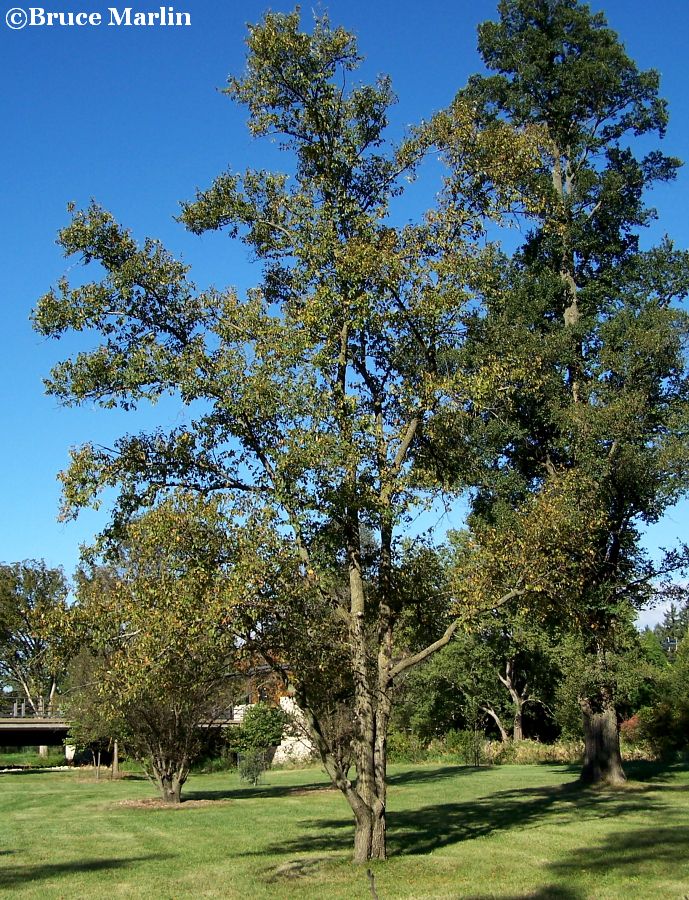
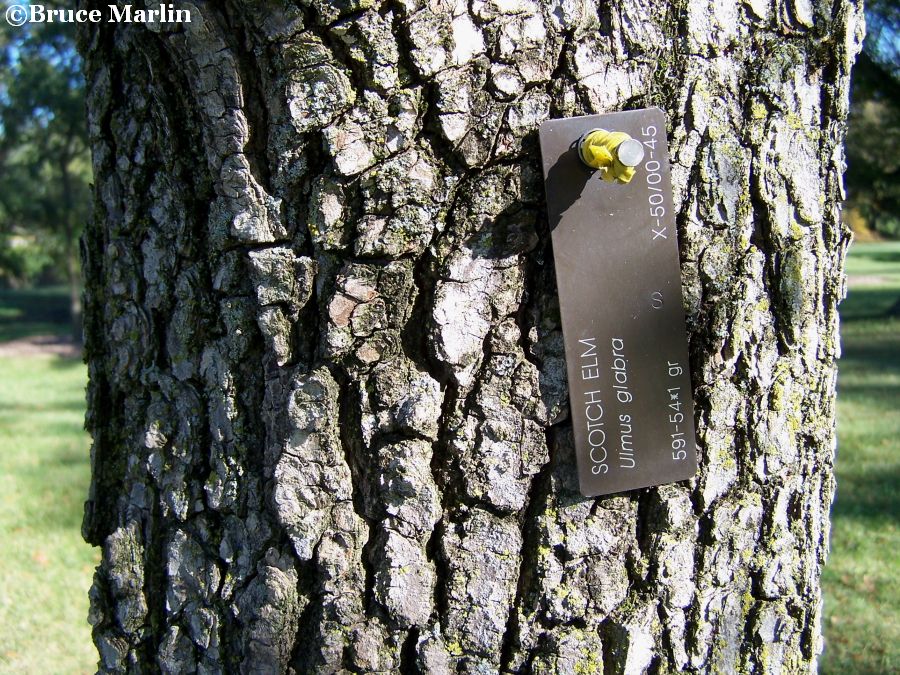
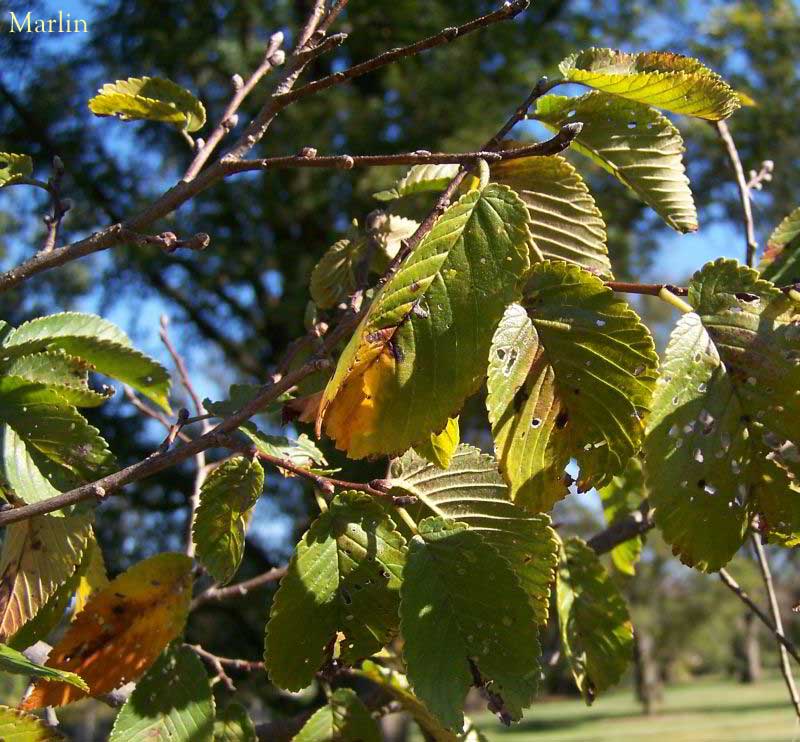
Scotch Elm foliage and bark |
|
Scotch elm is a native of Europe and planted for ornamental purposes.
The standard tree has a broad crown with upright branches. One cultivar,
the ‘Camperdown' elm, is commonly planted for its weeping habit and is
often budded on a Siberian elm understock. European elms are sensitive
to Dutch elm disease and elm yellows, as are the American elms. American
elms are more resistant to the elm-leaf beetle than Scotch elm.
Tree grows to 40m, lives up to 500 years.
Terminal buds are absent. Buds are imbricate and 1/4 inch (6 mm) long.
Branches are reddish-brown in color and hairy when young. Bark on the
main stem and branches is prominently smooth and without scales or corky
ridges.
Leaves are short-petioled, 31/4—61/2 inches (81/2—161/2 cm) long, and
nearly as wide. Leaves are broadest above the middle, rough to the touch
above, and pubescent beneath. Foliage is abruptly pointed and tends to
develop three points instead of one. Leaves are dark green in color and
tend to persist into late fall. [3]

Scotch Elm, Morton Arboretum accession 591-54*1 in summer [2] |
|
"Trees , to 40 m; trunks often
multiple; crowns spreading, broadly rounded or ovate.
Bark gray, smooth, furrowed with age. Wood hard.
Branches spreading to pendulous, glabrous, branchlets
lacking corky wings; twigs ash-gray to red-brown,
villous when young. Buds obtuse; scales reddish brown,
glabrous to marginally white-ciliate. Leaves: petiole
2-7 mm, densely villous. Leaf blade elliptic to obovate,
(4-)7-14(-16) × (3-)4.5-8(-10) cm, base strongly oblique
with lowermost lobe strongly overlapping, covering
petiole, margins doubly serrate, apex long-acuminate to
cuspidate, sometimes with 3 acuminate lobes at broad
apex; surfaces abaxially pale green, villous with woolly
tufts in vein axils, adaxially dark green, strigose to
scabrous, margins not ciliate.
Inflorescences dense fascicles, 8-20-flowered, less than
2.5 cm, flowers and fruits not pendulous; pedicel short,
0.4-0.8 mm, densely pubescent. Flowers: calyx lobed to
ca. 1/2 length, lobes 4-8, reddish pubescent; stamens
5-6, purplish; stigmas reddish, with white pubescence.
Samaras light greenish brown, elliptic to obovate with
blunt or rounded tip, 1.5-2.5 × 1-1.8 mm, broadly
winged, pubescent only along central vein of wing,
apical cleft minute, obscured by persistent, curved
styles. Seeds thickened, not inflated. 2 n = 28. [4] |
|

Scotch Elm, Morton Arboretum accession 591-54*1 in summer [2].
Leaf blade bulges at one side at the base. |
When I was a child in the 1950's, Thacker Street in Des Plaines, Illinois, was lined with huge Elm trees. We walked to school shaded by those magnificent trees; they were so tall, their branches overarched the street completely. It was a wonderful walk then, and especially in fall when our mornings were bathed in yellow light filtering through the glorious butter yellow foliage. Of course, we gathered leaves to take into school with us, to trace and do rubbings with fat Crayons from our (newly introduced) 64 packs. But when the school year started in 1960, those trees had all been cut down, victims of Dutch Elm Disease. It was so sad, and now we walked under blazing sun and boy, did we miss those trees. Similar scenarios are now playing themselves out amongst the lodgepole pine and ash trees of North America. |
|
References-
Scotch Elm, Morton Arboretum accession 591-54*1, photographed October 25, 2010 by Bruce Marlin
- The Morton Arboretum, Arboretum Records Honor, Milestone; Looks to Future, http://www.mortonarb.org/res/GEORGEWARE.pdf
- Ohio State University, Ohio Trees,
Bulletin 700-00
"Ulmus - Elm" Key to Ulmus Species
- Flora of North
America @ eFloras.org, "Ulmus
glabra Hudson, Fl. Angl. 95. 1762. Scotch elm, wych elm, broad-leaved
elm"
|
|