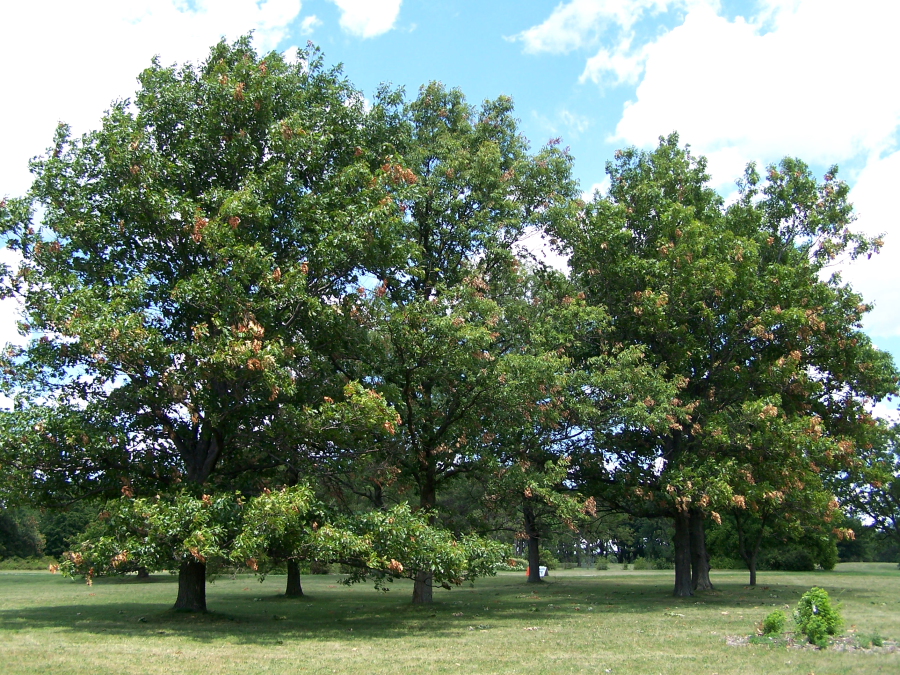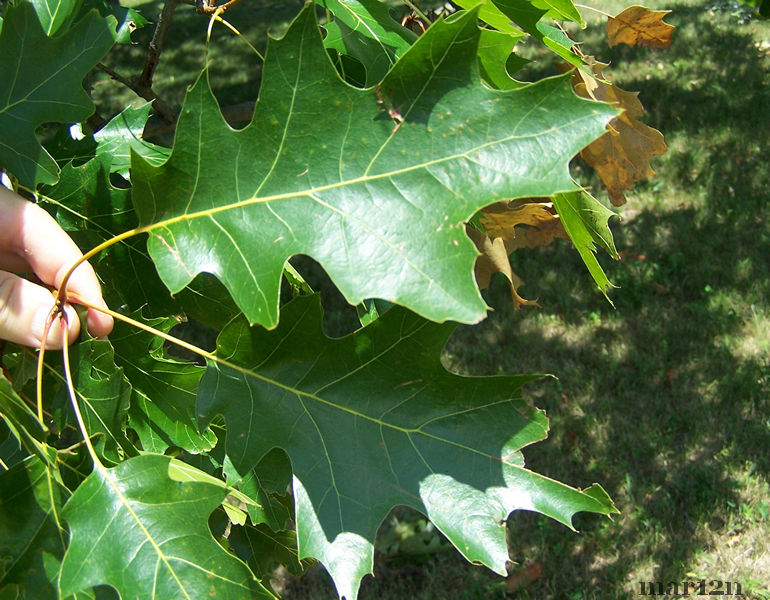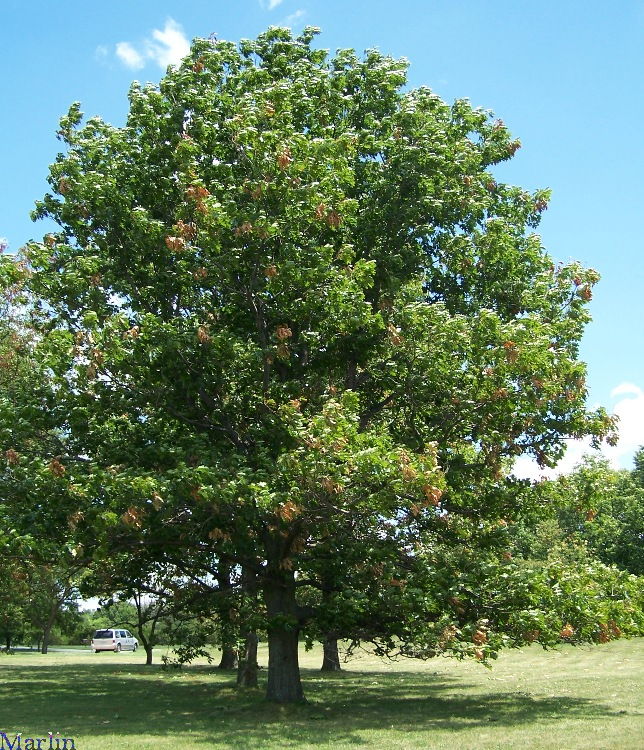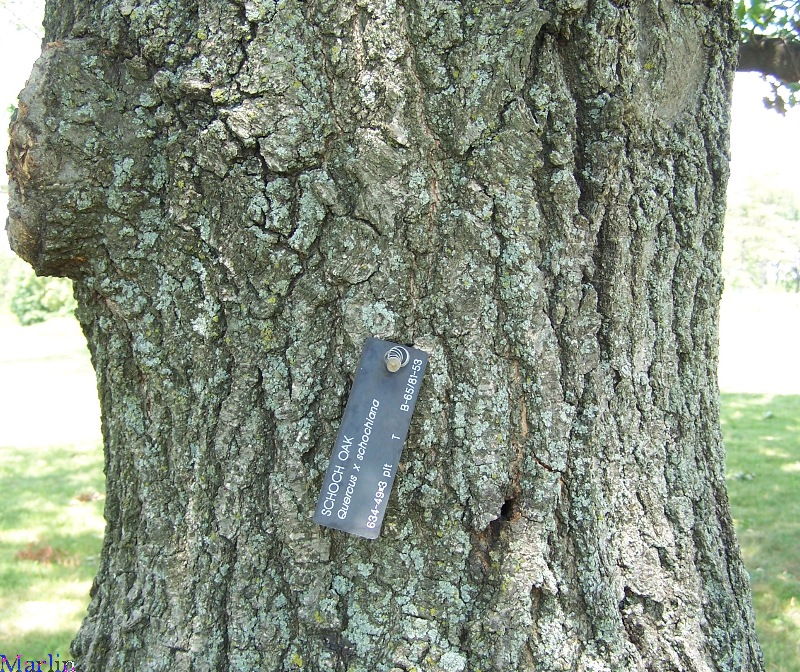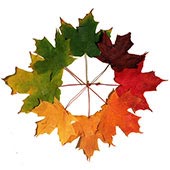
Schoch Oak - Quercus X schochiana  Dieck ex Palmer
Family: Fagaceae
Schoch Oak is a hybrid of  Q. palustris × Q. phellos (2)

Morton Arboretum accession 634-49-3. This tree is 58 years old.
Here is an interesting excerpt from a scientific paper regarding the decomposition rate of different tree leaves in an aquifer:

Abstract
Dry Chinquapin oak (Quercus macrocarpa) and American elm (Ulmus americana) leaves were placed in four microcosms fed by groundwater springs to monitor changes in dry mass, ash-free dry mass, and microbial activity over a 35-day period. Oxygen microelectrodes were used to measure microbial activity and to estimate millimeter-scale heterogeneity in that activity. Oak leaves lost mass more slowly than elm leaves. Generally, there was a decrease in total dry weight over the first 14 days, after which total dry weight began to increase. However, there were consistent decreases in ash-free dry mass over the entire incubation period, suggesting that the material remaining after initial leaf decomposition trapped inorganic particles. Microbial activity was higher on elm leaves than on oak leaves, with peak activity occurring at 6 and 27 days, respectively. The level of oxygen saturation on the bottom surface of an elm leaf ranged between 0 and 75% within a 30-mm2 area. This spatial heterogeneity in O2 saturation disappeared when the water velocity increased from 0 to 6 cm s-1. Our results suggest that as leaves enter the groundwater, they decompose and provide substrate for microorganisms. The rate of decomposition depends on leaf type, small-scale variations in microbial activity, water velocity, and the length of submersion time. During the initial stages of decomposition, anoxic microzones are formed that could potentially be important to the biogeochemistry of the otherwise oxic aquifer. (4)

Schoch Oak is Native to:
  • NORTHERN AMERICA
    North-Central U.S.A.: United States - Illinois
    Southeastern U.S.A.: United States - Arkansas, Kentucky (2) (3)


Trees are essential elements of livable communities and a healthful environment. They are not only beautiful, they carry out many beneficial environmental functions. Trees absorb carbon dioxide, the major greenhouse gas (up to 50 pounds per tree each year), and release oxygen. They shelter and provide nesting habitats for wildlife, retain moisture in soils, hold topsoil in place, and provide shade and cooling.

Trees also provide fruits, nuts, oils, and syrups; pulp for paper, cloth, and rope; and wood for innumerable products and heat. Trees provide both direct and indirect economic benefits. Air-conditioning costs are less in a tree-shaded home, and heating costs are reduced when a home has properly selected and placed windbreaks. Beyond energy savings, landscaping with mature trees increases the value of property.

Indirect economic benefits extend beyond the individual to the community or region. Customers pay lower electricity bills when power companies use less water in their cooling towers and fewer measures to control air pollution. Communities also save money if fewer facilities must be built to control storm water.

Trees make the world more beautiful. They add color, structure, height, and grace to our neighborhoods, parkways, and streetscapes. Trees also neutralize the harshness and stress of urban life. They enrich our lives. Our forests, woodlands, parks, and preserves help us feel more relaxed and serene. A day or even an hour in the woods can help us feel rejuvenated. Trees are magnets for wildlife, which also add beauty, value, and interest to our world.

City and suburban trees often serve several architectural functions. They provide privacy, frame views, and screen out objectionable sights. They reduce glare and reflection, direct pedestrian traffic, and provide background for and soften, complement, or enhance architecture or topography.
--From The Morton Arboretum "Go Green"


 Taxonomic Hierarchy (1)
       
  Kingdom Plantae  -- Planta, plantes, plants, Vegetal  
     Subkingdom Tracheobionta  -- vascular plants  
        Division Magnoliophyta  -- angiospermes, angiosperms, flowering plants, phanérogames, plantes à fleurs, plantes à fruits  
           Class Magnoliopsida  -- dicots, dicotylédones, dicotyledons  
              Subclass Hamamelidae   
                 Order Fagales   
                    Family Fagaceae   
                       Genus Quercus L. -- chêne, chênes, oak, oak spp., oaks  
                          Species Quercus X schochiana Dieck ex Palmer -- oak  
       
Expert(s):  (1)  
  Expert: John Kartesz  
  Notes: Biota of North America Project (BONAP), University of North Carolina   
  Reference for: Quercus X schochiana   
       
  Other Source(s):    
  Source: NODC Taxonomic Code, database (version 8.0)  
  Reference for: Quercus X schochiana   
       
  Source: The PLANTS Database, database (version 4.0.4)  
  Notes: National Plant Data Center, NRCS, USDA. Baton Rouge, LA 70874-4490 USA. http://plants.usda.gov   
  Reference for: Quercus X schochiana   
       
  Source: The PLANTS Database, database (version 5.1.1)  
  Notes: National Plant Data Center, NRCS, USDA. Baton Rouge, LA 70874-4490 USA. http://plants.usda.gov   
  Reference for: Quercus X schochiana 


Trees provide cover: Birds and small animals need concealed places for nesting and hiding from predators. The presence of wildlife can make your backyard or woodlot a special place for your family and children. As urban sprawl displaces many birds and animals from their natural habitat, it becomes even more important for home and landowners to provide green space and mini-sanctuaries for birds and other wildlife.

Trees provide food: Having a wide variety of trees that provide seeds, nuts and fruit for wildlife to eat is one way to increase your success in attracting wildlife. although artificial bird feeders can supplement naturally occurring foods, they can attract unwanted pests such as pigeons, Canada geese, squirrels, and even rats. Trees also provide food by attracting insects and providing cover for their activities; mating, egg-laying. Insects form a huge portion of the warm-weather food supply for many species of songbirds. Trees that provide fall and winter foods are especially important in helping wildlife survive the winter, and to provide forage and cover for early-arriving spring migrants that may get caught in late-season bad weather. Whatever the food sources you provide may be, birds and wildlife also need dependable source of water; create a small pool or birdbath in a protected place.


Schoch Oak - Quercus X schochiana


References:
1. ITIS Standard Report

2. USDA, ARS, National Genetic Resources Program.
Germplasm Resources Information Network - (GRIN) [Online Database].
National Germplasm Resources Laboratory, Beltsville, Maryland.
URL: http://www.ars-grin.gov/cgi-bin/npgs/html/taxon.pl?30746 (27 October 2007)

3. Missouri Botanical Garden - w3TROPICOS ID 13100125

4. Microbial Decomposition of Elm and Oak Leaves in a Karst Aquifer † Angela C. Eichem, Wtitleer K. Dodds,* Cathy M. Tate,‡ and Chris Edler
Division of Biology, Kansas State University

MORE TrEES