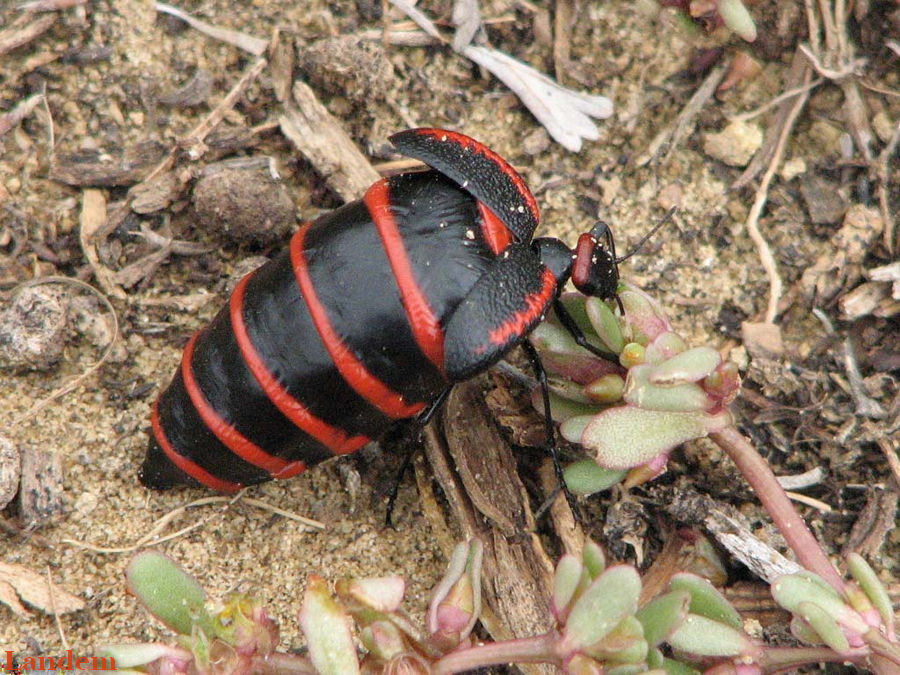
Blister Beetle - Megetra sp.
Live adult female blister beetles photographed near Gobernador, Rio Arriba County, New Mexico, USA
Order: Coleoptera / Family: Blister Beetles (Meloidae).   There are 3 species in genus Megetra. These beetles range the southwest U.S. and Mexico, and are often found in the Chihuahuan desert.
[Beetles Alphabetic Table of Contents]    [Beetles Main Page Graphics]
 

Blister Beetle - Megetra sp.
Photo: Michael J. Landem, Blue Spruce Photography

Blister beetles produce cantharidin, a highly toxic chemical that irritates the skin, gastrointestinal and urinary tracts and may lead to death if ingested, especially in horses. For centuries, cantharidin was prescribed as a cure for a variety of ailments. Spanish fly or cantharis, a preparation of dried meloid beetles, was thought to cure gout, carbuncles, rheumatism and many other medical disorders, in addition to its use as an aphrodisiac. Today, the toxic properties of cantharidin are more widely recognized and its use is largely restricted to veterinarians, who employ it as a counterirritant and blistering agent.

Blister beetles are a serious concern for hay producers and livestock owners. Cantharidiasis or blister beetle poisoning occurs when livestock eat hay that contains cantharidin. Cantharidin irritates the gastrointestinal and urinary tracts of animals and may lead to death. Although most deaths are reported in horses, cattle and sheep also are susceptible. Symptoms include blisters on the tongue and in the mouth, colic, diarrhea, blood or intestinal lining discharge in stools, and problems with urination or bloody discharge in urine. [1]

Beetles in the genus Megetra advertise their toxicity with aposematic coloring. Not all blister beetles use this method of warning off predators; Black Blister Beetle - Epicauta pennsylvanica.

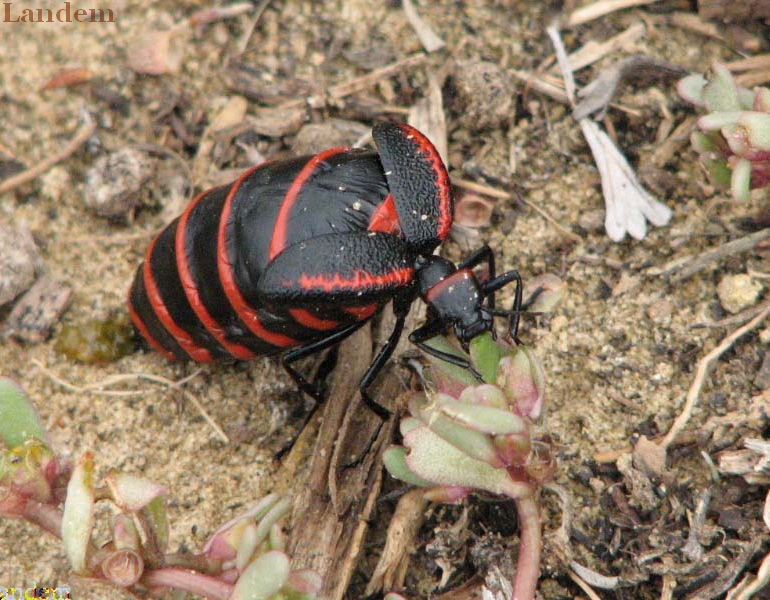
Blister Beetle - Megetra sp.
Megetra female feeding on succulent. The Navajo call this beetle the "water carrier" and modern-day colloquialisms include "football player", or simply "football beetle."
Photo: Michael J. Landem, Blue Spruce Photography

ITIS Standard report:

Kingdom Animalia  -- Animal, animals, animaux  
     Phylum Arthropoda  -- arthropodes, arthropods, Artrópode  
        Subphylum Hexapoda  -- hexapods  
           Class Insecta  -- hexapoda, insectes, insects, inseto  
              Subclass Pterygota  -- insects ailés, winged insects  
                 Infraclass Neoptera  -- modern, wing-folding insects  
                    Order Coleoptera Linnaeus, 1758 -- beetles, besouro, coléoptères  
                       Suborder Polyphaga Emery, 1886  
                          Infraorder Cucujiformia Lameere, 1938  
                             Superfamily Tenebrionoidea Latreille, 1802  
                                Family Meloidae Gyllenhal, 1810 -- blister beetles  
                                   Subfamily Meloinae Gyllenhal, 1810  
                                      Tribe Eupomphini LeConte, 1862  
                                         Genus Megetra LeConte, 1859  
    Direct Children:  
                                            Species Megetra cancellata (Brandt and Erichson, 1832)  
                                            Species Megetra punctata Selander, 1965  
                                            Species Megetra vittata (LeConte, 1853)

 References

  1. K.K. Kinney, F.B. Peairs and A.M. Swinker, Blister Beetles in Forage Crops, Colorado State University Extension no. 5.524