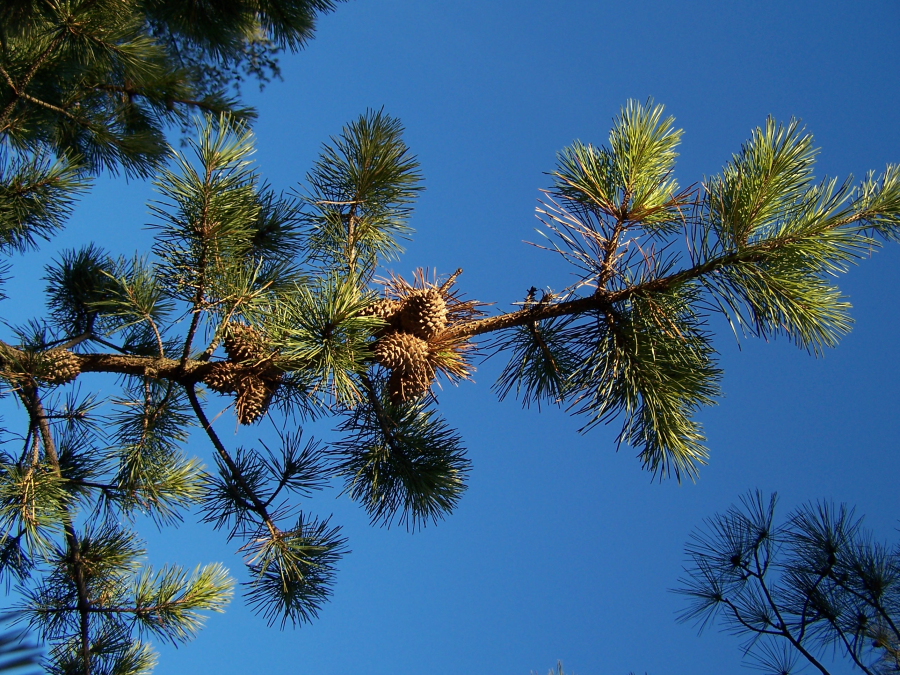
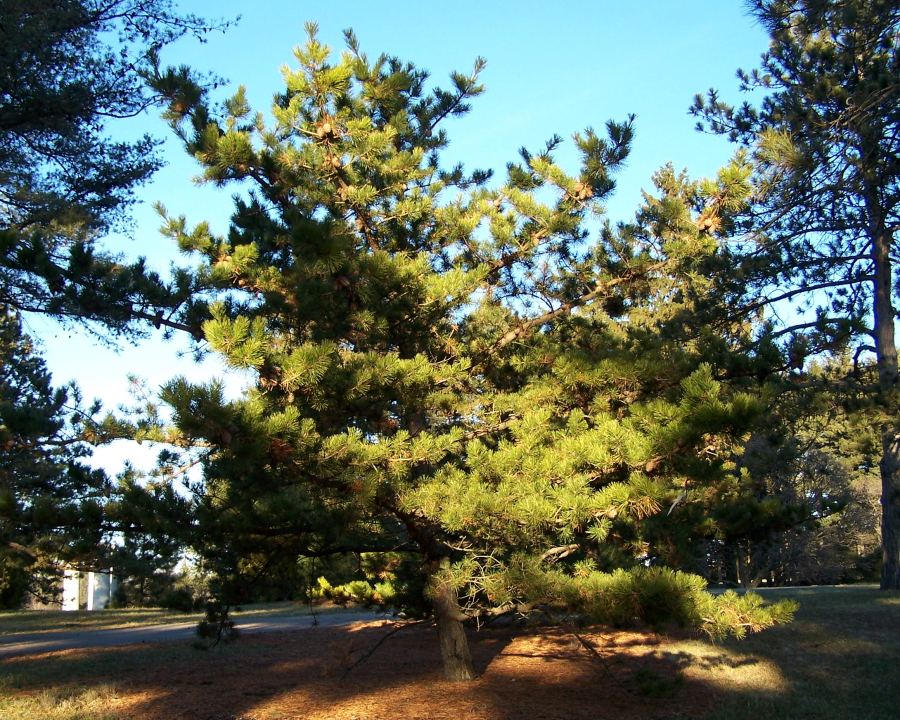
Table Mountain pine is also called hickory pine, mountain pine, or prickly pine. It is most often small in stature, eccentric in form, and exceedingly limby (I like to think they have character.)
One large tree near Covington, VA, measures 70 cm (28 in) in d.b.h. and 29.6 m (97 ft) tall and has a crown spread of 10.4 m (34 ft).
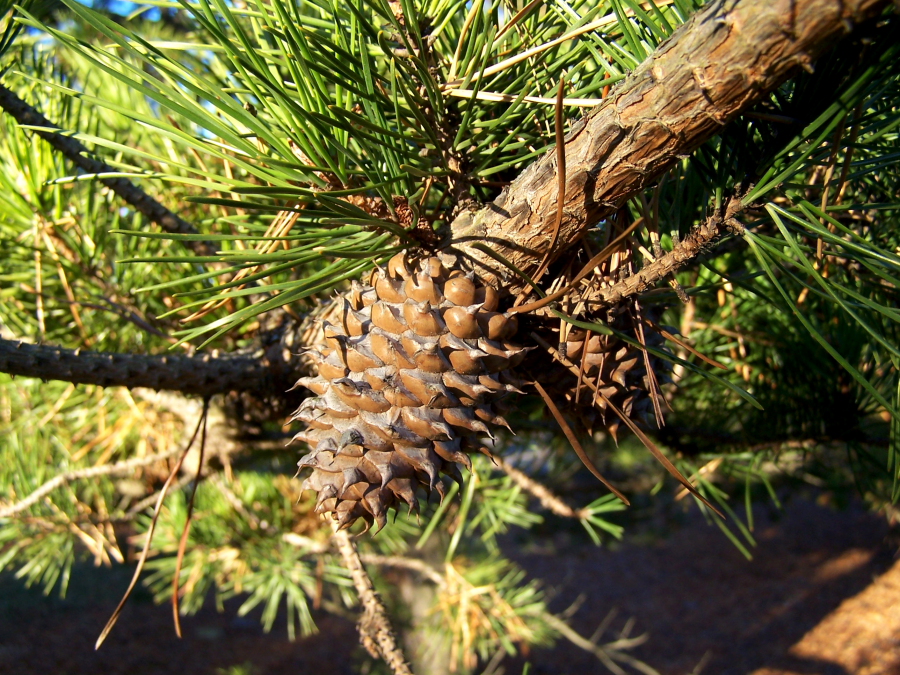
The species epithet pungens derives from the Latin for “sharp-pointed”, a reference to the characteristic stout hooked points on the cones.
22-year-old Table Mountain Pine – Morton Arboretum Specimen started from seed
Table Mountain pine, an Appalachian endemic, grows almost entirely within the range of pitch pine (Pinus rigida) and Virginia pine (P. virginiana), but is less frequent. In general, Table Mountain pine occupies xeric sites of Appalachian rocky and shaly mountainous areas from Georgia into Pennsylvania. It is frequently found on ridges of the precipitous gorges that dissect the Blue Ridge Mountains [1].
Species epithet pungens refers to the wicked sharp points on the cones
Table Mountain pine is used commercially for pulpwood, low-grade sawtimber, and firewood. The serotinous cones on many trees make seed available for wildlife on a year-round basis. Many of the short stubby limbs seen on Table Mountain pine are caused by squirrels that prune off the cone-bearing section of the limb to get at seed in the heavily armed cone cluster. Also, the heavy heath layer in Table Mountain pine stands provides plentiful wildlife food and cover.
The often gnarly Table Mountain pines are a welcome sight on rocky, cliff-like areas of the Appalachians, but perhaps the most important use of the species is as protection forest; it stabilizes soil, minimizing erosion and runoff from the vast shale barrens and other rugged topographic features within its natural range [2].
Animals, chiefly squirrels, make use of this tree for food and shelter: Using its teeth, the red squirrel (T. hudsonicus) will cut a cone-bearing branch from the tree. Once on the ground, the cone is removed from the branch in the same manner. One by one, the squirrel chews away cone scales from the base to the apex of the cone and consumes the seeds inside. Because of this activity, Pinus pungens has locally been dubbed ‘squirrel pine.’ [1]
References:
1. Karen R. Hall and Richard R. Braham, NC State University, NATIVE PINES OF NORTH AMERICA
2. USDA Forest Service Silvics Manual Pinus pungens
To provide the best experiences, we use technologies like cookies to store and/or access device information. Consenting to these technologies will allow us to process data such as browsing behavior or unique IDs on this site. Not consenting or withdrawing consent, may adversely affect certain features and functions.
Functional
Always active
The technical storage or access is strictly necessary for the legitimate purpose of enabling the use of a specific service explicitly requested by the subscriber or user, or for the sole purpose of carrying out the transmission of a communication over an electronic communications network.
Preferences
The technical storage or access is necessary for the legitimate purpose of storing preferences that are not requested by the subscriber or user.
Statistics
The technical storage or access that is used exclusively for statistical purposes.The technical storage or access that is used exclusively for anonymous statistical purposes. Without a subpoena, voluntary compliance on the part of your Internet Service Provider, or additional records from a third party, information stored or retrieved for this purpose alone cannot usually be used to identify you.
Marketing
The technical storage or access is required to create user profiles to send advertising, or to track the user on a website or across several websites for similar marketing purposes.
 22-year-old Table Mountain Pine – Morton Arboretum Specimen started from seed
 Species epithet pungens refers to the wicked sharp points on the cones