![]() |
Sugarberry - Celtis laevigata Family: Ulmaceae. Sugarberry is a North American native. [Cirrus Home] [Tree Encyclopedia] [Trees TOC] [Ulmaceae TOC] [Ulmaceae Main Page Graphics] |
|
| Sugarberry is a moderately tall (60 to 100 feet [18-30
m]), native deciduous tree. Mature trees are typically 18
inches (46 cm) in d.b.h., 80 feet (24 m) tall, with 30 feet
(9 m) clear of branches in good stands. The crown is
spreading and round-topped or oblong. The bark of young
trees is gray and smooth; mature trees develop corky
outgrowths that are scattered to dense with smooth areas in
between. The roots of sugarberry are relatively shallow; it
does not form a distinct taproot and has only average
resistance to windthrow. Sugarberry has a moderately long
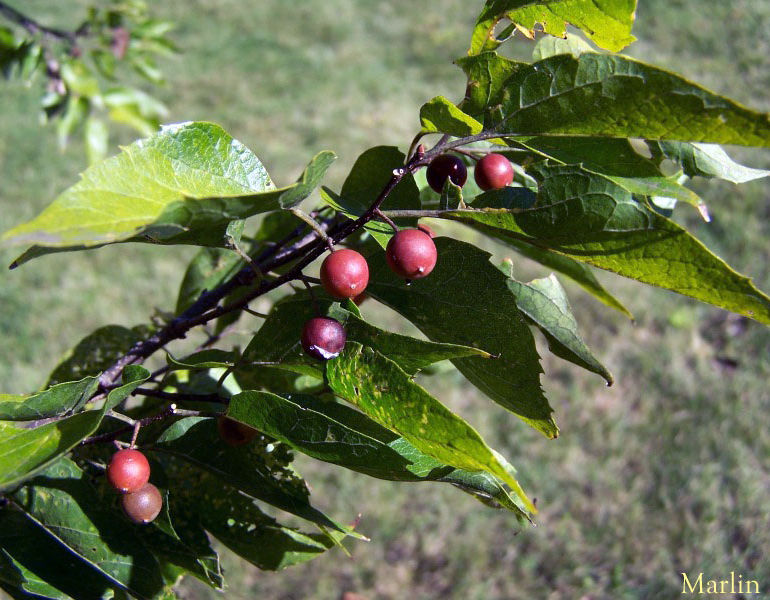
life span, not usually living over 150 years. The wood of sugarberry is close grained, soft, and of medium strength. It is used mostly for furniture but also is used for dimension stock, flooring, crating, fuel, cooperage, and fence posts. Sugarberry flowers when the leaves first appear in spring, from March to May, depending on latitude. Fruit appears in July and August, ripening into October. The fruit is retained on the tree until midwinter [2]. Most or all leaves are lost by mid-December. The fruits of sugarberry are eaten by many birds, including the ring-necked pheasant, waterfowl, quail, and ruffed grouse. They are a preferred food of turkeys in fall and winter. Squirrels occasionally eat the fruit, and will also consume buds and bark, but do so rarely. Other game and nongame animals consume the fruit. Cattle will browse sugarberry heavily, especially in winter on poor ranges. White-tailed deer will browse sugarberry, but it has a low preference rating [1]. |
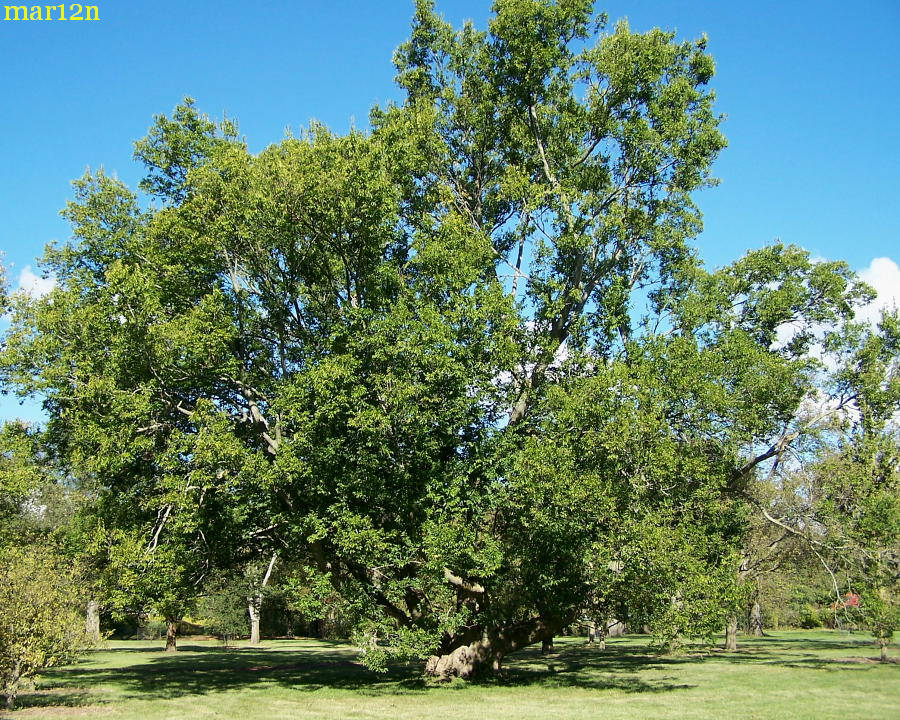
This huge sugarberry tree at the Morton Arboretum is
72 years old.
| Sugarberry is native to the southeastern part of the
United States, ranging south from southeastern Virginia
to southern Florida; west to central Texas and including
northeastern Mexico; north to western Oklahoma and
southern Kansas; and east to Missouri, extreme southern
Illinois, and Indiana. It occurs locally in Maryland. HABITAT TYPES AND PLANT COMMUNITIES : In many areas, sugarberry occurs as scattered individuals. After disturbances, a seral sugarberry-American elm (Ulmus americana)-green ash (Fraxinus pennsylvanica) forest cover type may develop, with sugarberry as a codominant. This type intermixes with sweetgum (Liquidambar styraciflua)-willow oak (Quercus phellos) types, which contain essentially the same species in different densities. The sugarberry-American elm-green ash type occurs most often on the central coastal plain of the Gulf of Mexico, heavily concentrated on the Mississippi alluvial plain, and along major river basins. Sugarberry is susceptible to damage by ice, which breaks main stems and branches. Defoliation of sugarberry by hackberry butterfly (Asterocampa celtis) has been reported, though no tree death or crown die-back was observed. Sugarberry is used as an ornamental, even though leaf leachate can reduce growth of grasses under the trees due to the presence of ferulic, caffeic, and p-coumaric acids [1]. |
|
Sugarberry cannot tolerate prolonged
flooding or water-saturated soils. Hook listed sugarberry as
weakly tolerant to waterlogging, and capable of living from
seedling to maturity in soils temporarily waterlogged for 1
to 4 weeks of the year, or about 10 percent of the growing
season. In forested wetlands sugarberry grows best in the
drier areas. Rising water levels (due to sea level rise,
flooding, impoundments etc.) will reduce sugarberry basal
area in these forests. . Pests |

[Cirrus Home] [Tree Encyclopedia] [Trees Alphabetic Table of Contents]
[Family Ulmaceae Table of Contents]
[Family Ulmaceae Main Page Graphics]
References
|
|