Silver King Juniper - Juniperus scopulorum 'Silver King'
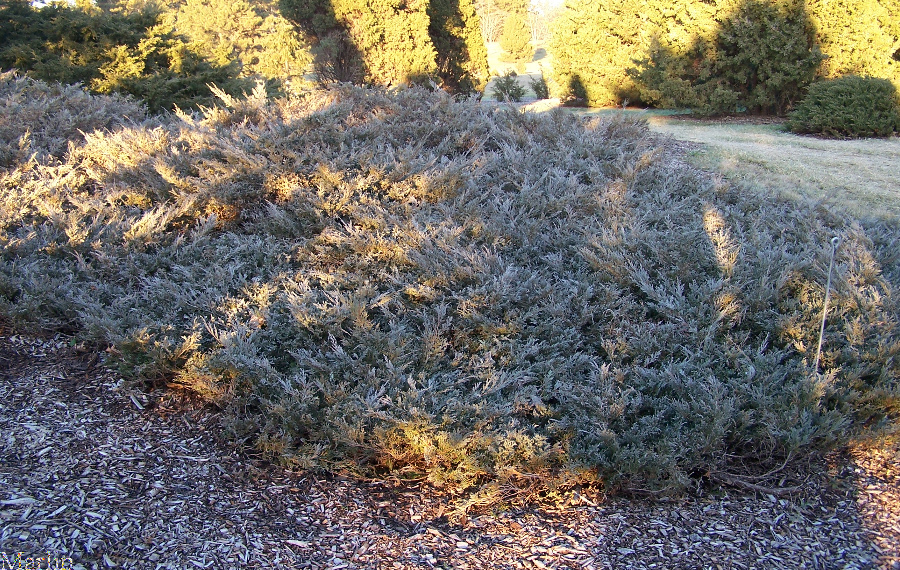
Silver King Juniper is a dwarf variation of the commonly named "Rocky Mountain" juniper. It originated as a seedling at the nurseries of C. White, Walla Walla Washington, in 1955. USA patent number 1186. (1) Cultivated specimen photographed at The Morton Arboretum, northern Illinois, USA.
[Cirrus Home]  [Tree Encyclopedia]
 
Silver King Juniper is one of several cultivars resistant to phomopsis tip blight. (See table 1) (3)
Juniperus scopulorum is a perennial, evergreen gymnosperm native to North America. The species grows as a shrub or tree to 30 feet (10 m) or more and has thin, fibrous bark that usually shreds with age. In the open, trees are stubby and broadly pyramidal with branches to ground level. In shaded areas, the trunk is less tapered and foliage arranges in "weeping sprays". Leaves are scalelike and 0.03-0.11 inch (1-3 mm) long or needlelike and 0.11-0.47 inch (3-12 mm) long.


 White's Silver King Juniper grows to 50 cm tall and about 2 meters in diameter, densely spreading filiform branchlets, in silvery-blue foliage. (1)

Juniperus scopulorum juniper prefers calcareous and somewhat alkaline soils and grows best on moist, deep soils. It survives extremes of temperature well. Rocky Mountain juniper is considered hardy except for "burning" of foliage on trees exposed to northwest winds during winter in the northern Great Plains. It can tolerate shade when young, but becomes intolerant later in life. It is more drought tolerant than eastern redcedar and less so than other tree junipers in the west. In fact, during the 1930s drought, Rocky Mountain juniper woodland maintained and expanded range in the western Dakotas.

Juniperus scopulorum grows throughout the drier mountains and foothills of British Columbia and Alberta; south through the Great Basin and Rocky Mountains to Arizona, New Mexico, and western Texas; and north across eastern Colorado, western Nebraska and North Dakota, Montana, and into Saskatchewan. It is also found on Vancouver and other Puget Sound islands, as well as the surrounding mainland.

Juniperus scopulorum is found over most of the range of pinyon (Pinus spp.)-juniper (Juniperus spp.) woodlands. It is a major tree species in the higher elevations of pinyon-juniper woodlands in Colorado, northern New Mexico, and Arizona, and locally in Nevada and Utah. In pinyon-juniper woodlands, it is found in association with other juniper species such as alligator juniper, oneseed juniper, and Utah juniper, as well as Colorado pinyon (Pinus edulis), Mexican pinyon (P. cembroides), and singleleaf pinyon (P. monophylla).

Rocky Mountain juniper communities in the northern Great Plains are often restricted to steep, north-facing slopes. Individuals may be scattered across other areas in mountains and canyons throughout the Rocky Mountain region, such as rocky outcrops, butte tops, draws, and floodplains [19,49,58,109]. Rocky Mountain juniper forms open woodland with sagebrush and grasses, and it is often found mixed with Douglas-fir (Pseudotsuga menziesii), Gambel oak (Quercus gambelii), or ponderosa pine (Pinus ponderosa). It is also found along waterways in pure stands or as understory in the cottonwood (Populus spp.)-willow (Salix spp.) habitat type. It forms pure stands at middle and low elevations in the northern part of its range. (2)
 

Table 1.
Juniperus species and cultivars with resistance to Phomopsis tip blight (3)
J. chinensis 'Femina'
J. chinensis 'Iowa'
J. chinensis 'Keteleeri'
J. chinensis 'Mountbatten'
J. chinensis 'Pfitzeriana'
J. chinensis 'Pfitzeriana Aurea'
J. chinensis 'Robusta'
J. chinensis 'Robusta Green'
J. chinensis var. sargentii
J. chinensis var. sargentii 'Glauca'
J. chinensis 'Wintergreen'
J. communis 'Ashfordii'
J. communis 'Aurea-spica'
J. communis 'Depressa'
J. communis 'Hulkjaerhus'  
J. communis ' Aurea'
J. communis
'Repanda'
J. conferta
J. horizontalis 'Depressa Aurea'
J. sabina 'Arcadia'
J. sabina 'Broadmoor'
J. sabina 'Knap Hill'
J. sabina 'Skandia'
J. scopulorum 'Silver King'
J. squamata 'Campbellii'
J. squamata 'Prostrata'
J. squamata 'Pumila'
J. squamata var. fargesii
J. virginiana 'Tripartita'


Juniper tip blight is caused by one of two different fungi, Phomopsis juniperovora or Kabatina juniperi. Symptoms of the two diseases are identical; however, some aspects of their control differ. Therefore, correct identification of the causal agent is important. These fungi can also attack other hosts, including Cryptomeria, Chamaecyparis, and Thuja species. They seldom cause significant damage in landscapes unless weather conditions become favorable for disease development.

Visible symptoms include browning and dieback of young needles and shoot tips. Gray lesions usually girdle the shoot at the base of the dead tissue. Tiny, black or grayish fungal fruiting bodies may be visible in the gray lesions. On highly susceptible hosts, the fungus may invade and girdle larger stems, resulting in browning and death of major branches; however, this degree of disease severity is rare. Both Kabatina tip blight and Phomopsis tip blight are most damaging on younger plants.

Symptoms of tip blight diseases can be easily confused with damage from either of two different insects, the juniper midge or the juniper tip midge. Both insects deposit their eggs inside young juniper shoots. The developing larvae mine the inside of the shoot and cause death of shoot tips. If affected shoot tips are carefully examined with a hand lens, small holes can be seen where the adult insect exited the shoot. These holes distinguish this type of damage from Phomopsis or Kabatina tip blight.

Phomopsis Tip Blight
During prolonged wet, cool periods in spring or fall, spores of Phomopsis juniperovora ooze from black fruiting bodies (Fig. 2) and are spread by splashing rain or overhead irrigation to other branches and adjacent healthy plants. Spores of this fungus can be produced throughout the summer, but most infections occur in spring and fall. Fungal spores germinate and invade young, healthy twigs. Older twigs are resistant to infection. The blight fungus penetrates young tissues rapidly and may kill first-year seedlings. (3)

Newly developing tissues are very susceptible to the fungus. Infection may occur late in the season, if growth is prolonged and encouraged by heavy pruning, high fertility and excessive moisture. An infection may begin within seven hours on a wet surface when temperatures are 20-24 °C. Prolonged wet periods promote and enhance the severity of the disease. Following infections, high temperatures intensify the severity of symptoms.

Native Americans have used Juniperus scopulorum seeds, "berries", and foliage for incense, teas, or salves to treat a variety of ailments including respiratory problems, backaches, vomiting and diarrhea, dandruff, high fever, arthritis and muscular aches, kidney and urinary ailments, and heart and circulatory problems. It has also been used to facilitate childbirth. Juniper berries are also used in gin making. (2)


References:
1. Pieter den Ouden and Boudewijn Karel Boom, Manual of Cultivated Conifers: Hardy in the Cold-and Warm-temperate Zone (Springer, 1982).
2. Scher, Janette S. Juniperus scopulorum. In: Fire Effects Information System, [Online]. U.S. Department of Agriculture, Forest Service
3. Mary Ann Hansen, Juniper Tip Blights (Virginia Tech Publication Number: 450-601, May 2000)


       web       www.cirrusimage.com


Tree Encyclopedia by Bruce Marlin is licensed under a Creative Commons Attribution-Noncommercial-No Derivative Works 3.0 Unported License.
Based on a work at www.cirrusimage.com.
Attribution and permissions guidelines at http://www.cirrusimage.com/copyright.htm.