|
Ponderosa Pine -
Pinus ponderosa Dougl. ex Laws.
Ponderosa Pine is one of America's abundant tree species, covering
approximately 27 million acres of land. Stands can be found from Canada
to Mexico and from the Pacific Coast eastward to the Black Hills of
South Dakota. Its growth range covers an area encompassing more than 35
percent of the total acreage of the U.S.
(2)
|
|
|

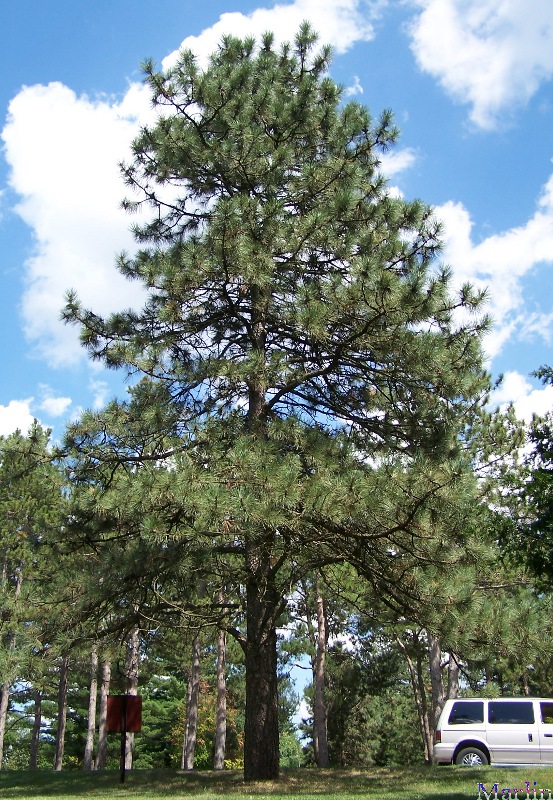
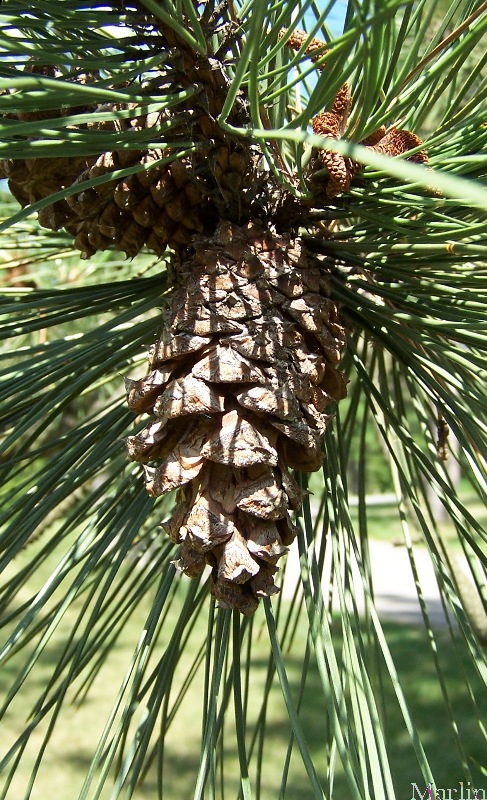
This Ponderosa pine is a
Morton Arboretum specimen. Photo: Bruce Marlin
|
|
Ponderosa pine,
also called western yellow pine, is one of the most widely
distributed pines in western North America. A major source of
timber, ponderosa pine forests are also important as wildlife
habitat, for recreational use, and for esthetic values.
Within its
extensive range, two varieties of the species currently are
recognized: Pinus ponderosa var. ponderosa (Pacific ponderosa
pine) (typical) and var. scopulorum (Rocky Mountain ponderosa
pine). Arizona pine (P. arizonica), sometimes classified as a
variety of ponderosa pine, is presently recognized as a separate
species.
Ponderosa pine
wood is principally used in millwork, including windows, doors,
shelving, molding, knotty-pine paneling and dimension lumber.
Sap used as glue and source of turpentine oils.
Native
Americans used inner bark and seed as food, sap was used as a
chewing gum. Source of pyrone used as a FDA approved flavoring
to bread and cakes.
Medicinal - Pinus species have been used as an antiseptic, an
expectorant, a poultice to treat boils, rheumatism, backaches
and other inflammations.
Ponderosa Pine forests are
usually selectively harvested rather than clear cut. This method
of logging removes only the mature trees and leaves the other
trees to re-seed and mature. Selective harvesting often makes it
difficult to identify a recently logged stand.
Ponderosa Pine is one of the
Western pine species that includes Idaho White Pine (pinus
monticola), Sugar Pine (pinus lambertiana) and Lodgepole Pine
(pinus contorta). The Western pines are distinct from the
Southern Yellow pines which are denser and pitchier, with widely
different characteristics and uses.
(1) |
|
Ponderosa Pine trees average 100' to
160' in height, with some exceeding
180'. The trees range from 2-4' in
diameter, with the rate of growth
depending upon titleitude, soil,
temperature and rainfall.
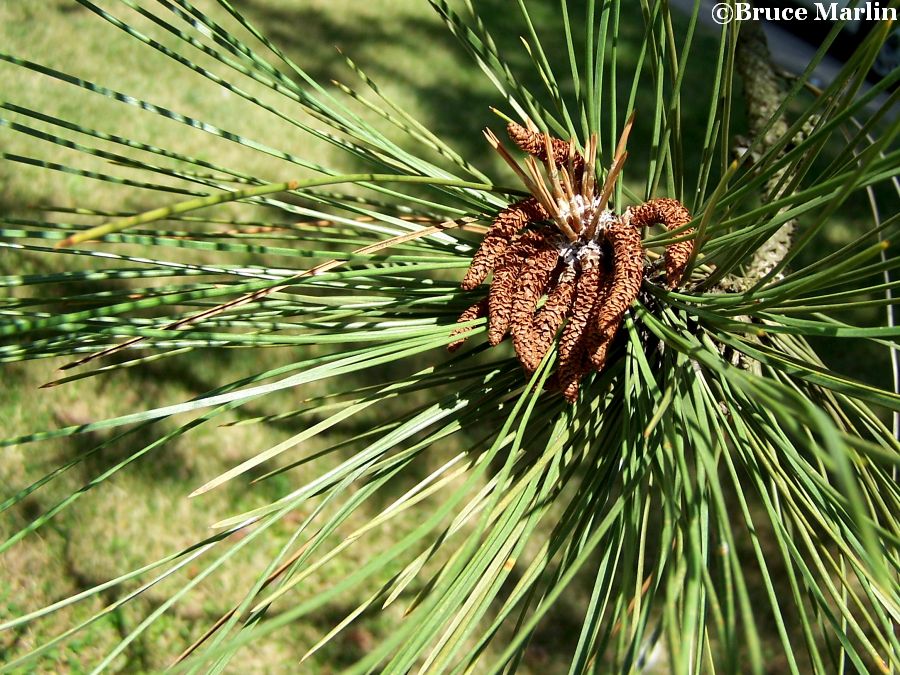
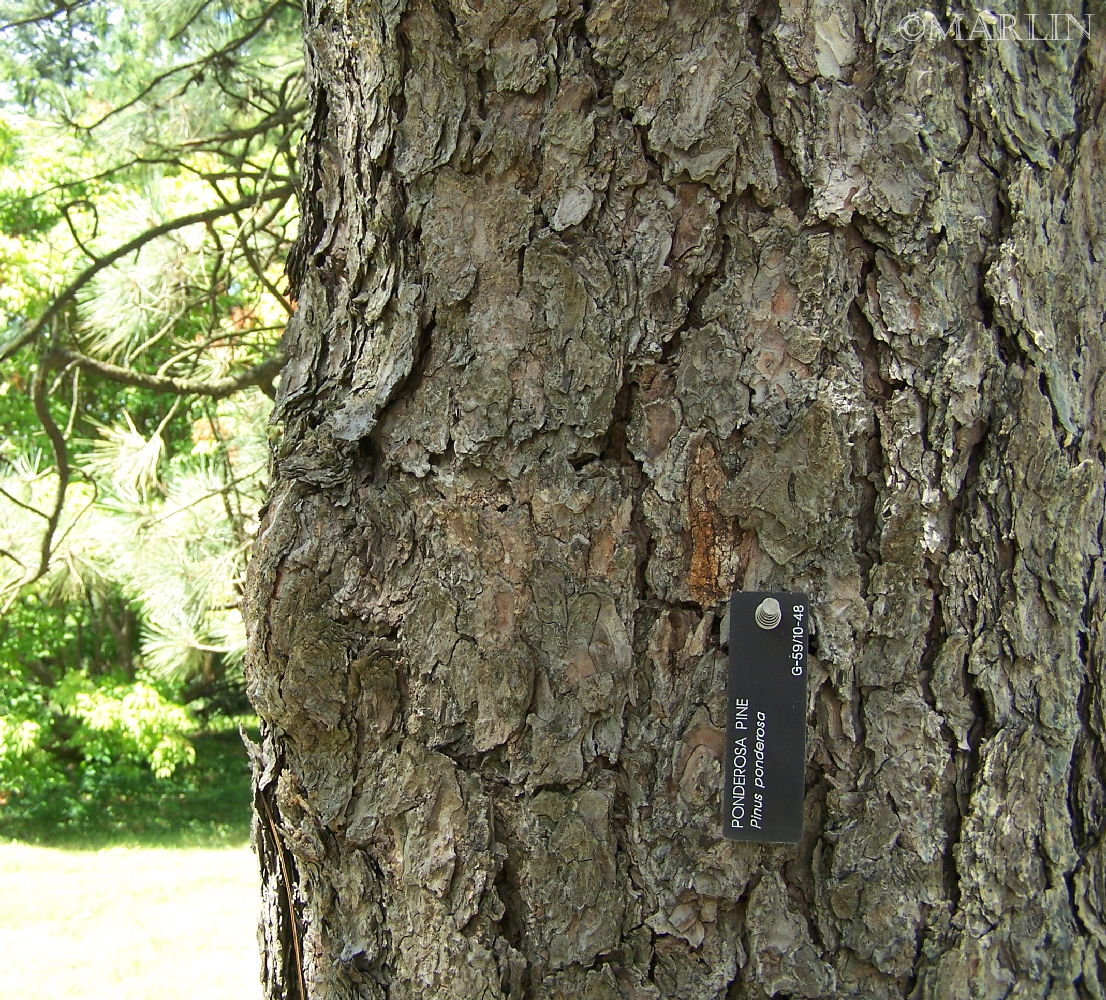
Mature
Ponderosa Pines can be easily
identified by their distinctive
orange-brown bark which is arranged
in large plates. The dark
yellow-green needles are 5-10" long
and grow in clusters of three. The
cones, similar in color to the bark,
are 3-6" long and 2-4" in diameter.
Seeds are 5/16-3/8" long with a
3/4-1" wing.
Ponderosa Pine is well suited for
remanufacturing which requires
clear, splinter-free wood, with a
minimum of knots, resin and other
unwanted characteristics. The large
trees include substantial volumes of
virtually clear sapwood with
relatively few, widely-spaced knots.
Shop and Factory lumber is graded to
yield standard cuttings of clear
material suitable for fabrication.
Such wood is selected to be almost
completely free from pitch and resin
pockets, has an even grain and is
dimensionally stable. Ponderosa also
ranks moderately high for ease of
gluing and is used for all types of
products where glued-up construction
is required.
The
species is prized for moulding and
for doors, windows, frames and
drawers where durability under
movement is essential. It has the
ability to withstand scuffs, shocks
and jars without spliting, which
makes it the premier wood for these
and other applications such as
sashes, jambs, shutters, screens,
columns, stairwork and fascia. Pine
paneling is often associated with
Early American decor in kitchens,
family rooms, dens and bedrooms.
However, new finishing techniques
and patterns make it appropriate for
contemporary or traditional
settings.
Industrial uses for Ponderosa Pine
include pallets, concrete forms,
crates and boxes, dunnage, hives,
partitions and foundry patterns. It
is also used for a wide variety of
wood packaging and novelty items
such as boats, wagons, toys, window
shade slats, rat and mouse traps.
(2)
|

Ponderosa pine's open, spreading crown
makes for moderate, dappled shade.
| The range of
ponderosa pine extends from southern Canada into
Mexico, and from the Plains States of Nebraska and
Oklahoma to the Pacific Coast. Pacific ponderosa
pine (var. ponderosa) ranges from latitude 52° N. in
the Fraser River drainage of southern British
Columbia, south through the mountains of Washington,
Oregon, and California, to latitude 33° N. near San
Diego. In the northeast part of its range it extends
east of the Continental Divide to longitude 110° W.
in Montana, and south to the Snake River Plain, in
Idaho. Rocky Mountain ponderosa pine (var.
scopulorum) extends east of the Continental Divide
from latitude 48° N. in north-central Montana,
southeasterly into North and South Dakota, eastern
Wyoming, and as far east as north-central Nebraska.
Within this area,
ponderosa pine grows on the discontinuous mountains,
plateaus, canyons, and breaks of the plains, with
the most extensive stands found in the Black Hills
of South Dakota and Wyoming. South of Wyoming, Rocky
Mountain ponderosa pine extends south on both sides
of the Continental Divide, west to Arizona, and the
eastern edge of the Great Basin in Nevada, east to
Texas west of the Pecos River, New Mexico, extreme
northwestern Oklahoma, Colorado, and northern
Mexico.
Within this wide
range, ponderosa pine is absent from a large area
that includes southwestern Montana, western Wyoming,
southern Idaho, and part of the Great Basin. A
possible explanation for the absence is that the
distribution of rainfall during the summer months
prevents seedling establishment except at higher
elevations, where the species has little tolerance
for the shorter growing season. Arizona pine (var.
arizonica) is found primarily in the mountains of
extreme southwestern New Mexico, southeastern
Arizona, and northern Mexico.
(1) |
|
|
 
Ponderosa pine seeds are consumed by
a great many birds and small mammals
such as mice, chipmunks, and tree
squirrels. In years of low cone
production, the potential seed crop
may be severely reduced. Squirrels
clip many of the cone bearing twigs,
destroying flowers and conelets.
Because of ponderosa pine's
intolerance of shade, it tends to
grow in even-aged stands and is
usually managed by that method.
Uneven-aged stands might appear
common throughout the drier portion
of its range but are in reality a
mosaic of even-aged groups.
Ponderosa pines lose vigor in dense
stands.
Damaging Agents- Rabbits and hares
injure or kill many seedlings, and
pocket gophers are especially
destructive. In areas where pocket
gopher populations are high all
seedlings and many saplings may be
destroyed. Squirrels and porcupines
attack sapling and pole-size trees
and, although rarely killing them,
deform the stems on which they feed.
Repeated browsing by deer has
stunted seedlings for 50 years or
more. In the absence of regulation,
sheep and cattle have damaged
reproduction by trampling, bedding,
and occasional browsing.
At least 108 species of insects
attack P. ponderosa var. ponderosa,
and 59 species attack P. ponderosa
var. scopulorum. The most damaging
of the tree-killing insects are
several species of Dendroctonus.
Trees die from the combined effects
of a blue stain fungus transmitted
by the beetle and extensive larval
consumption of the phloem. The
western pine beetle (D. brevicomis)
is a common cause of mortality in
overmature, decadent trees within
the range of ponderosa pine from
Baja California, north into Oregon,
Washington, western Canada, Idaho,
and western Montana. During
epidemics, however, apparently
healthy, vigorous trees are also
killed. During the drought years of
the 1930's, losses from western pine
beetle in the Pacific Northwest were
so heavy that many foresters feared
for the pine stands' continued
existence. The mountain pine beetle
(D. ponderosae) is the most
destructive and aggressive enemy in
the central and southern Rocky
Mountains.
During the 1894-1908 outbreak in the
Black Hills of South Dakota, this
insect killed between 5.7 and 11
million m³ (1 and 2 billion/fbm) of
ponderosa pine. Tree killing by D.
ponderosae has increased with the
conversion of old-growth to
young-growth stands in the Pacific
Northwest. High stand density is
believed to reduce vigor of some of
the larger trees in a stand and,
therefore, is an underlying factor
in the occurrence of bark beetle
outbreaks. D. adjunctus, D.
approximatus, and D. valens are
other species of the genus that
often kill ponderosa pines.
Among bark beetles, Ips species are
second in destructiveness only to
Dendroctonus. Ips are present
naturally in all stands, where they
usually breed in slash. In abundant
slash from forestry activities, Ips
can kill vigorous ponderosa pine up
to 66 cm (26 in) in d.b.h. when
populations reach explosive levels.
Eleven species of Ips have been
found attacking ponderosa pine. Of
these, I. latidens, I. emarginatus,
I. pini, I. lecontei, and I.
paraconfusus have the most impact.
Several insects mine buds and
shoots, primarily of young trees.
although seldom killed, trees are
retarded in growth when infestations
are severe. Pine tip moths
(Rhyacionia spp.) and the gouty
pitch midge (Cecidomyia piniinopis)
kill the buds and shoots they mine.
A more insidious pest, until
recently overlooked and overrated,
is the western pineshoot borer
(Eucosma sonomana). Larvae of this
species bore within the pith of the
terminal shoot, stunting but seldom
killing them. Shoots that are
potentially more robust are more
likely to be infested than are
weaker shoots. Accordingly, direct
comparisons of infested vs.
uninfested shoot lengths will
underestimate actual growth loss.
Each terminal shoot infested by a
larva that developed to maturity was
reduced in length that year by more
than 25 percent in one study. The
pine reproduction weevil
(Cylindrocopturus eatoni), a native
of California and, presumably,
Oregon, can be a threat to
slowgrowing plantations. Its impact
has declined, however, with the
improvement in planting stock and
control of competing vegetation.
Defoliating insects, such as the
pine butterfly (Neophasia menapia)
and the pandora moth (Coloradia
pandora), periodically cause
damage over extensive areas. The
pine needle sheathminer (Zelleria
haimbachi) can be locally severe
in young stands. Dwarf mistletoe (Arceuthobium
vaginatum ssp. vaginatum in the
Southwest, and A. campylopodium
in California and the Northwest) is
ponderosa pine's most widespread
disease, absent only in the Black
Hills. It seems to be particularly
devastating in the Southwest, where
it infects trees on about onethird
of the commercial acreage. At Fort
Valley Experimental Forest in
northern Arizona, dwarf mistletoe
has caused up to 36 percent of the
mortality. On trees not killed, the
parasite is responsible for a
significant loss in growth,
primarily in height, and is reported
to reduce seed viability as much as
20 percent. In the Northwest, A.
campylopodium has little effect on
vigorous, young trees because height
growth will usually exceed its
upward spread, relegating the
parasite to the lower crown.
Several diseases attack ponderosa
pine roots. Black stain root
disease, Leptographium
(syn. Verticicladiella) wageneri,
causes a diffuse dark staining of
the root wood and kills roots.
Heterobasidion annosum causes an
insidious lethal root disease that
is spread by airborne spores to the
surfaces of freshly-cut stumps. It
and L. wageneri kill trees of all
ages and usually result in group
mortality that is sometimes mistaken
for the work of bark beetles, which
are frequently secondary invaders.
Armillaria sp., previously
considered weak root and butt
decayers, are causing increased
mortality in young plantations and
thinned stands where the disease can
build up in dead root systems.
Active infection centers of L.
wageneri and H. annosum
spread about 1 m (3 ft) per year.
The rate is usually less for
Armillaria sp. The most damaging
heart rot in the southern Rocky
Mountains and the Black Hills is
western red rot caused by Dichomitus
squalens. It is a major cause of
loss of sound wood in commercial
stands. Because ponderosa pines
older than 100 years have
substantially greater defect,
shorter rotation ages should
eliminate much of the heart rot.
Phellinus pini is the major
heart rot in the Pacific Coast
States.
Air pollution is an increasing and
vexing source of foliar damage to
ponderosa pine. Ozone is the major
plant-damaging constituent of
photochemical oxidant air pollution.
Ozone becomes concentrated enough to
cause damage near the border of air
basins and in the predominant summer
downwind direction from heavily
populated areas. Because ponderosa
pine, especially var. ponderosa, is
susceptible, and because it grows
near areas heavily polluted, ozone
damage can be great. Typical injury
is a chlorotic mottling accompanied
by premature abscission of old
needles. Moderately or severely
injured trees are attacked more
frequently by bark beetles and
Heterobasidion annosum root disease.
In ponderosa pine forests, timber
production, livestock grazing, and
recreation are the principal land
uses. Ponderosa pine forests are
found at low elevations offering
year-round recreation, and they
frequently border forest highways
where esthetic values are high. They
provide habitats for various
wildlife species. Abert's and Kaibab
squirrels usually live in the
ponderosa pine forests (55). Snags
in the mature pine forest provide a
large number of species with nesting
and roosting sites. Big game, such
as deer and elk, also use the pine
forests for food and shelter.
Hybrids
Natural crosses of ponderosa pine
with Jeffrey pine have been observed
in California where their ranges
overlap, but they are rare. Where
the two species grow in the same
stand, different flowering times and
other reproductive barriers restrict
crossing. Ponderosa pine crosses
with Pinus montezumae and P.
arizonica, and rarely with P.
engelmannii. Introgressive
hybridization has been observed with
P. washoensis. In addition to
the natural hybrids, artificial
crosses have been obtained with a
number of other hard pine species,
including P. durangensis.
(1) |
References:
1.
USDA United States Forest Service Silvics Manual
Pinus ponderosa
2.
Western Wood Products Association, Ponderosa Pine
MORE TREES |
|
|
|