Pin Oak - Quercus palustris
Also commonly called swamp oak, water oak, and swamp Spanish oak.
Fagaceae -- Beech family
 
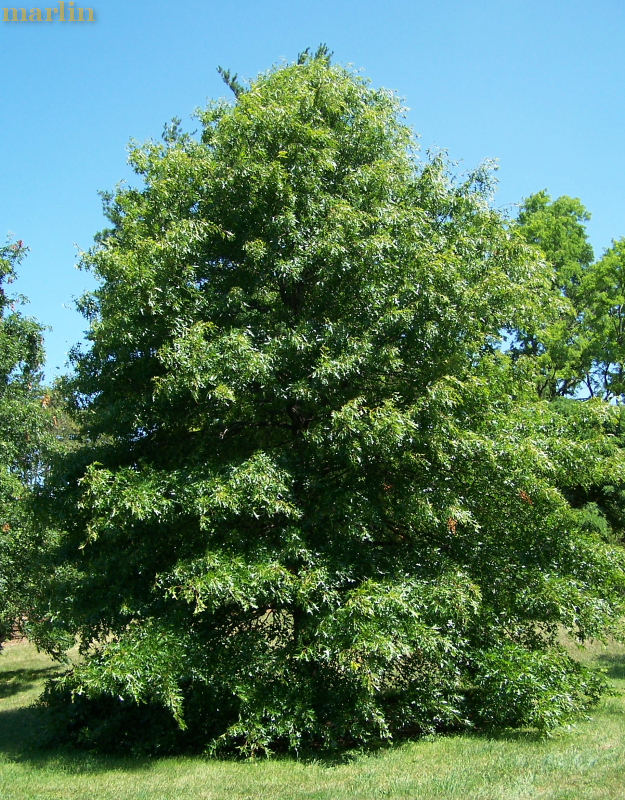
Pin Oak has an unruly, dense branching habit
Pin oak (Quercus palustris), also called swamp oak, water oak, and swamp Spanish oak, is a fast-growing, moderately large tree found on bottom lands or moist uplands, often on poorly drained clay soils. Best development is in the Ohio Valley. The wood is hard and heavy and is used in general construction and for firewood. Pin oak transplants well and is tolerant of the many stresses of the urban environment, so has become a favored tree for streets and landscapes.
Native Range - Pin oak grows from southwestern New England west to extreme southern Ontario, southern Michigan, northern Illinois, and Iowa; south to Missouri, eastern Kansas, and northeastern Oklahoma; then east to central Arkansas, Tennessee, central North Carolina, and Virginia. Pin oak grows primarily on level or nearly level, poorly drained alluvial floodplain and river bottom soils with high clay content (order Entisols). Pin oak is usually found on sites that flood intermittently during the dormant season but do not ordinarily flood during the growing season. It does not grow on the lowest, most poorly drained sites that may be covered with standing water through much of the growing season. It does grow extensively on poorly drained upland "pin oak flats" on the glacial till plains of southwestern Ohio, southern Illinois and Indiana, and northern Missouri (order Alfisols). Because of the level topography and presence of a claypan in the soil, these sites tend to be excessively wet in the winter and spring.

Pin oak is a major species in only one forest cover type, Pin Oak-Sweetgum (Society of American Foresters Type 65), which is found on bottom lands and some upland sites throughout the central portion of the pin oak range (8). Associated species in this type include red maple (Acer rubrum), American elm (Ulmus americana), black tupelo (Nyssa sylvatica), swamp white oak (Quercus bicolor), willow oak (Q. phellos), overcup oak (Q. lyrata), bur oak (Q. macrocarpa), green ash (Fraxinus pennsylvanica), Nuttall oak (Quercus nuttallii), swamp chestnut oak (Q. michauxii), and shellbark (Carya laciniosa) and shagbark (C. ovata) hickories. Pin oak and sweetgum (Liquidambar styraciflua) vary in their relative proportions in this cover type, and large areas of almost pure pin oak occur on the "pin oak flats" of the upland glacial till plains or in the bottom lands of the lower Ohio and central Mississippi River valleys.

Pin oak is an associated species in Silver Maple-American Elm (Type 62) in the bottom lands along the Ohio, Wabash, Mississippi, and Missouri Rivers; a variant of this type, silver maple-American elm-pin oak-sweetgum, is found along major streams in southern Illinois and Indiana. Pin oak also occurs in Black Ash-American Elm-Red Maple (Type 39) in poorly drained bottom lands in northern Ohio and Indiana along with silver maple (Acer saccharinum), swamp white oak, sycamore (Platanus occidentalis), black tupelo, and eastern cottonwood (Populus deltoides).


This pin oak started from acorn 22 years ago


Pin Oak bark showing old pruning wounds


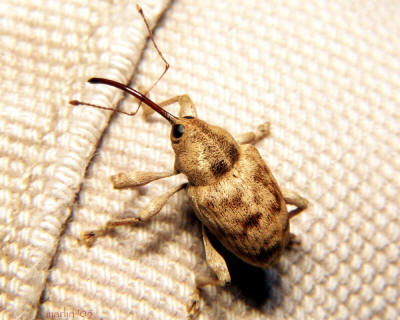
Acorn Weevil, Curculio sp.


Flowering and Fruiting- Pin oak is monoecious; flowers appear at about the time the leaves develop in the spring. Staminate flowers are borne on aments that develop from buds formed in the leaf axils of the previous year, and pistillate flowers are borne on short stalks from the axils of current-year leaves. Pollination is by wind. Fruit is an acorn (nut) that matures at the end of the second growing season after flowering. Acorns are dispersed from September to early December.

Seed Production and Dissemination- Pin oak stands begin producing seed at about age 20, but open-grown trees may begin at ages as young as 15 years. During a 14-year period, production of mature acorns in 32- to 46- year-old pin oak stands in southeastern Missouri averaged 210,300/ha (85,100/acre) but varied yearly from 13,300 to 492,700/ha (5,400 to 99,400/acre). Poor acorn crops occurred at 3- to 4-year intervals. Insect infestation rates varied inversely with crop size and, over all years, averaged 26 percent. Pin oak acorns are dispersed by  squirrels, mice, blue jays, and woodpeckers.

Pin oak acorns submerged in cold water as long as 6 months were not damaged. This tolerance may be partly due to a thick, waxy coating on the pericarp that impedes water absorption. The acorns require stratification of 30 to 45 days at 0° to 5° C (32° to 41° F) to break dormancy, and germination of sound, stratified acorns averages about 68 percent .

Damaging Agents- although pin oak is very tolerant of dormantseason flooding, it is much less tolerant of growing-season flooding and trees may be injured or killed by intermittent growing-season flooding over several successive years. The trees can usually survive one growing season of continuous flooding but will be killed by continuous flooding over 2 or 3 consecutive years (2,4,10,22). Pin oak is rated as "intermediately tolerant" to growing season flooding, along with such species as sugar maple (Acer saccharum), river birch (Betula nigra), southern red oak (Quercus falcata), and Shumard oak (Q. shumardii); it is less tolerant than red maple, silver maple, sweetgum, sycamore, swamp white oak, and American elm (tolerant) and eastern cottonwood, green ash, and black willow (very tolerant) (28,29). Dormant-season flooding for 20 years in a greentree reservoir in southeastern Missouri did not appear to damage pin oak trees, but did reduce stand basal area growth by 10 percent. However, in this same area approximately 5 years later (i.e., after 25 years of flooding), many, of these trees had developed bole swellings at and just above the average flood water level. These swellings caused longitudinal fissures in the bark up to 10 cm (4 in) wide, thereby exposing the bole xylem to decay organisms. The cause of this phenomenon is unknown, but it appears to be associated with the continuous dormant-season flooding, because pin oaks in adjacent areas subject only to intermittent natural flooding were not similarly affected.

The bark of pin oak is relatively thin and the species is therefore especially susceptible to damage by fire and the decay associated with fire wounds (12,22). Pin oak is subject to most of the diseases of oaks including oak wilt (Ceratocystis fagacearum) and is particularly susceptible to a leaf blister fungus (Taphrina caerulescens), a shoot-blight and twig canker fungus (Dothiorella quercina), and pin oak blight (Endothia gyrosa) (12). Pin oak is also host to many of the common oak-feeding insects including many defoliators, wood borers, gall wasps, and acorn weevils. Pin oak is classified as a "most preferred" host for gypsy moth (Lymantria dispar), and is also especially susceptible to the obscure scale (Melanaspis obscura), oak leaftier (Croesia semipurpurana), pin oak sawfly (Caliroa lineata), scarlet oak sawfly (C. quercuscoccineae), the sawfly Calinoa petiolata, the forest tent caterpillar (Malacosoma disstria), a leafroller (Argyrotaenia quercifoliana), the homed oak gall wasp (Callirhytis cornigera), and the gouty oak gall wasp (C. quercuspunctata). Thousands of acres of pin oak stands in southern Illinois have been severely damaged over the past 25 years by outbreaks of the horned oak gall wasp and the forest tent caterpillar.


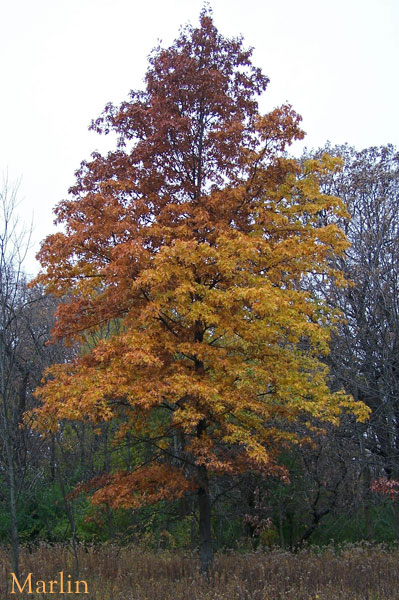
Pin Oak Fall Foliage

Pin oak acorns are an important food for mallards and wood ducks during their fall migration. Pin and other bottom-land oaks are the primary tree species in bottom-land duck-hunting areas (greentree reservoirs) that are artificially flooded during the fall and winter to attract migrating waterfowl. Pin oak acorns are also an important food for deer, squirrels, turkeys, woodpeckers, and blue jays. The wood of pin oak is similar to that of northern red oak, and pin oak lumber is marketed under the general designation of "red oak." The occurrence of numerous small knots in the wood of many pin oak trees limits its use for high quality products, however. Pin oak transplants well, and because of its rapid growth, large symmetrical crown, and scarlet fall colorations, it is commonly planted as a shade or ornamental tree.
--USDA NRCS Silvics Manual, Volume 2 - Hardwoods


       web       www.cirrusimage.com


[Cirrus Home]    [Butterflies]    [Bugs]    [Beetles]    [Mantids]    [Spiders]    [Bees & Wasps]    [Dragon & Damselflies]    [Moths]   [Wildflowers]
[Fungi & Mushrooms]    [Flies]   [Butterflies of the World]  [Trees of North America]  [Cicadas & Grasshoppers]   [Ticks & Mites] 

© Red Planet Inc.