Trident Maple - Acer buergerianum [1]
Eminently well-suited to many different styles of bonsai, its tiny yellow flowers attract many types of pollinators.
Tree Encyclopedia Graphics | Trees Table of Contents | Family Aceraceae

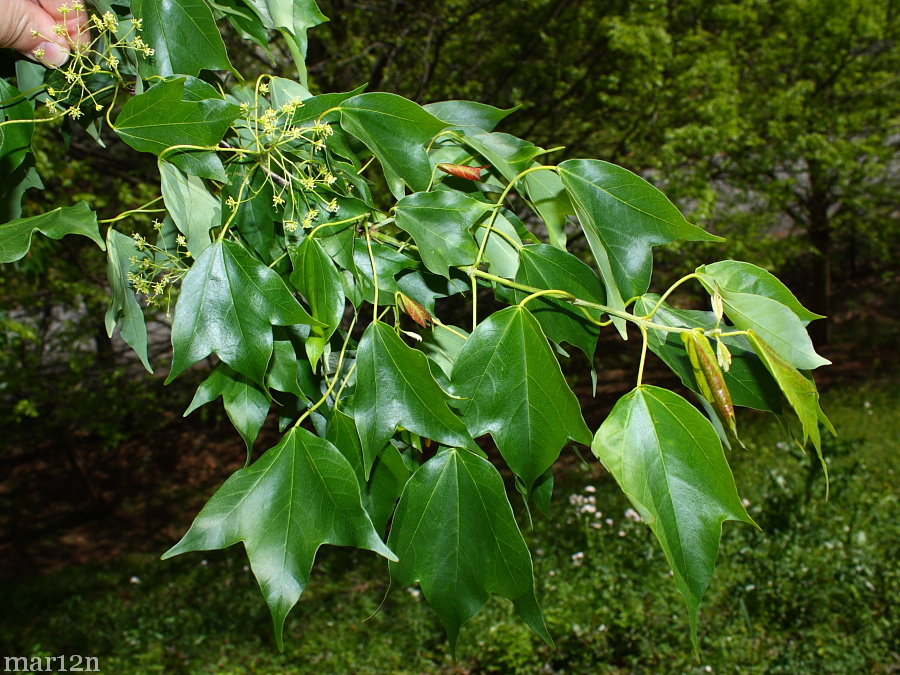
Trident Maple foliage and flowers
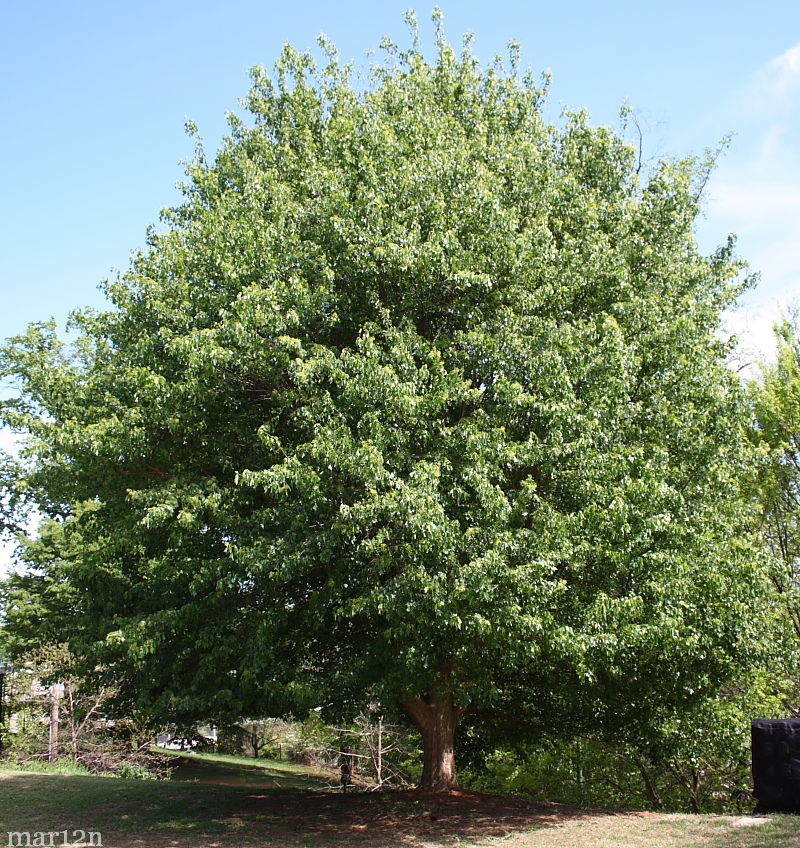
Growing to 60 feet tall and nearly as wide, Trident Maple's rounded crown is valuable as a street tree or specimen tree in residential settings. Trident Maple is a popular choice for the art of bonsai and responds well to techniques that create leaf reduction and ramification, is suitable for many style and sizes of bonsai.
Numerous cultivars include:
Acer buergerianum var. buergerianum. Hubei, Hunan, Jiangsu, Jiangxi, Shandong, Zhejiang.
Acer buergerianum var. jiujiangense Z.X.Yu. Jiangxi.
Acer buergerianum var. horizontale F.P.Metcalf. Southern Zhejiang.
Acer buergerianum var. formosanum (Hayata ex Koidzumi) Sasaki. Taiwan (endemic).
Acer buergerianum var. kaiscianense (Pampanini) W.P.Fang. Gansu, Hubei, Shaanxi.
Acer buergerianum var. yentangense W.P.Fang & M.Y.Fang. Zhejiang. [2]

Trident Maple at Atlanta Botanical Garden
Trident Maple is hardy in USDA zones 5-8
Other interesting maple cultivars include:
‘Armstrong’ - upright growth habit, almost columnar, somewhat prone to splitting branches due to tight crotches, 50 feet tall.
Bowhall’ - upright growth habit, branches form embedded bark, graft incompatibility on grafted trees.
‘Gerling’ - densely branched, broadly pyramidal, about 35 feet tall when mature.
‘October Glory’ - above average fall color, excellent tree, retains leaves late, 60 feet tall.
Red Sunset’ - does well in the south in USDA hardiness zone 8, probably the best cultivar for the deep south, oval, 50 feet tall.
‘Scanlon’ - upright growth habit; ‘Schlesinger’ - good fall color, rapid growth rate; ‘Tilford’ - globe-shaped crown. [2]
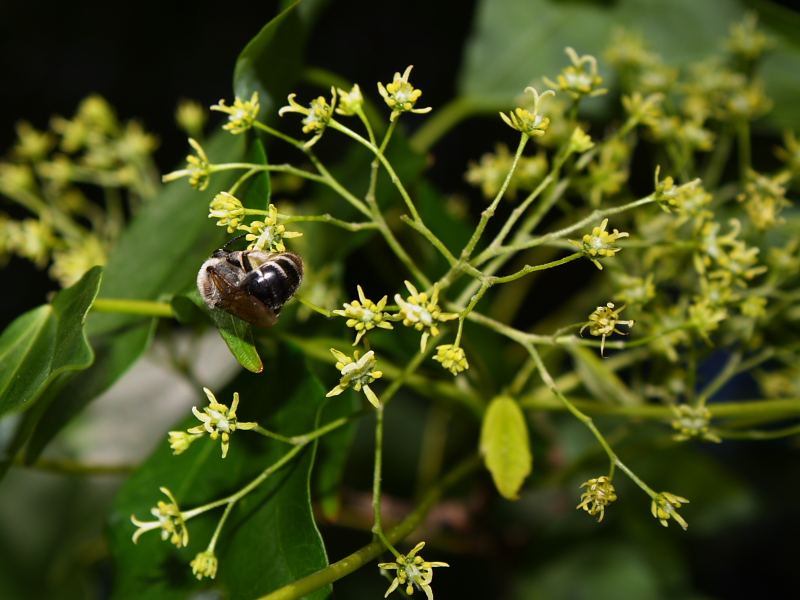
Trident Maple Flowers
Bees LOVE these flowers. This tree was audibly abuzz with many different types (Halictus species shown).
Photographed on April 9th at Atlanta Botanical Garden

Aphids infest maples, usually Norway Maple, and may be extremely numerous. High populations can cause leaf drop. Another sign of heavy aphid infestation is a sticky honeydew residue on lower leaves and objects beneath the tree.

If not sprayed, predatory insects will sometimes bring the aphid population under control. Scales are also an occasional problem on maples. The most common is cottony maple scale. The insect forms a cottony mass on the lower sides of branches. Scales are usually controlled with horticultural oil sprays. Scales may also be controlled with well-timed sprays to kill the crawlers. 

Diseases
Verticillium wilt symptoms are wilting and death of branches. Infected sapwood will be stained a dark or olive green but staining can’t always be found. If staining can not be found do not assume the problem is not verticillium wilt. Severely infected trees probably can’t be saved. Lightly infected trees showing only a few wilted branches may be pulled through. Fertilize and prune lightly infected trees. This treatment will not cure the problem but may allow the tree to outgrow the infection. Girdling roots will cause symptoms which mimic verticillium wilt. Scorch may occur during periods of high temperatures accompanied by wind. Trees with diseased or inadequate root systems will also show scorching. When trees do not get enough water they scorch. Scorch symptoms are light brown or tan dead areas between leaf veins. [3]

Tree Encyclopedia | Trees Index | Maples | Birch | Oak | Rose Family | Insects & Spiders

References

  1. Trident Maple at Atlanta Botanical Garden, photographed by Bruce Marlin

  2. Wikipedia, Acer buergerianum
  3. The Morton Arboretum, "Autumn Blaze® Maple"
Custom Search


© Red Planet Inc.