|

Sugar Maple Leaves
|
Sugar maple, sometimes called hard maple
or rock maple, is one of the largest and
more important of our hardwoods. It grows on
approximately 31 million acres, or 9 percent
of the hardwood forests in midwest and
northeast North America. The greatest
commercial sawtimber volumes are presently
in Michigan, New York, Maine, Wisconsin, and
Pennsylvania. In most regions, both the
sawtimber and growing stock volumes are
increasing, with increased production of saw
logs, pulpwood, and more recently, firewood.
Sugar maple grows only in regions with
relatively with cool, moist climates. They
grow best with ranges in temperature from
-40° F. in the north to 100° F. in the
southwestern areas. Occasional extremes may
be more than 20° F. lower or higher than
these. It is expected the current man-made
rise in global temperature will be
deleterious to the species. Rainfall
requirements are between about 20 inches and
100 inches. It is not known how global
climate change will affect rainfall,
although the vast majority of scientific
data suggest there will be an increase in
short and long-term droughts in areas
previously unafflicted thus. The dramatic
increase in atmospheric carbon dioxide
levels due to man's burning of fossil fuels
may benefit the trees, however.
The fruit of the sugar maple, called a
samara, is a double-winged, papery
seed-bearing fruit, commonly called a
"helicopter" or "whirlybird." The
aerodynamic properties allow the seeds to be
dispersed, in a fresh breeze, more than 100
meters (330 feet) from the parent tree. A
mature sugar maple can produce between 3,000
and 9,000 pounds of seeds. |

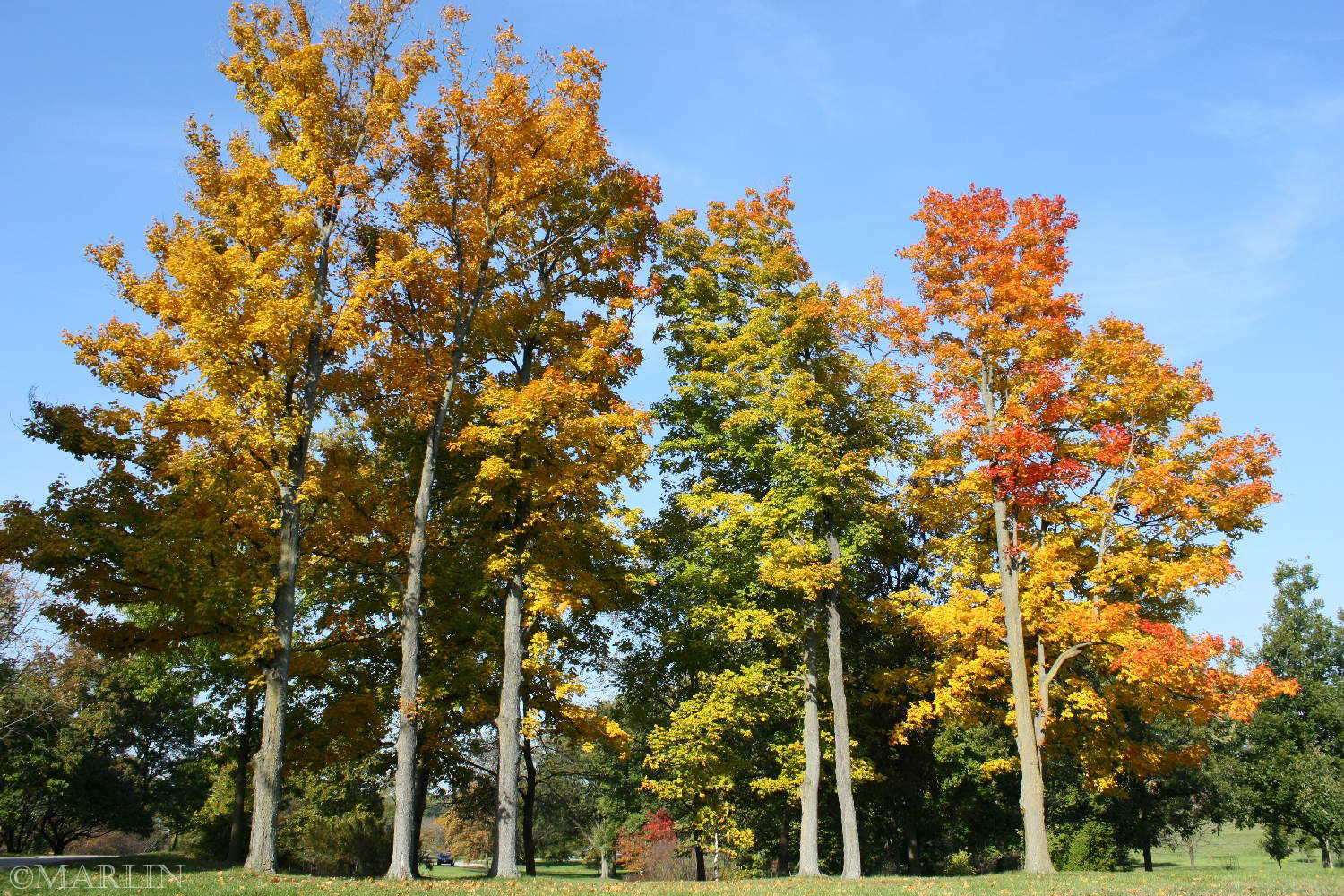
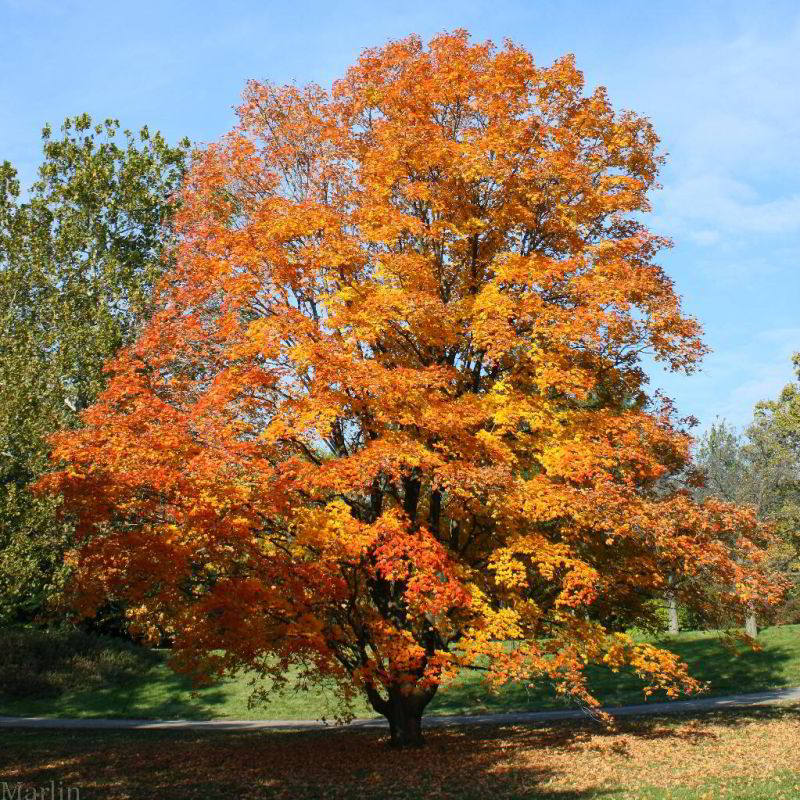
The sugar maple is famous for its
spectacular, unrivalled autumn color change.
Photo:
Chris Glass
|
The sugar maple tree is the principal source
of maple sugar. The trees are tapped early
in the spring for the first flow of sap,
which usually has the highest sugar
content. The sap is collected and boiled or
evaporated to a syrup. Further concentration
by evaporation produces the maple sugar.
Sugar maple sap averages about 2.5 percent
sugar; about 129 liters (34 gal) of sap are
required to make 3.8 liters (1 gal) of syrup
or 3.6 kg (8 lb) of sugar.
Sugar maple is rated as very tolerant of
shade, exceeded among hardwoods only by a
few smaller, shorter lived species. In large
trees, only American
beech (Fagus
grandifolia)
equals it in tolerance under
forest conditions. Except for bud losses,
sugar maple is not highly susceptible to
insect injury and serious outbreaks are not
common. The most common insects to attack
sugar maple are defoliators and these
include the gypsy moth (Lymantria dispar),
forest tent caterpillar (Malacosoma
disstria), linden looper (Erannis tiliaria),
fall cankerworm (Alsophila pometaria),
spring cankerworm (Paleacrita vernata),
green-striped mapleworm (Anisota rubicunda),
Bruce span-worm (Operophtera bruceata),
maple leaf-cutter (Paraclemensia
acerifoliella), maple trumpet skeletonizer
(Epinotia aceriella), and saddled prominent
(Heterocampa guttivitta).
Borers that attack sugar maple include the
carpenterworm (Prionoxystus robiniae), sugar
maple borer (Glycobius speciosus), maple
callus borer, Synanthedon acerni, and
occasionally horntails (Xiphydria
abdominalis and X. maculata). Sucking
insects that affect sugar maple include the
woolly alder aphid (Prociphilus tesselatus)
and other aphid species (Neoprociphilus
aceris and Periphyllus lyropictus) which
injure leaves and reduce growth. Of the
scale insects, the maple phenacoccus
(Phenacoccus acericola), is the most
important to sugar maple. The maple leaf
scale (Pulvinaria acericola) and the gloomy
scale (Melanaspis tenebricosa) also
frequently attack sugar maple.
Sugar maple can be severely damaged from
deicing road salt. In an industrial area the
number of overstory sugar maples was
markedly reduced from exposure to sulfur
oxides, nitrogen oxides, chlorides, and
fluorides. Numerous animals feed on or
injure sugar maple without serious effect
except in local and limited situations. Deer
browsing is probably the most common
wildlife factor. Red, grey, and flying
squirrels sometimes gnaw or feed on the
seed, buds, foliage, and twigs of sugar
maple. In rare instances, they have girdled
and killed larger branches and tree tops.
Porcupines may feed on the bark and kill the
top by girdling the upper stem. |

Sugar Maple Bark
|