Green Star Magnolia – Magnolia stellata ‘Green Star’

Star magnolia is one of the hardiest of the genus. It can be trained as a tree growing to 20 feet (as pictured here), or multi-trunked bush with a 15-foot spread. Typically branching close to the ground, the multi-stemmed form develops with a dense head of foliage. Star magnolia makes a wonderful patio, lawn specimen or accent tree. Lower foliage can be removed to show off the trunk and to create more of a tree form. Otherwise, the persistent lower branches and oval to round form lend a large bush look to the plant. The white flowers have a slight touch of pink, and are produced in spring before the leaves appear, even on young plants. Flowers are usually not as sensitive to cold as saucer magnolia, but they can still be injured if cold weather arrives during flowering [6].
 Green Star Magnolia, Morton Arboretum acc. 573-65*3, from graft, is 45 years old
Star magnolia is intolerant of root competition or dryness, and plants grow slowly, perhaps one foot per year. Plant in the full sun in a rich, porous and slightly acid soil. It is hard to transplant successfully and in the north should be moved balled and burlapped when actively growing. In USDA hardiness zones 7 and 8, transplant in late winter while the plants are still dormant, or after the growth flush in the spring or plant from containers at any time [6].

Taxonomic relations in the family Magnoliaceae have been puzzling botanists for a long time. Because the family is quite old and has survived many geological events such as ice ages, mountain formation and continental drift, the family’s distribution is scattered nearly worldwide. Some species have been isolated for a long time, while others were in close contact and able to exchange gentic material until later in their lineage. To create divisions in the family solely based on morphological characteristics has proven to be an impossible task.
 |
The genus Magnolia contains about 200 species of flowering trees and shrubs, with innumerable cultivars and varieties being developed all the time. Magnolia is an ancient plant lineage, first appearing in the fossil record about 20 million years ago, while evidence of plants in the family goes back to 90 mya [5].Having evolved before pollinators in Hymenoptera (bees, wasps & ants) appeared, the progenitors of our modern ornamental magnolias relied on beetles for their sexual gratification. Their large, showy flowers are a direct result of the plant’s strengthening its delicate flower parts against the beetle’s comparitively “rough handling” while feeding on pollen.
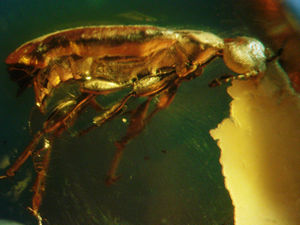
Left: Primitive beetle ancestor inside 50 million year old Baltic amber [4]. |
The earliest flowering plants date back about 130 million years. According to Cronquist Evolution and Classification of Flowering Plants, the most primitive of all living angiosperms belong to the subclass Magnoliidae. This subclass contains several primitive plant families, including the water-lily family (Nymphaeaceae), buttercup family (Ranunculaceae) and Magnoliaceae. Plants in the magnolia family have the following characteristics:
- Large flowers with numerous tepals
- Numerous spirally arranged stamens at the base of a conelike receptacle bearing numerous spirally arranged carpels. At maturity the carpels develop into a woody, conelike aggregate of seed-bearing follicles. Each seed has a fleshy red outer layer (aril) and hangs from its follicle by a threadlike stalk. Other primitive floral characteristics are radial symmetry or actinomorphic (floral parts similar in size & shape), perfect (with functional androecium and gynoecium), complete (with all 4 floral parts: calyx, corolla, androecium & gynoecium), and floral axis (receptacle) elongated. The latter characteristic is clearly visible in the magnolia blossom. With all the woody, spirally arranged carpels (follicles), this axis truly resembles a conelike structure [2].
References
- Colin Tudge, The Tree: A Natural History of What Trees Are, How They Live, and Why They Matter
- National Audubon Society, Field Guide to North American Trees
- Green Star Magnolia, Morton Arboretum acc. 573-65*3 photos by Bruce Marlin
- Anders L. Damgaard, File:Baltic amber Coleoptera Scraptiidae.JPG under Creative Commons 3.0 unported
- Wikipedia contributors, “Magnolia” retrieved April 19, 2012
- Edward F. Gilman, Institute of Food and Agricultural Sciences, University of FLA, FPS-360 “Green Star Magnolia” (Reviewed 2011.) Retrieved April 19, 2012. Excerpts used with permission.
Tree Encyclopedia / North American Insects & Spiders is dedicated to providing scientific and educational resources for our users through use of large images and macro photographs of flora and fauna.