Holland Elm – Ulmus x hollandica ‘Greuneveld’
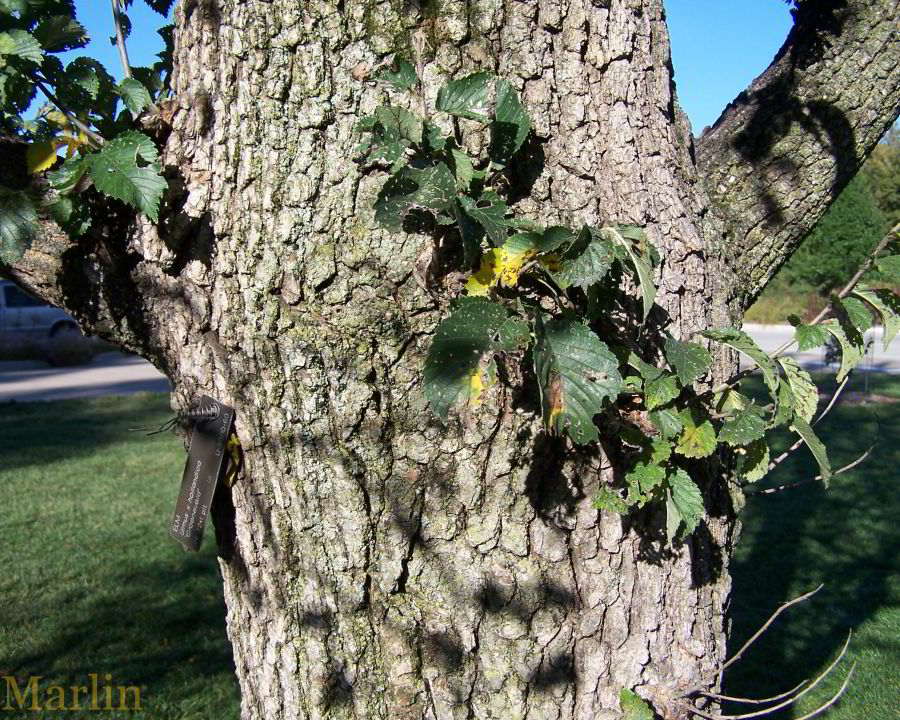
Holland elm is indigenous to low-lying areas of the Netherlands
Holland elm is a native of Europe and is planted for shade and ornamental purposes. The tree has a broad crown with upright branches. One cultivar, the ‘Camperdown’ elm, is commonly planted for its weeping habit and is often budded on a Siberian elm understock. European elms are sensitive to Dutch elm disease and elm yellows, as are the American elms.
Terminal buds are absent. Buds are imbricate and 1/4 inch (6 mm) long. Branches are reddish-brown in color and hairy when young. Bark on the main stem and branches is prominently smooth and without scales or corky ridges.
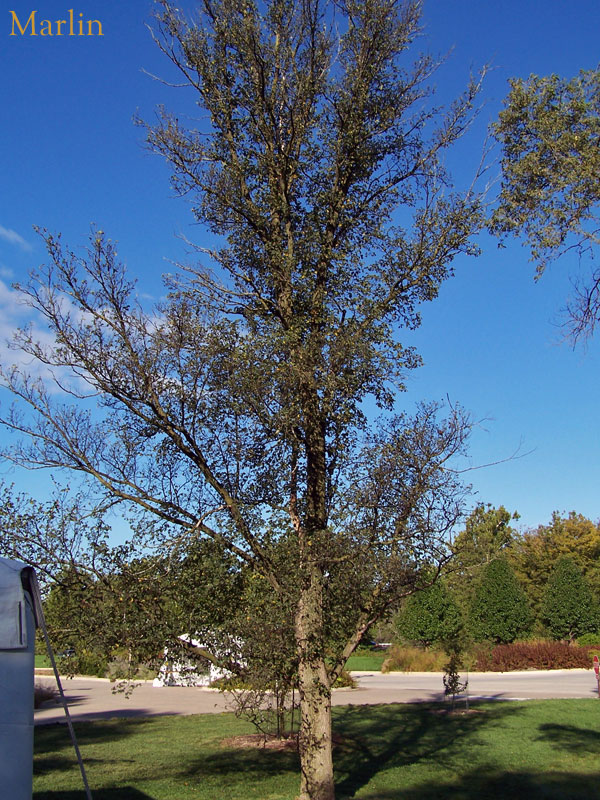
Morton Arboretum accession 76-72*1
“Trees , to 40 m; trunks often multiple; crowns spreading, broadly rounded or ovate. Bark gray, smooth, furrowed with age. Wood hard. Branches spreading to pendulous, glabrous, branchlets lacking corky wings; twigs ash-gray to red-brown, villous when young. Buds obtuse; scales reddish brown, glabrous to marginally white-ciliate. Leaves: petiole 2-7 mm, densely villous.
Inflorescences dense fascicles, 8-20-flowered, less than 2.5 cm, flowers and fruits not pendulous; pedicel short, 0.4-0.8 mm, densely pubescent. Flowers: calyx lobed to ca. 1/2 length, lobes 4-8, reddish pubescent; stamens 5-6, purplish; stigmas reddish, with white pubescence. Samaras light greenish brown, elliptic to obovate with blunt or rounded tip, 1.5-2.5 — 1-1.8 mm, broadly winged, pubescent only along central vein of wing, apical cleft minute, obscured by persistent, curved styles. Seeds thickened, not inflated. 2 n = 28. [4]
References
- Ulmus x hollandica ‘Greuneveld’ photographed by Bruce Marlin
- The Morton Arboretum, Arboretum Records Honor, Milestone; Looks to Future
- Ohio State University, Ohio Trees, Bulletin 700-00 “Ulmus – Elm” Key to Ulmus Species
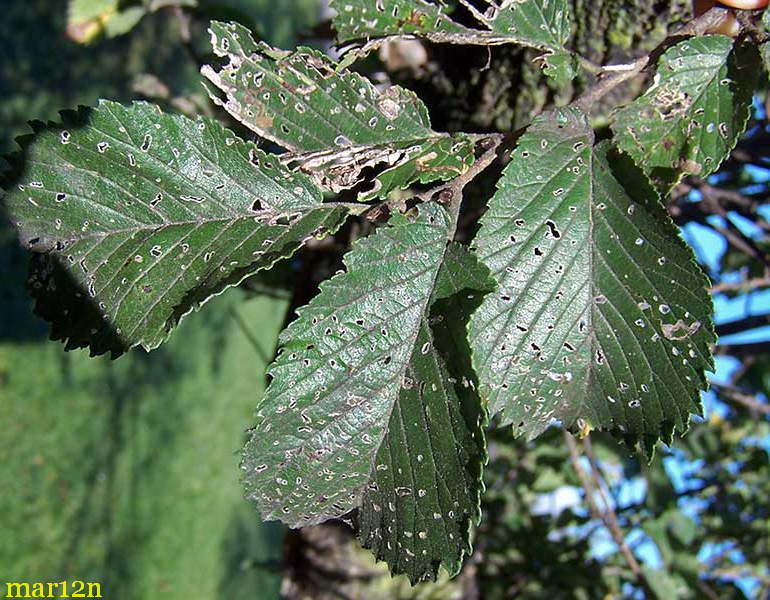
This elm does not appear to be doing well
Family Ulmaceae – Zelkovas, Hackberries and Elms
There are about 200 species of trees and shrubs in Ulmaceae. Elms fell victim to Dutch Elm disease during the 1950s; until that time, they were the premier shade tree along the streets of our American towns and cities. The Morton Arboretum in past years has bred and marketed five new elm varieties resistant to Dutch elm disease. Insects & Spiders Home | Elm Index | Tree Encyclopedia | Trees Index