|
|  Downy Birch - Betula pubescens |
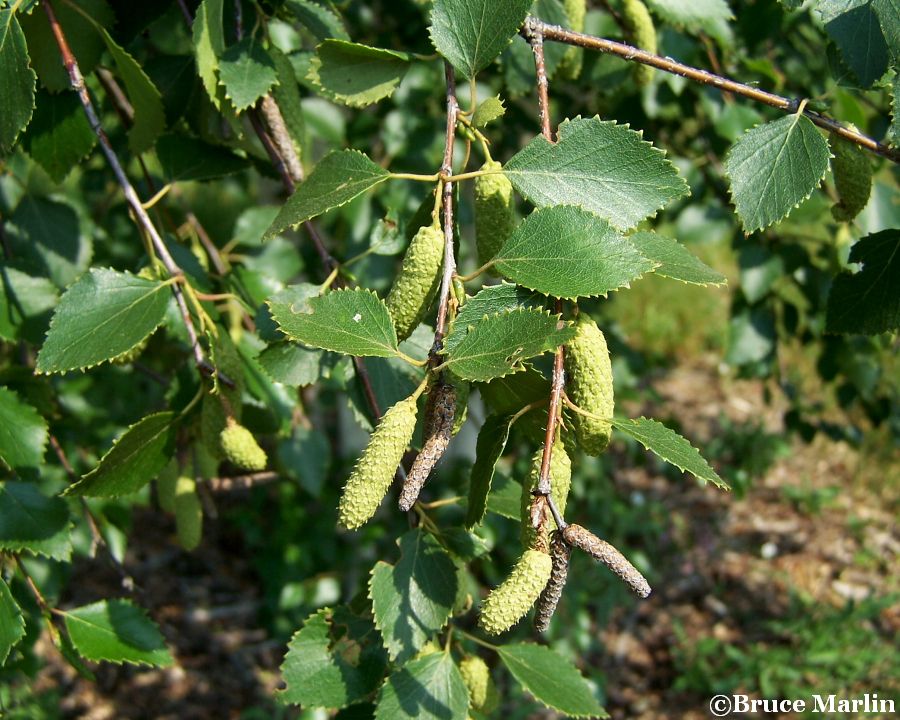
Downy Birch is a deciduous tree growing to 20 m, with a slender crown and a trunk up to 1 m diameter. Bark is smooth, dull grey, and finely marked with dark horizontal lenticels. The shoots are grey-brown and pubescent (downy). The leaves are ovate-acute, 2-5 cm long and 1.5-4.5 cm broad, with a finely serrated margin. The flowers are wind pollinated catkins, produced in early spring before the leaves. Fruit is a pendulous cylindrical aggregate 1-4 cm long and 5-7 mm diameter, which disintegrates at maturity releasing the individual seeds; these are 2 mm long with two small wings along the side.
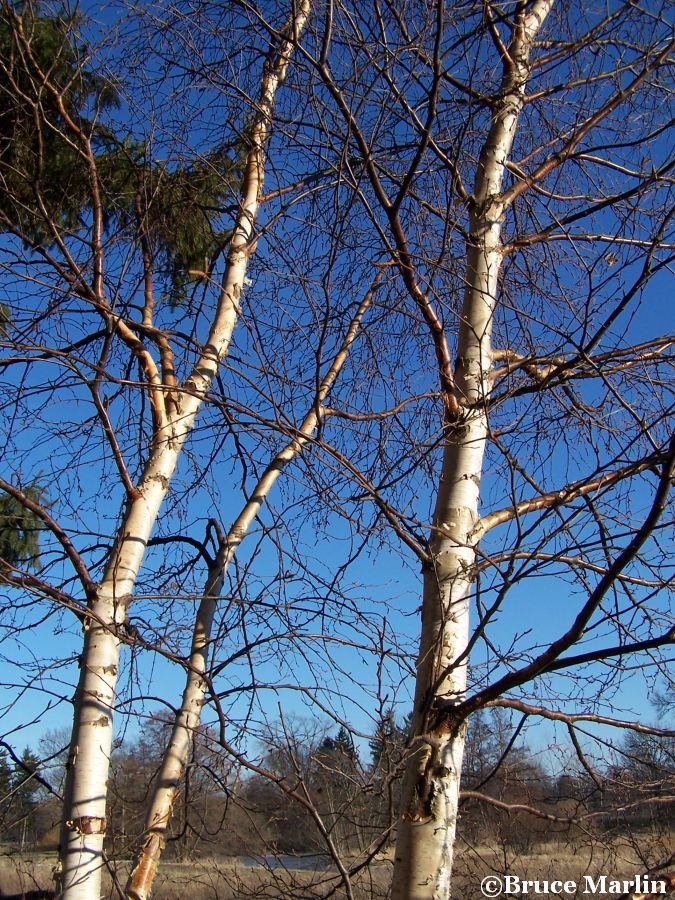
Closely related and often confused with the Silver Birch (B. pendula). Many North American texts treat the two species as conspecific (and cause confusion by combining the Downy Birch's alternative vernacular name 'White Birch', with the scientific name B. pendula of the other species), but they are regarded as distinct species throughout Europe.
Downy Birch can be distinguished from Silver Birch in having smooth, downy shoots, which are hairless and warty in Silver Birch. The leaf margins also differ, finely serrated in Downy Birch, coarsely double-toothed in Silver Birch. They are also distinguished cytologically, Silver Birch being diploid (with two sets of chromosomes), whereas Downy Birch is tetraploid (four sets of chromosomes). The two have differences in habitat requirements, with Downy Birch more common on wet, poorly drained sites such as clays and peat bogs, and Silver Birch found mainly on dry, sandy soils.
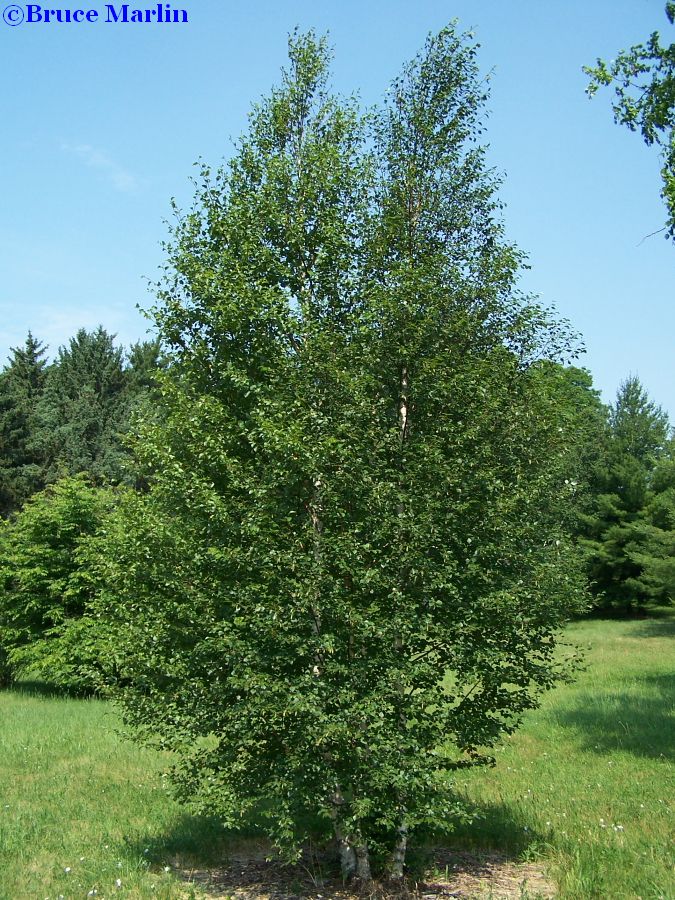
Downy Birch extends farther north into the Arctic than any other broadleaf tree. Specimens of the subarctic populations are usually small and very contorted, and are often distinguished as Arctic Downy Birch, Betula pubescens subsp. tortuosa. This subspecies is notable as being the only tree native to Iceland and to Greenland, where large specimens can reach 5-6 m tall. [2] |
 [Trees Index] [Trees Main Page Graphics]
Birch grows in climates ranging from boreal to humid and tolerates wide variations in precipitation. Its northern limit of growth is arctic Canada and Alaska, in boreal spruce woodlands, in mountain and sub alpine forests of the western United States, the Great Plains, and in coniferous - deciduous forests of the Northeast and Great Lakes states.
Unlike other kinds of birch tree, the fruits of the River Birch mature in the spring following flowering. The trunk of this tree often is short, branching into several large limbs that grow upward. The bark of younger trees is pinkish to reddish brown. When older it is shaggy and silver-gray to black. The River Birch favors moist soils and typically is found growing on stream banks and in swampy lowlands. In her book on The Woody Plants of Ohio, Lucy Braun calls this a "semi-aquatic species" since it can survive flooding for several weeks at a time. This tree grows throughout most of the eastern United States and westward to eastern Oklahoma and eastern Texas. It is more common in the South, where it is the only birch tree that is found at low altitudes. although not of great commercial importance, manufacturers sometimes use it for furniture and woodenware. It also is planted for its ornamental value and is very effective in preventing stream bank erosion |
| Animals dependant on Birch- Moose: Important browse throughout most of range. Nutritional quality is poor in winter, but is important to wintering moose because of its sheer abundance in young stands.
- White-tailed Deer: though considered a "secondary-choice food", it is an important dietary component. In Minnesota, white-tailed deer eat considerable amounts of birch leaves in the fall.
- Snowshoe hare browse birch seedlings and saplings.
- Porcupines feed on the inner bark
- Beaver also eat it though generally prefer aspen, while willow and paper birch are second choice foods.
- Voles and shrews eat the seeds.
- Numerous birds and small mammals eat paper birch buds, catkins and seeds.
- Young paper birch stands provide prime deer and moose cover.
Birds: - Numerous cavity-nesting birds nest in birch, including woodpeckers, chickadees, nuthatches, and swallows.
- A favorite feeding tree of yellow-bellied sapsuckers, which peck holes in the bark to feed on the sap. Hummingbirds and red squirrels also feed at sap wells in paper birch created by sapsuckers.
- Ruffed grouse eat the catkins and buds.
- Redpolls, siskins, and chickadees obtain a considerable portion of their annual diet from birch seeds
|
|
|
|
|  Downy Birch
|
Separate male and female flowers are borne on the same tree; the male in the form of a catkin, and the female in cone-like clusters that fall from the tree and are blown for long distances by the wind. In the fall, the foliage turns pale yellow.
The graceful elegance of the birch allows it to be used as a specimen or for naturalizing, and is best used in large areas. It transplants easily and is most effective when planted in groupings. A multi-trunk specimen is more handsome than single-trunk trees. It should not be planted in high-use areas such as driveways, walks and patios, as dead branches tend to be messy. Periodic pruning is required to remove these branches; this can be done at any time of year. although the river birch thrives in wet areas, it does not require excessive amounts of water. It tolerates fairly dry soils once it is established. It requires acidic soils, suffering from iron deficiency if pH levels are 6.5 or higher. This species requires full sun and tolerates high temperatures. |

|