Cucumbertree – Magnolia acuminata

AKA cucumber magnolia, yellow cucumbertree, yellow-flower magnolia, or mountain magnolia, is the most widespread and hardiest of the eight native magnolia species in the United States, and the only magnolia native to Canada. The soft, durable, straight-grained wood is similar to yellow-poplar (Liriodendron tulipifera). They are often marketed together and used for pallets, crates, furniture, plywood, and special products.
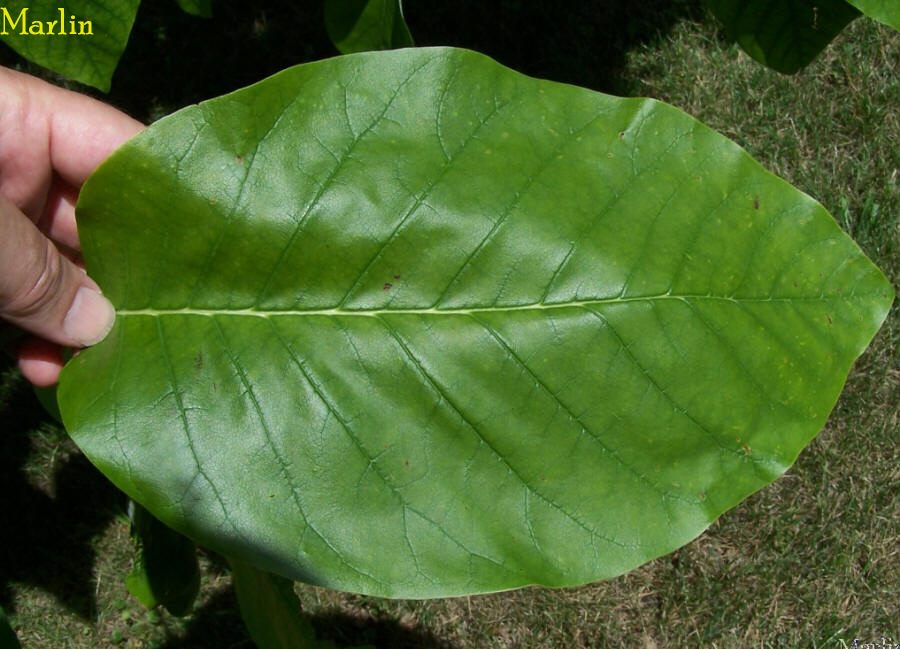
Leaves are huge, 6-10 inches long
Cucumbertree is widely distributed but never abundant. It grows on cool moist sites mostly in the mountains from western New York and southern Ontario southwest to Ohio, southern Indiana and Illinois, southern Missouri south to southeastern Oklahoma and Louisiana; east to northwest Florida and central Georgia; and north in the mountains to Pennsylvania.
Cucumbertree flowers from early April through early July depending on location. Self-pollination usually does not occur because the flowers do not produce ripe pollen until the female stigma is no longer receptive. Magnolia flowers are perfect and are borne singly at the ends of the branches. They appear after the leaves start developing. The flowers close at night and do not last longer than 2 to 4 days.
Pollination is largely by insects. The fruit, a green cucumber-shaped cone, ripens in late August or September. The thickened, rounded, red knobby follicles open exposing reddish-orange seeds that hang on slender threads before falling to the ground. The outer seed coat is fleshy, oily, and soft; the inner seed coat is hard, thin, and membranous enclosing a large and fleshy endosperm.
Weather adversely influences the sensitive flower receptivity and available pollen. Also, cucumbertrees have a shorter period of receptivity and pollen shedding than other native magnolias.
Cucumbertree is a valuable forest and shade tree, highly desirable for ornamental planting because of the showy flowers, fruits, and attractive foliage and bark. This species has been planted successfully well north of its native range; it grows well in slightly acid, well-drained soil.
Cucumbertree is used for wood products and resembles yellow-poplar except that the wood is heavier, harder, and stronger. This species is commonly used for lumber in the Appalachian Mountains, especially in West Virginia and adjoining States. The wood is usually sold as yellow-poplar; it has not been sold as cucumbertree lumber since 1928. The wood is used in furniture, fixtures, Venetian blinds, siding, interior trim, sashes, doors, boxes, and crates.
Cucumbertree can reach a height of about 30 m (100 ft) and a d.b.h. of 91 to 122 cm (36 to 48 in). Typically, this tree is 18 to 24 m (60 to 80 ft) tall and 60 cm (24 in) in d.b.h. Cucumbertree grows fast in moist, deep soils of coves and lower slopes. This species matures in 100 years and seldom lives more than 150 years (8). Generally, the species is rapid growing and short lived. There are no available published data on the growth rate and yield of individual trees. The root system for cucumbertree is deep and widespread, and trees rarely develop a taproot. Cucumbertree is susceptible to windthrow, especially on steep slopes.
Magnoliaceae – Magnolia Family
The earliest flowering plants date back about 130 million years. According to Cronquist Evolution and Classification of Flowering Plants, the most primitive of all living angiosperms belong to the subclass Magnoliidae.
Tree Encyclopedia | Tree Index | Magnolias Index