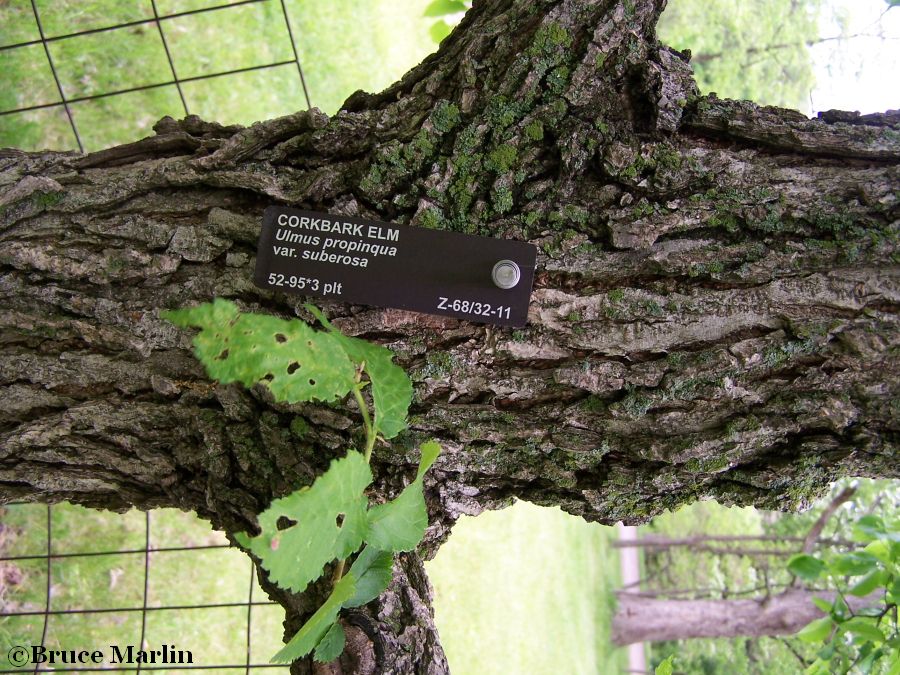
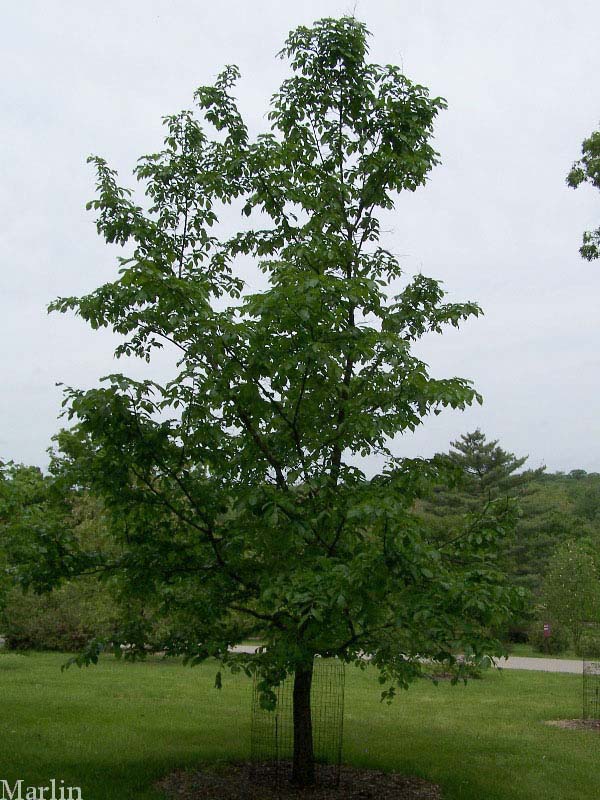
Cork Bark Elm - Ulmus propinqua var. suberosa
Morton Arboretum Accession 52-95*3, collected from the Nei Mongol Zizhiqu Autonomous Region, China. [1]
Family: Ulmaceae. Synonym of Ulmus davidiana Planch. var. japonica (Sarg. ex Rehder) Nakai [3]
[Family Ulmaceae Main Page Graphics]   [Tree Encyclopedia Main Page Graphics[Trees Table of Contents]
 

Corkbark Elm Tree
Corkbark Elm at The Morton Arboretum is 13 years old.

The Morton Arboretum, at Lisle, Illinois, is home to the largest Elm collection in North America. The collection includes almost all of the 22 Elm species native to China, a dozen of which show resistance to Dutch elm disease and elm yellows. The Arboretum in past years has bred and marketed five new elm varieties resistant to Dutch elm disease.
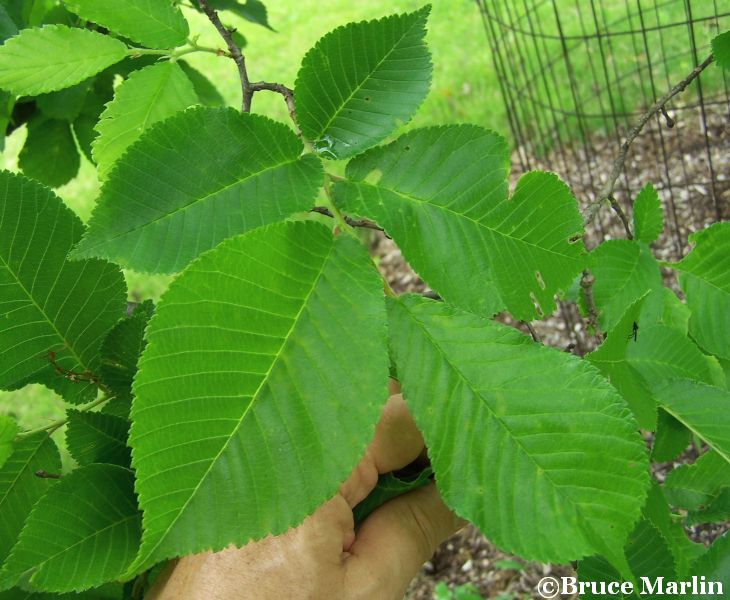
The 12 species are: the Bergmann (Ulmus bergmanniana), Taihang Mountain (U. taihangshanensis), Tibetan (U. microcarpa), Anhui (U. gaussenii), Hebei (U. lamellosa), Harbin (U. harbinensis), corkbark (U. propinqua var. suberosa) shown here, plum-leaved (U. prunifolia), Chenmou (Ulmus chenmoui), Gansu (Ulmus glaucescens var. lasiocarpa), chestnut-leaved (U. castaneifolia) and Father David (U. davidiana var. mandshurica) elms.

These 12 Chinese trees are virtually unknown in the U.S., but are under close study at the arboretum. Dendrologist Emeritus and former research director Dr. George Ware, and Arboretum Assistant Director of Collections Kunso Kim are responsible for their observation and data collection. Their efforts may help ameliorate the effects of numerous maladies affecting trees around the world, such as Emerald Ash Borer, Oak wilt, Asian Longhorned Beetle, and others.

"These and other problems underscore the urgent need for the Arboretum and others to continue seeking new species for urban use," Kim says. The average lifespan of an urban tree is fewer than 10 years, according to Ware. But planting hardier trees increases the likelihood of a longer life span and a greener world - a goal that has never been more important than now, with climate change upon us.[2]

Corkbark Elm Foliage

DUTCH ELM DISEASE
"This disease is not of Dutch origin, but because early work on the disease was done by Dutch pathologists in the 1920s, the disease has been called Dutch elm disease (DED). In all probability the disease is of Asiatic origin.

DED is caused by a fungus called Ophiostoma ulmi (formerly Ceratocystis ulmi) that was introduced to the U.S. in the early 1930s. The American elm, Ulmus americana, is extremely susceptible and the disease has killed hundreds of thousands of elms across the U.S. All native elms are susceptible, as are European elms, but the Asiatic elms, U. parvifolia (Lace bark elm) and U. pumila (Siberian elm) are highly resistant to the disease. The disease is still a threat today, but fortunately, several resistant American elm and hybrid elm selections are available or being developed. Consult a reputable nursery or contact the Elm Research Institute for information on the availability of DED-resistant elms. Address: Elm Research Institute, Harrisville, NH 03450. Fax: 603-827-3794.

DIAGNOSIS
The disease is most easily detected during early summer when the leaves on an upper branch curl and turn gray-green or yellow and finally brown. This condition is known as "flagging," but a flag alone is not absolute assurance that the tree has DED. Brown streaks in the wood beneath the bark of affected branches is further evidence, but only laboratory isolation and identification can confirm positively that the tree has DED.

Samples should be sent to a diagnostic laboratory as soon as DED is suspected. Secure branch samples at least 1/2 inch in diameter and at least 8 inches long from a branch that shows active wilting (but is not completely dead). Wrap the sample in plastic wrap or place in a plastic bag to prevent the sample from drying out (do not add water or damp paper towels to provide moisture). The University of Illinois Plant Clinic will confirm DED for a nominal charge. The clinic is open from the first of May through mid-September.
Address: Plant Clinic, University of Illinois,
1401 West St. Mary’s Road, Urbana, IL 61801.
Phone: 217-333-0519.


CONTROL
Both the beetles and the fungus need to be considered for control of DED. Control is possible through prevention, early detection of the disease, and replanting with resistant elms. Valuable trees should be inspected frequently, e.g. weekly, from early May through July, and monthly through September. An infected tree may be saved by pruning out the diseased branch promptly after seeing the first "flag." A final pruning cut 7-10 feet below the lowest evidence of discolored (streaked) wood is necessary, but the saw blade should be wiped (sterilized) with 10% bleach (1 part bleach: 9 parts water) or denatured alcohol before the final cut is made. Injecting trees with systemic fungicides (see below) may be done at this time.

If a tree shows many flags or completely wilts and dies, it must be removed quickly so that beetles and root grafts do not transmit the disease further. Root grafts should be severed before removal of a diseased tree whenever possible.

Sanitation
The bark beetles breed in standing dead or dying elm trees and piles of elm wood with the bark attached. Therefore, trees that completely wilt and die are suitable for beetle reproduction and should be felled. Destroy the infected wood and bark by chipping and composting (chips must attain temperatures of at least 120 degrees F), or at a minimum, remove the bark from cut logs and let the logs dry out. Cut logs from diseased trees should not be kept for firewood unless all of the bark has been removed and there is no evidence of bark beetles. Transporting diseased elm firewood may spread DED to otherwise disease- free areas. Covering and sealing cut logs and chips in clear plastic during the summer will allow the sun to heat up the wood and is another way to kill the beetles and fungus. Prolonged sunny weather and high temperatures are necessary, however, for this method of sanitation, called "solarization," to be effective.

Chemical Protection and Therapy
At present, treatments of affected trees with thiabendazole or propiconazole-containing fungicide such as Arbortect and Alamo show promise and should only be applied by licensed, certified arborists. If properly applied, American elms may be protected for 3 years. Be aware that Arbortect is not recommended for red elm (U. rubra), and repeated injections with a systemic fungicide may damage the bark and water-conducting tissues." [4]

Corkbark Elm Bark
Ulmus propinqua var. suberosa is under study for resistance to Dutch elm disease and elm yellows.

References
  1. Wikipedia, The Free Encyclopedia, Ulmus davidiana var. japonica
  2. The Morton Arboretum, Arboretum Records Honor, Milestone; Looks to Future, http://www.mortonarb.org/res/GEORGEWARE.pdf.
  3. USDA, ARS, National Genetic Resources Program. Germplasm Resources Information Network, National Germplasm Resources Laboratory, Beltsville, Maryland.
    URL: http://www.ars-grin.gov/cgi-bin/npgs/html/taxon.pl?418808 (29 November 2008)
  4. The Morton Arboretum, Dutch Elm Disease, http://www.mortonarb.org/res/CLINIC_dis_dutchElm.pdf


       web      www.cirrusimage.com
[Cirrus Home]  [Family Ulmaceae Main Page Graphics]   [Tree Encyclopedia Main Page Graphics[Trees Table of Contents]


© Red Planet Inc.