Amur Cherry – Prunus maackii
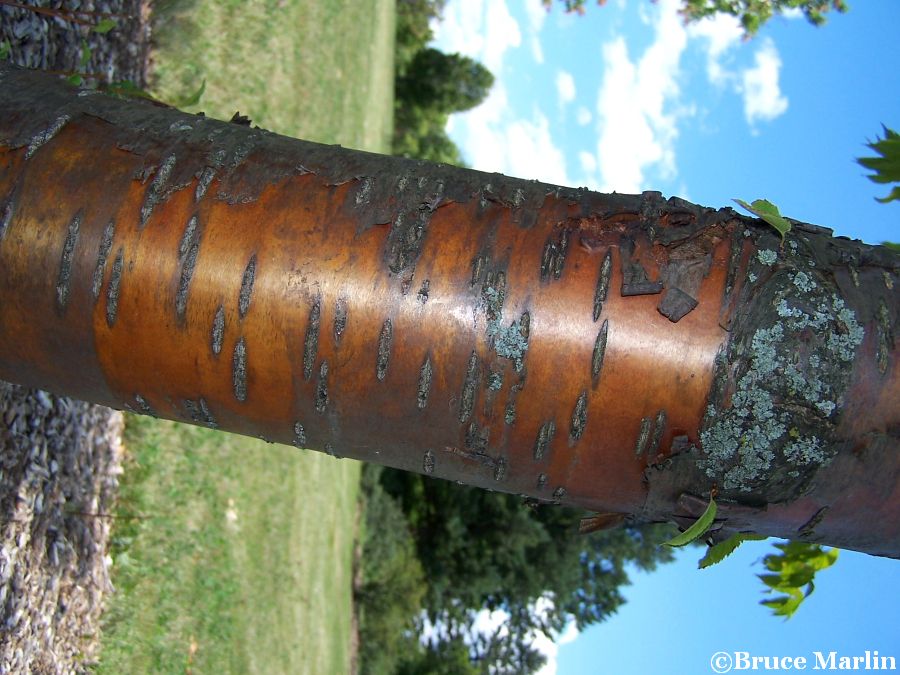
Also called Amur chokecherry or Manchurian Cherry, this tree’s bark is a striking copper color.
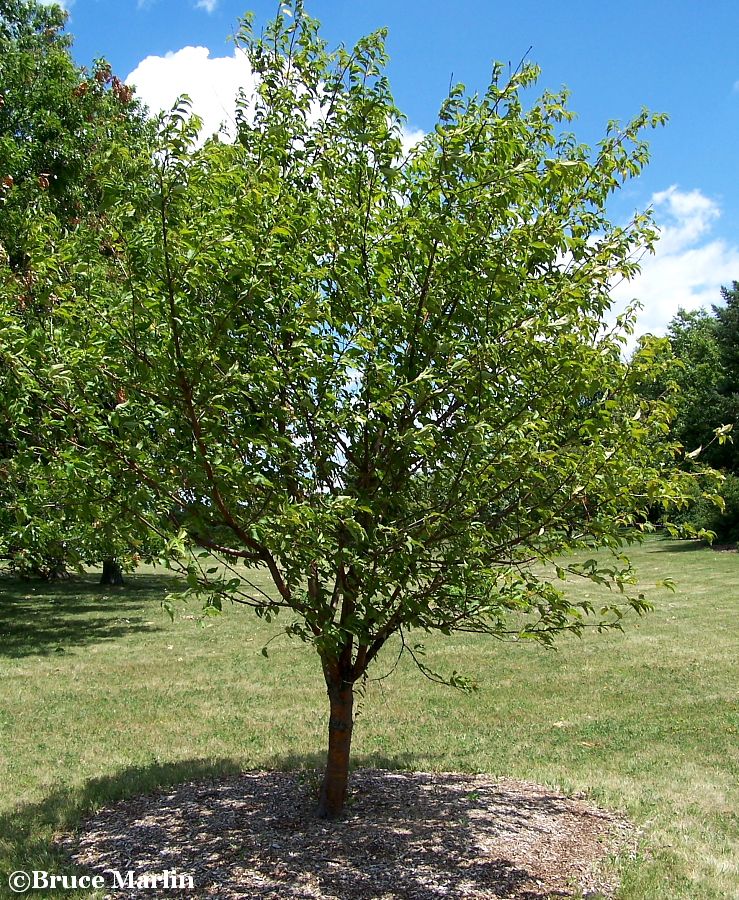
Can grow to 30 to 40 feet / Spread: 25 to 35 feet / Growth rate: medium
Amur Chokecherry is pyramidal when young but ultimately forms a 30 to 40-foot-tall tree with a dense, rounded canopy which provides light shade below. The deciduous leaves are three inches long and are joined in early to mid-May by an explosion of white, fragrant flowers in two to three-inch-long racemes. The multitude of tiny black fruits which follow ripen in August and are quite attractive to birds. The bark is occasionally handsome cinnamon brown peeling off in shaggy masses on the trunk, but more often is an attractive brown with minimum exfoliation. In my humble opinion, this tree has some of the most beautiful bark on any tree in North America.
Trunk/bark/branches: routinely grown with multiple trunks; grows mostly upright and will not droop; tree wants to grow with several trunks but can be trained to grow with a single trunk; very showy trunk; no thorns. Needs little pruning to develop a strong structure.
Amur Chokecherry should be grown in full sun on well-drained soil, and performs well only in the north. The trees should be located where the roots can remain moist, but not wet, as drought tolerance is not characteristic. Propagation is by softwood cuttings from June to July, or by seed.
Leaf blade length: 2 to 4 inches / Fall color: yellow / Flower color: white; pleasant fragrance; showy; spring floweringFruit shape: round
Fruit length: < .5 inch
Fruit covering: fleshy
Fruit color: black
Fruit characteristics: attracts birds; not showy; fruit, twigs, or foliage cause litter problems [1].
Family Rosaceae – Rose Family; Fruit Trees
Containing Hawthorns, Apples, Pears, Cherries, Plums, Peach, Almond, Mountain-Ash and Whitebeam. Rosaceae is a large family of plants with about 3,000 species in ~100 genera. Crabapple and other fruit trees provide some of our most outstanding flowering ornamentals. Tree Encyclopedia | Tree Index | Rosaceae Index
References:
1. USDA NRCS Plants Profile Amur Chokecherry
2. USDA Forest Service Fact Sheet ST-510 October 1994
3. USDA, ARS, National Genetic Resources Program (GRIN) [Online Database]
Trees Index | Pine Family | Beech, Oak | Nut Trees | Birch Family | Magnolias | Rose Family
Tree Encyclopedia / North American Insects & Spiders is dedicated to providing free, family-friendly
educational resources for our users through large images and macro photographs of flora and fauna.
Online since 2002