Redbud Crabapple - Malus x zumi 'Calocarpa' [2]
Rose Family: Rosaceae
A hybrid of Malus baccata and Malus seiboldii, Redbud Crabapple grows at a moderate rate to 25 feet tall and 15 feet wide [4]
[Cirrus Home]   [Trees Graphics]   [Trees Table of Contents]   [Rosaceae Table of Contents]   [Rosaceae Graphics]
  Redbud Crabapple

A hybrid of Malus baccata and Malus seiboldii, Redbud Crabapple grows at a moderate rate to 25 feet tall and 15 feet wide (can grow 30 feet wide), creating a dense, pyramidal form with weeping branch tips. True to its name, the blossoms of Redbud Crabapple start out as red buds in spring which open to soft pink flowers, eventually fading to white. These blooms are delightfully fragrant and open in spring before the new leaves appear. The small, shiny, bright orange/red fruits which follow, persist on the tree well into the winter if not first eaten by birds.  [4]


USDA hardiness zones: 4 through 8A (Fig. 1)
Planting month for zone 7: year round
Planting month for zone 8: year round
Origin: not native to North America

Uses: residential street tree; espalier; small parking lot islands (< 100 square feet in size); medium-sized parking lot islands (100-200 square feet in size); large parking lot islands (> 200 square feet in size); narrow tree lawns (3-4 feet wide); medium-sized tree lawns (4-6 feet wide); wide tree lawns (>6 feet wide); recommended for buffer strips around parking lots or for median strip plantings in the highway; container or aboveground planter; trained as a standard; bonsai Availablity: generally available in many areas within its hardiness range.

Description
Height: to 30 feet / Spread: to 30 feet
Plant habit: spreading / Plant density: dense
Growth rate: moderate / Texture: medium

Foliage
Leaf arrangement: alternate, simple, crenate, serrate, elliptic;
Leaf venation: brachidodrome; pinnate / Leaf type and persistence: deciduous
Leaf blade length: 2 to 4 inches
Leaf color: green
Fall color: yellow
Fall characteristic: not showy
Flower color: pink, white
Flower characteristic: very showy; pleasant fragrance  [4]
Redbud Crabapple
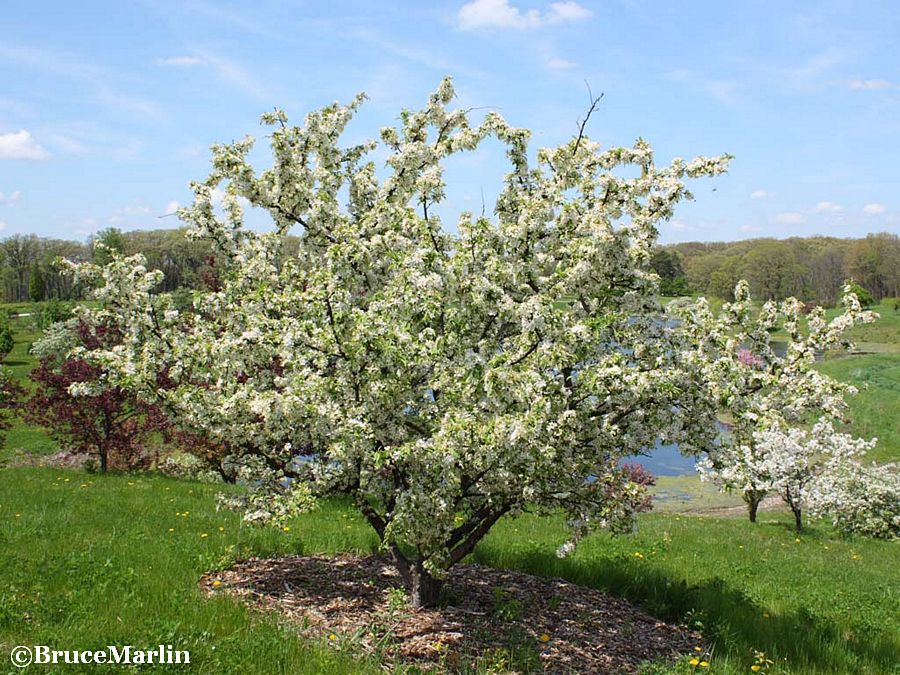
Redbud Crabapple - Malus x zumi 'Calocarpa', Morton Arboretum acc. 105-90* 3  [2] May 8th, near Chicago.
Fruit shape: round / Fruit length: < .5 inch / Fruit covering: fleshy Fruit color: orange; red
Fruit characteristics: attracts birds; no significant litter problem; persistent on the tree; showy

Trunk/bark/branches: droop as the tree grows, and will require pruning for vehicular or pedestrian clearance beneath the canopy; routinely grown with, or trainable to be grown with, multiple trunks; not particularly showy; tree wants to grow with several trunks but can be trained to grow with a single trunk; no thorns.

Requires pruning to develop strong structure. Resistant to breakage and windthrow. [4]
 Tree Hardiness Zone Map

Fig. 1
Hardiness zone map courtesy the Arbor Day Foundation*


Redbud has been described as one of the best crabapples for street tree planting. When specifying trees for street or parking lot planting, be sure to order single trunked trees with major branches located as high on the trunk as possible. This will reduce the need to prune off lower limbs to provide clearance for vehicles and pedestrians. However, branches will still need to be removed as the tree grows older due to the slightly drooping habit of the tree.

Suckers from the root system may also need to be occasionally removed. Trees planted away from walks and streets can be pruned and trained any way you like. They often look nice with branches left to the ground, forming a solid, thick, mounding shape with age. Redbud Crabapple should be grown in full sun on well-drained, acid soil. They are adapted to a variety of soils, including clays. It is recommended that you purchase trees propagated on their own roots.

No pests are of major concern. Aphids can usually be found infesting a variety of Crabapples, including this one. Control of pests is usually not needed. Although resistant to scab, Redbud Crabapple is
susceptible to fireblight and mildew. [4]

Please visit some of our other tree species and families:


Hickory
 Carya sp.

Umbrella Black Locust
Robinia pseudoacacia
Japanese Horse Chestnut - Aesculus turbinata
Japanese Horse Chestnut
Aesculus turbinata

Tulip-Tree
Liriodendron tulipifera
References
  1. Morton Arboretum, Crabapple: A Tree For All Seasons
  2. Redbud Crabapple - Malus x zumi 'Calocarpa', Morton Arboretum acc. 105-90* 3, photographed May 8th, 2009. Photographer: Bruce J. Marlin
  3. Morton Arboretum, Crabapples for the Home Landscape
  4. Edward F. Gilman and Dennis G. Watson, USDA, National Forest Service Fact Sheet ST-403, Malus x zumi 'Calocarpa' (.pdf)
Excerpts from Morton Arboretum articles used with permission.