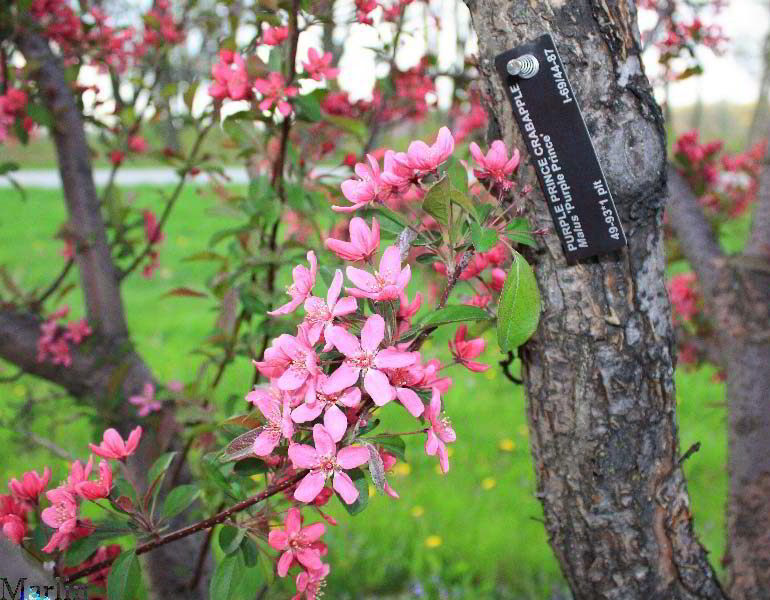
Purple Prince Crabapple - Malus 'Purple Prince' [2]
Rose Family: Rosaceae
Height: 15 feet / 4.5 m / USDA zones 4 through 7
 Insects & Spiders Home | Trees Graphics | Trees Index | Rosaceae Index | Rosaceae Graphics
Purple Prince Crabapple - Malus 'Purple Prince'
 Seventeen crabapple (Malus) cultivars planted under utility wires in 27 communities were evaluated as street trees. In most communities, 2 cultivars were alternated within each of several plots. Cooperators in the Municipal Tree Restoration Program used standardized methods to measure them annually at the end of the growing period for 3 years and periodically afterwards until the ninth year in some cases.

Many differences were found in growth rate, height, crown width, and trunk diameter. Most cultivars had healthy foliage, though some injuries were caused by apple scab and several insects. Basal sprouts were common, and low branching of broader cultivars also required periodic pruning especially in confined spaces. Centurion®, Harvest Gold®, Red Jewel®, ‘Spring Snow’, and Sugar Tyme® are recommended as street trees based on the most extensive data. ‘Adams’, ‘Donald Wyman’, ‘Prairiefire’, ‘Red Barron’, and zumi ‘Calocarpa’ also appear promising. [3]

Custom Search
Purple Prince Crabapple - Malus 'Purple Prince'
Purple Prince Crabapples - Malus 'Purple Prince', Morton Arboretum acc. 49-93*1 & 2 [2]
26 communities in Pennsylvania and Delaware planted trees represented in this report. Four of the communities had 2 tests planted in different years. Community representatives chose the planting sites with assistance by utility foresters, service foresters, and Extension urban foresters; 2 of these usually assisted each community.

A typical test consisted of 4 varieties planted alternately within 8 to 10 plots that could contain 4 to 16 trees each a total of 50 trees. All test trees were planted along streets and under electric conductors; the utility company arranged for removal of large trees that interfered with utility lines. Both cultivars for a community were ordered balled and burlapped from the same nursery, with a caliper of 4.4 or 5.1 cm (1.75 or 2 in.); heights ranged from 2.4 to 3.7 m (8 to 12 ft). The cultivar tests were planted between 1987 and 1996.

A trained cooperator inspected and measured the trees annually during the first 4 years, and then at 3-year intervals. During September or October, a service forester or Extension urban forester used standardized methods to measure tree height, trunk diameter at breast height (dbh), and crown width, and to classify foliage health, branch health, trunk health, maintenance needs, and an overall quality rating). Causes of damage such as disease, insects, drought, and mechanical injuries also were recorded. [3]
-- Read the rest of this abstract at: CRABAPPLE CULTIVARS TESTED AS STREET TREES: SECOND REPORT .pdf

Crabapples are useful as ornamentals where the fruit will not fall on sidewalks, driveways, or anywhere there is pedestrian traffic. Even placed in a lawn, some cultivars produce so much fruit the windfalls can interfere with mowing operations.  [1]

Purple Prince Crabapple Flowers
Outstanding Purple flowers

Various cultivars of genus Malus and their attributes:

Malus x 'Mary Potter' 'Mary Potter' Crabapple white flowers, red and fairly large fruit, susceptible to scab and powdery mildew; 'Red Jade' - weeping habit, white flowers, red fruit persisting after leaves drop; 'Sargenti' - dwarf, pink bud opens to white flowers, small dark red fruit; 'Snowdrift' - white flowers, orange red fruit; 'Tanner' - white flowers, red fruits, susceptible to diseases; 'Tschonoski' - white flowers, vigorous growth, good bronze red fall color, fruit brownish; 'White Angel' - white flowers, glossy red fruit persisting into winter; 'White Candle' - pink buds open to white flowers, red fruit, upright growth habit; 'Zumi Calocarpa' - white flowers, bright red persistent fruit. Pink flowered cultivars include: 'Arnoldiana' - red buds, pale pink to white flowers, red and yellow fruits, susceptible to diseases.

 Cultivars with red flowers include: 'American Beauty' - double, red flowers, susceptible to scab; 'Centurion' - a columnar growth habit, red flowers followed by bright red, persistent fruits; 'Indian Magic' - red flowers, maroon fall color, small red fruit, persistent; 'Purpurea Lemoinei' - dark rose color flowers, alternate bearing; 'Profusion' - red flowers and fruit; 'Red Baron' - red flowers, susceptible to scab; 'Red Silver' - red flowers, red fruit, susceptible to scab; 'Red Splendor' - red buds, red to pink flowers, red fruit, susceptible to scab; 'Royal Ruby' - double red flowers, sparse red fruit, susceptible to scab; 'Royalty' - red flowers, red fruits, foliage purple, susceptible to scab; 'Selkirk' - red flowers, red fruits, susceptible to diseases; 'Sparkler' - red flowers, red fruits; 'Tomiko' - disease-resistant, 'Wisley' - red flowers. [1]

References
  1. USDA National Forest Service Fact Sheet 393, Malus x 'Mary Potter'
  2. Purple Prince Crabapples - Malus 'Purple Prince', Morton Arboretum acc. 49-93*1 & 2, photographed by Bruce Marlin
  3. Henry D. Gerhold, Journal of Arboriculture 26(1): January 2000, CRABAPPLE CULTIVARS : SECOND REPORT .pdf
 
Custom Search

Insects & Spiders Home | Trees Graphics | Trees Index | Rosaceae Index | Rosaceae Graphics


© Red Planet Inc.