
Peking Lilac Tree – Syringa pekinensis
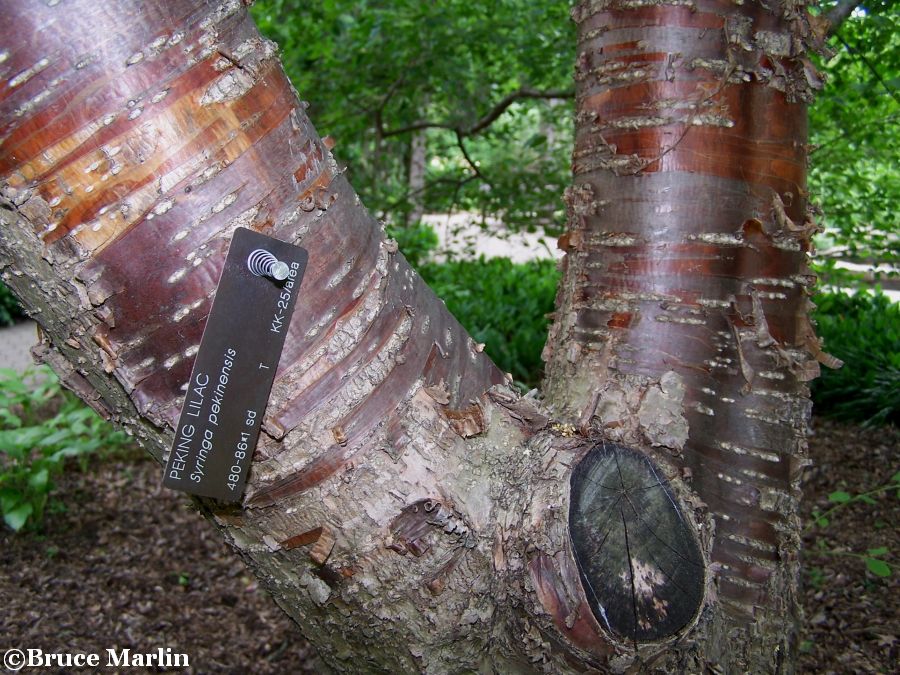
Family Oleaceae – Olive, Ash, Lilac.
Height: 15-20′ / Habit: upright arching, open USDA Hardiness Zone: 3
A small tree or large shrub, The Peking Lilac fits nicely into a typical home landscape. It can be grown with either a single trunk or as a multistemmed tree. It has nice late-spring flowers and shiny, coppery, exfoliating bark. Cold-tolerant and able to withstand dry urban soils, the Peking Lilac makes an excellent plant for a variety of midwestern garden uses.
Flowers are yellowish-white in 3-6″ long panicles in late spring and early summer. Smooth, dark-green leaves, the Peking lilac has a finer texture than Japanese tree lilac because of smaller leaves and stems. Fall: Color is not showy. Winter: Its handsome, shiny, copper-colored bark with prominent horizontal lenticels gives it the appearance of a cherry tree [3].
 This Peking Lilac was planted as a seed 21 years ago
Lilacs are deciduous shrubs or small trees, ranging in size from 2-10 m tall, with stems up to 20-30 cm diameter. The leaves are opposite (occasionally in whorls of three) in arrangement, and their shape is simple and heart-shaped to broad lanceolate in most species, but pinnate in a few species. The flowers are produced in spring, each flower being 5-10 mm in diameter with a four-lobed corolla, the corolla tube narrow, 5-20 mm long; they are bisexual, with fertile stamens and stigma in each flower.
The usual flower colour is a shade of purple (often a light purple or lilac), but white, pale yellow and pink, and even a dark burgundy color are also found. The flowers grow in large panicles, and in several species have a strong fragrance. Flowering varies between mid spring to early summer, depending on the species. The fruit is a dry, brown capsule, splitting in two at maturity to release the two winged seeds.
References
- General Sheridan Common Lilac , Morton Arboretum acc. 788-73*1, photos © Bruce Marlin
- Morton Arboretum, Crabapples for the Home Landscape
- Wikipedia, the Free Encyclopedia, Oleaceae
- Wikipedia, Syringa
Family Oleaceae – Olive, Ash, Lilac and Privet
The olive family contains 25 genera and over 500 species of flowering plants. Most species are native to temperate and tropical regions of the Northern Hemisphere. The best known of this family are olive, ash, privet, lilac, and Forsythia.
Family Oleaceae – Olive, Ash, Lilac and Privet
Trees Index | Pine Family | Beech, Oak | Nut Trees | Birch Family | Magnolias
Tree Encyclopedia / North American Insects & Spiders is dedicated to providing family-friendly educational
resources for our friends around the world through large images and macro photographs of flora and fauna.
Online since 2002