Miyama Cherry Tree – Prunus maximowiczii
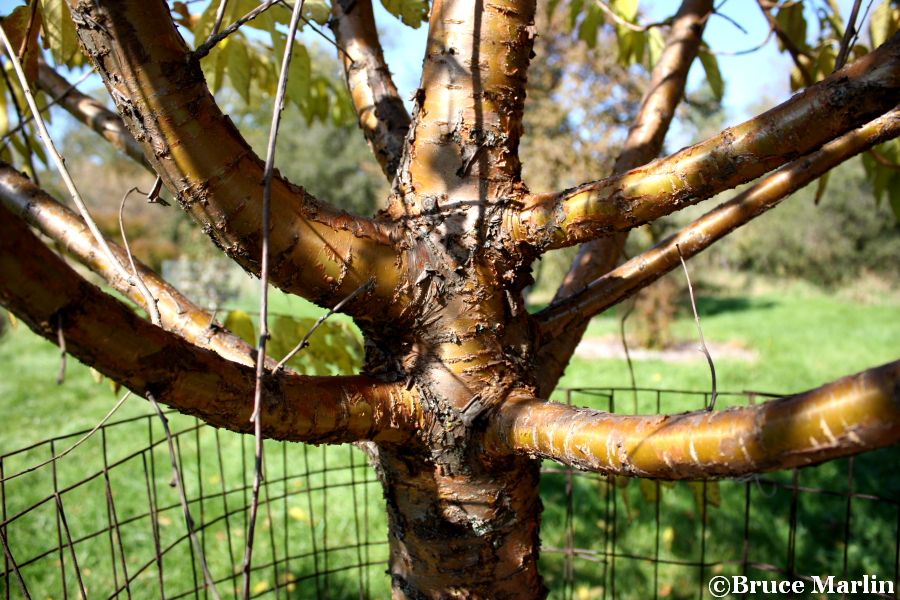 Outstanding bronze – green exfoliating bark
Range and habitat: Korea, China (Heilong Jiang, Jilin, Liaoning and Zhejiang), Russia (Khabarovsk, Primorye or Sakhalin), and Japan (Hokkaido, Honshu or Kyushu), often in mountainous, woodland regions and in clay soil.
Miyama cherry is useful in many ways; aside from eating the fruit, the flowers can be used as a condiment, preserved in brine. The wood is very hard, heavy, and close grained, making it excellent for carving and furniture making. Green dye is produced from the leaves. [5]
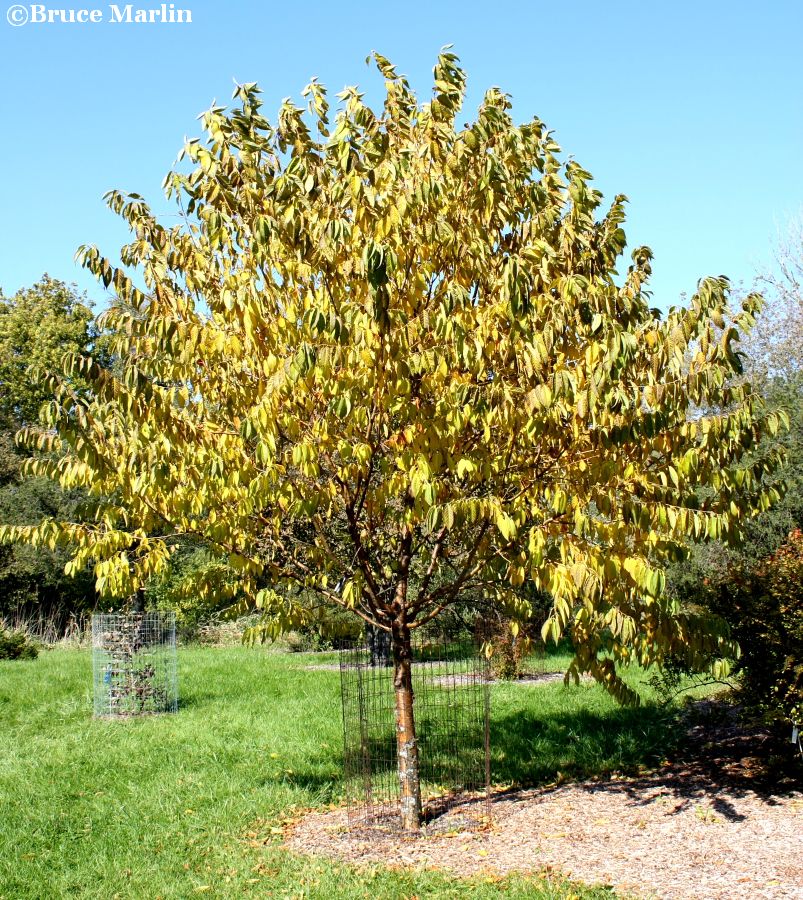 Miyama Cherry, from seed, is 10 years old
Prunus maximowiczii, known as the Miyama cherry or Korean cherry (not to be confused with P. japonica, also called Korean cherry), is a small (about 7.5m), fruiting cherry tree that can be found growing wild in northeastern Asia and Eurasia.
Taxonomy
The species was first described in 1857 by Franz Josef Ruprecht. It was treated in the genus Cerasus (now accepted as a subgenus of Prunus) by Vladimir Leontyevich Komarov in 1927, but the original P. maximowiczii remains the accepted binomial [5].
The root system of most cherries are predominantly spreading and shallow, even in well-drained soils. Most roots are restricted to the upper 60 cm (24 in) of soil or less, with occasional sinker roots extending to depths of 90 to 120 cm (36 to 48 in). On wet sites, the tendency toward shallow rooting is especially pronounced. Because of this tendency to grow taller than associated species in mixed stands, cherry is vulnerable to windthrow, especially on poorly drained soils and at older ages.
References
- Miyama Cherry – Prunus maximowiczii, Morton acc. 35-2000*3 photograph: Bruce Marlin
- USDA, ARS, National Genetic Resources Program, (GRIN) Prunus —juddii E. S. Anderson
- Lynn E. Long, Oregon State University Extension Horticulturist, Growing Quality Cherries PDF
- Wikipedia, Prunus maximowiczii
Family Rosaceae – Rose Family; Fruit Trees
Trees Index | Pine Family | Beech, Oak | Nut Trees | Birch Family | Magnolias
Tree Encyclopedia / North American Insects & Spiders is dedicated to providing family-friendly educational
resources for our friends around the world through large images and macro photographs of flora and fauna.
Online since 2002