Japanese Cedar – Cryptomeria japonica
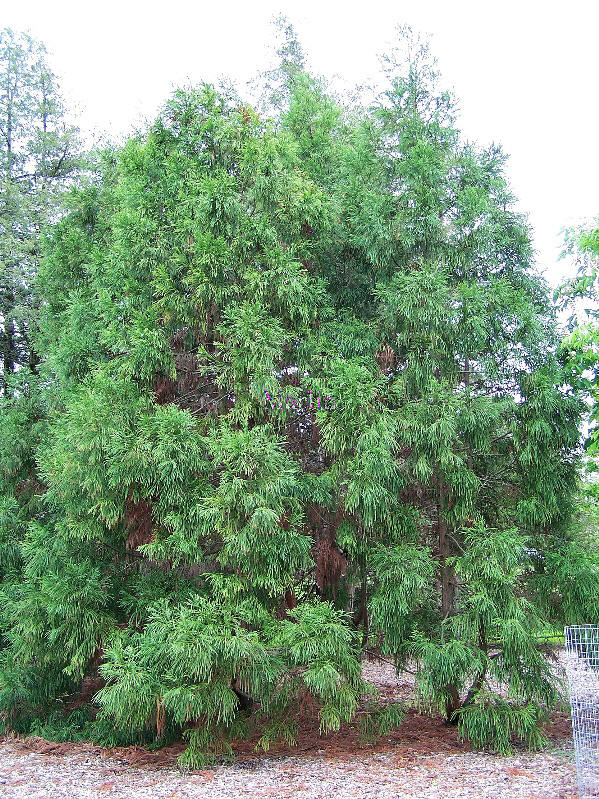 These Japanese Cedars were started from cuttings 25 years ago
Cryptomeria japonica, commonly called Japanese cedar or Sugi, is a tall, evergreen conifer with tiered horizontal branching. The genus Cryptomeria is monotypic and unrelated to the true cedars (Cedrus). Called “Sugi” in Japan, where it is the national tree, and is commonly incorporated into the landscape of temples and shrines.
Trees monoecious, evergreen, up to 50(-65) m tall and up to 300 cm in diameter, with a conical crown and a straight, slender trunk. Bark reddish brown to dark gray, fibrous, peeling off in strips. Branches ± whorled, horizontally spreading or slightly pendulous; branchlets usually pendulous, those of 1st year green. Shoots green, glabrous. Winter buds small, not scaly.
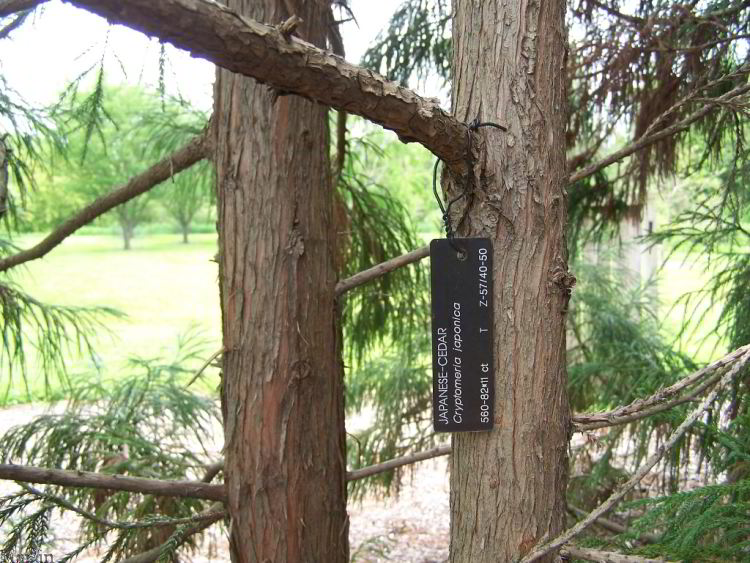 Bark is reddish brown to dark gray, fibrous, peeling off in strips
Sugi can grow very large, indeed, and no one seems to know how old they can grow. The Yaku-sugi of Yakushima Island are probably the largest specimens extant. “Jomon-sugi” is 5.2 meters in diameter and fully 25 meters tall; another is 35 meters tall. It is thought they may be 1,000 years old or more, and that under favorable conditions these trees might reach 2,000. Some have claimed sugi as 7200 years old, but there is no scientific evidence to support this age; it is simply folklore or local exaggeration.
The wood of Japanese Cedar is particularly rot-resistant and easily worked. It is used in buildings, bridges, ships, furniture, utensils and paper manufacture. In Japan, sugi is one of the two most economically important timber species. Outside of China and Japan, the tree is widely planted as a beautiful ornamental tree for specimen plantings. Japanese incorporate them into landscapes of temples and shrines. (1)
 Leaves and Pollen Cones
References:
1. The Gymnosperm Database
2. USDA NRCS Plant Guide
3. USDA NRCS Threatened and Endangered species
4. USDA, ARS, National Genetic Resources Program.
5. University of Michigan Native American Ethnobotany
Trees Index | Family Cupressaceae | Beech, Oak | Nut Trees | Birch Family | Magnolias | Rose Family
Tree Encyclopedia / North American Insects & Spiders is dedicated to providing family-friendly educational
resources for our friends around the world through large images and macro photographs of flora and fauna.
Online since 2002