Eucalyptus – Eucalyptus globulus
Myrtaceae – Myrtle Family. Eucalyptus is a diverse genus of trees which dominate the tree flora of Australia with over 700 species.
 Figure 1. Mature Eucalyptus Trees |
 Figure 2. Eucalyptus Bark – Ribbon Type |
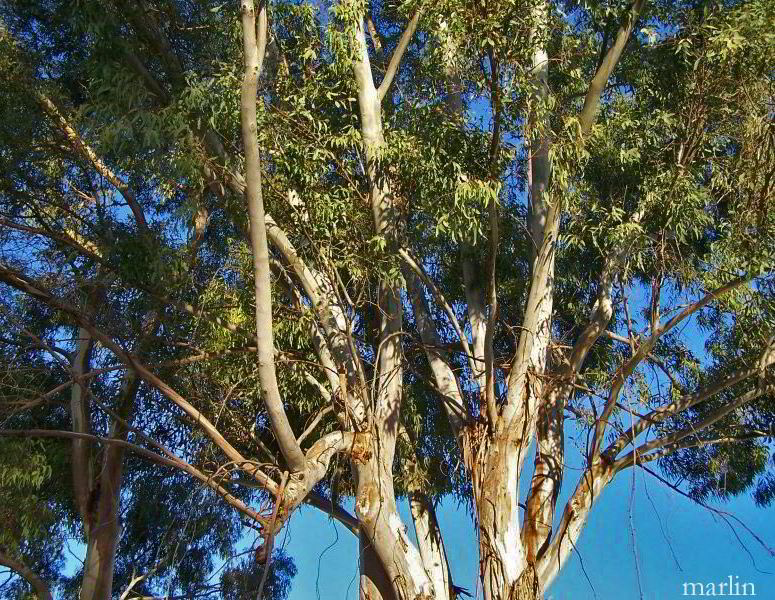
Eucalyptus is a diverse genus of trees which dominate the tree flora of Australia with over 700 species. Eucalypts are found in almost every part of the continent, adapted to all climatic conditions. No other continent is so characterized by a single genus of tree as is Australia by Eucalyptus. Many species are commonly called gum trees; other common names include mallee, box, ironbark, stringybark, and ash. [1]
Eucalypts are among the tallest trees in the world. The Australian Mountain Ash (Eucalyptus regnans), at nearly 200 meters, is second in height only to the coast redwood, Sequoia sempervirens [5].
The Myrtle family is comprised of over 5600 species in 150 genera. Notable in the group are clove, guava, feijoa, allspice, and Eucalyptus [3].
Eucalyptus Uses: Pulpwood
Eucalyptus is the most common short fiber source for pulpwood to make pulp. Eucalyptus globulus and Eucalyptus grandis are the favored varieties in papermaking. The fiber length of Eucalyptus is relatively short and uniform, with low coarseness compared with other hardwoods. Eucalyptus fibers are slender, yet relatively thick walled. This gives the uniform paper formation and high opacity required for all types of fine papers. Eucalyptus is suitable for many tissue papers as the short and slender fibers gives a high number of fibers per gram and low coarseness contributes to softness.
Eucalyptus oil uses:
Eucalyptus oil is readily steam distilled from the leaves and can be used for cleaning, deodorizing, and in very small quantities in food supplements, especially sweets, cough drops, toothpaste and decongestants. It also has insect repellent properties (Jahn 1991 a, b; 1992), and is an active ingredient in some commercial mosquito repellents (Fradin & Day 2002) [4].
Quite a number of alternative therapies espouse various inhalation or aromathrapy Eucalyptus oil benefits, including relief from sinus congestion, sinus infections, common cold, bronchitis, flu, and other respiratory diseases. In certain instances, whether eucalyptus oil benefits health is a matter of great anecdotal, but little empirical evidence, e.g. claims of effective asthma treatments. And here’s some great anecdotal evidence to go along with that assertion: I suffered terribly from asthma as a child and young adult, and I can tell you in no uncertain terms, eucalyptus was no help whatsoever.
Eucalyptus species are sometimes grouped by bark characteristics:
- Stringybark – consists of long-fibers and can be pulled off in long pieces. It is usually thick with a spongy texture.
- Ironbark – is hard, rough and deeply furrowed. It is soaked with dried kino (exuded sap) which gives a dark red color.
- Tessellated – bark is broken up into many distinct flakes.
- Box – has short fibers. Some also show tessellation.
- Ribbon – this has the bark coming off in long thin pieces but still loosely attached in places. Long ribbons, or twisted curls.
References
1. Colin Tudge, The Tree: A Natural History of What Trees Are, How They Live, and Why They Matter
2. NATIONAL AUDUBON SOCIETY, National Audubon Society Field Guide to North American Trees
3. Wikipedia, “Myrtaceae”
4.Wikipedia, “Eucalyptus”
5.Wikipedia, “Tree”
6. Google Insight for Search, Oct 25, 2011
Tree Encyclopedia | Oak & Beech Index | Walnut | Fruit Trees | Nut Trees