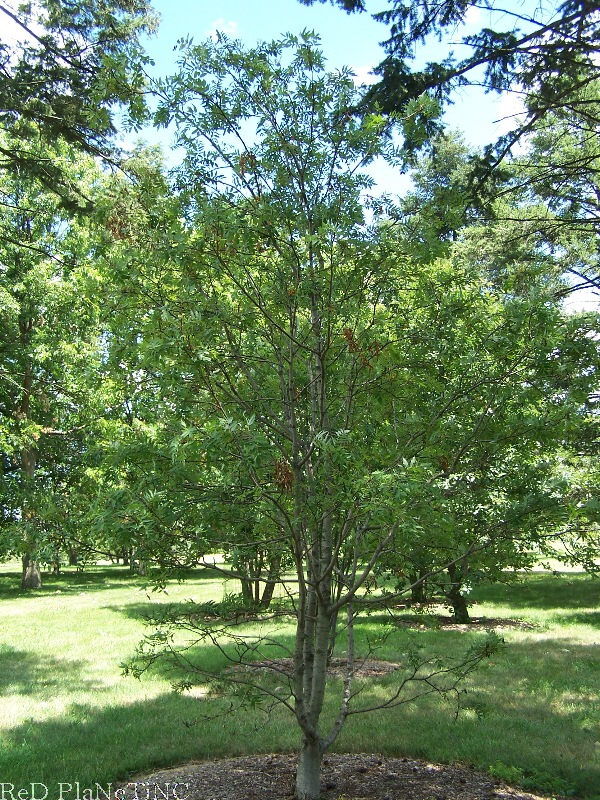
Amur Mountain-ash - Sorbus amurensis Koehne (1)
Synonym Sorbus pohuashanensis (Hance) Hedl
Rosaceae – Rose family.


Common names:

Economic importance:

Native:

  • ASIA-TEMPERATE
    Soviet Far East: Russian Federation - Amur, Khabarovsk, Primorye
    Mongolia: Mongolia
    China: China - Gansu, Hebei, Heilongjiang, Jilin, Liaoning, Nei Monggol, Shaanxi, Shandong, Shanxi
    Eastern Asia: Korea (2)

Amur mountain-ash is a deciduous tree growing to 25 feet. (3)
 

Trees to 8 m tall. Branchlets brown or purplish brown to grayish brown, tomentose-villous when young, gradually glabrescent, with small grayish white lenticels; buds oblong-ovoid, 0.8–1.2 cm × 5–7 mm, apex acuminate; scales several, reddish brown, densely gray tomentose-villous. Leaves imparipinnate, together with rachis 10–20 cm; petiole 2.5–5 cm; stipules broadly ovate or semiorbicular, 5–10 × 5–12 mm, margin coarsely sharply serrate; rachis slightly winged, sulcate, tomentose-villous, subglabrous when old; leaflets 5–7-paired, at intervals of 1–2.5 cm, terminal and basal ones usually smaller than others, blade ovate-lanceolate or elliptic-lanceolate, 3–5 × 1.4–1.8 cm, lateral veins 9–16 pairs, slightly arcuate-anastomosing at margin, abaxially pale, tomentose-villous when young, subglabrous or tomentose-villous only along midvein when old, adaxially sparsely tomentose-villous or glabrous, base obliquely rounded, margin minutely sharply serrate, nearly entire basally, apex acute or shortly acuminate. Inflorescences terminal, 8–12 × 10–15 cm, densely flowered; rachis and pedicels tomentose-villous, subglabrous or glabrous when old; bracts ovate, smaller than stipules, sharply serrate, rarely entire. Pedicel 3–4 mm. Flowers 5–8 mm in diam. Hypanthium campanulate, abaxially tomentose-villous or subglabrous. Sepals triangular, 1.5–2.5 × 1–2 mm, glabrous or subglabrous, apex acute. Petals white, broadly ovate or suborbicular, 3.5–5 × 3–4 mm, adaxially puberulous, apex obtuse. Stamens 20, nearly as long as petals. Styles 3(or 4), not exceeding stamens, pubescent basally. Fruit red or orangish red, 6–8 mm in diam., glabrous when mature; sepals persistent. Fl. Jun, fr. Sep–Oct. (3)

The showy white flowers appear in early summer, and the abundant orange fruit appear in summer, persisting through winter. Fruit provides palatable browse for many animals and birds, but is not suitable for human consumption, except, perhaps for various folk remedies; the plant is not toxic. (5)
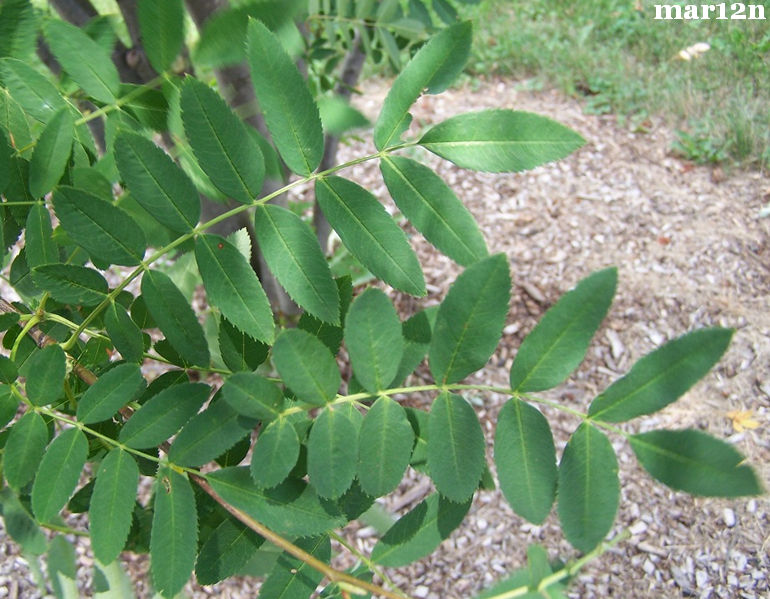
The mountain ash and related species (most often the European Mountian ash, Sorbus aucuparia) are sometimes referred to in folklore as "Rowan" trees, but this use has almost disappeared from the modern lexicon. The rowans were thought by the Celts and other primitive peoples of The British Isles to have magical properties.

"Mountain ash, 1804, from rowan-tree, rountree (1548), northern English and Scottish, from a Scandinavian source (cf. O.N. reynir, Swed. Ronn "the rowan"), ultimately from the root of red, in reference to the berries. The rowan "was the tree most often credited with protective magical powers against all effects of witchcraft, not merely in Celtic areas but throughout Britain." -- Oxford Dictionary of English Folklore


American Mountain-ash was used extensively by Native Americans for various purposes (5):
  • Algonquin, Quebec, Drug (Cold Remedy); Infusion of inner bark taken for colds.
  • Algonquin, Tete-de-Boule Drug (Psychological Aid); Buds and inner bark fibers boiled and used for depression.
  • Iroquois Drug (Gastrointestinal Aid); Fruit used to facilitate digestion.
  • Malecite Drug (Analgesic); Infusion of bark used for pain after childbirth.
  • Micmac Drug (Gastrointestinal Aid); Infusion of root taken for colic.
  • Ojibwa Drug (Venereal Aid); Infusion of root bark taken for gonorrhea.
  • Penobscot Drug (Emetic); Plant used as an emetic.
  • Algonquin, Quebec Food (Fruit); Fruit used for food.
  • Ojibwa Fiber (Canoe Material); Wood used to make ribs for canoes, snowshoe frames.


Check other databases for Sorbus pohuashanensis (Hance) Hedl.:

  • Flora of China: Online version from Harvard University
  • W³TROPICOS: Nomenclatural and Specimen Database of the Missouri Botanical Garden
  • Mansfeld: Mansfeld's World Database of Agricultural and Horticultural Crops
  • ICRA: International Cultivar Registration Authority for Sorbus pohuashanensis cultivars
  • ePIC: Electronic Plant Information Centre of Royal Botanic Gardens, Kew
  • AGRICOLA: Article Citation Database or NAL Catalog of USDA's National Agricultural Library
  • Entrez: NCBI's search engine for PubMed citations, GenBank sequences, etc.
    Note: Defaults to a search by genus or species epithet if species binomial not found.


Kingdom Plantae – Plants
Subkingdom Tracheobionta – Vascular plants
Superdivision Spermatophyta – Seed plants
Division Magnoliophyta – Flowering plants
Class Magnoliopsida – Dicotyledons
Subclass Rosidae
Order Rosales
Family Rosaceae – Rose family
Genus Sorbus L. – mountain ash
Species Sorbus pohuashanensis (Hance) Hedl  – Amur mountain ash


       web       www.cirrusimage.com