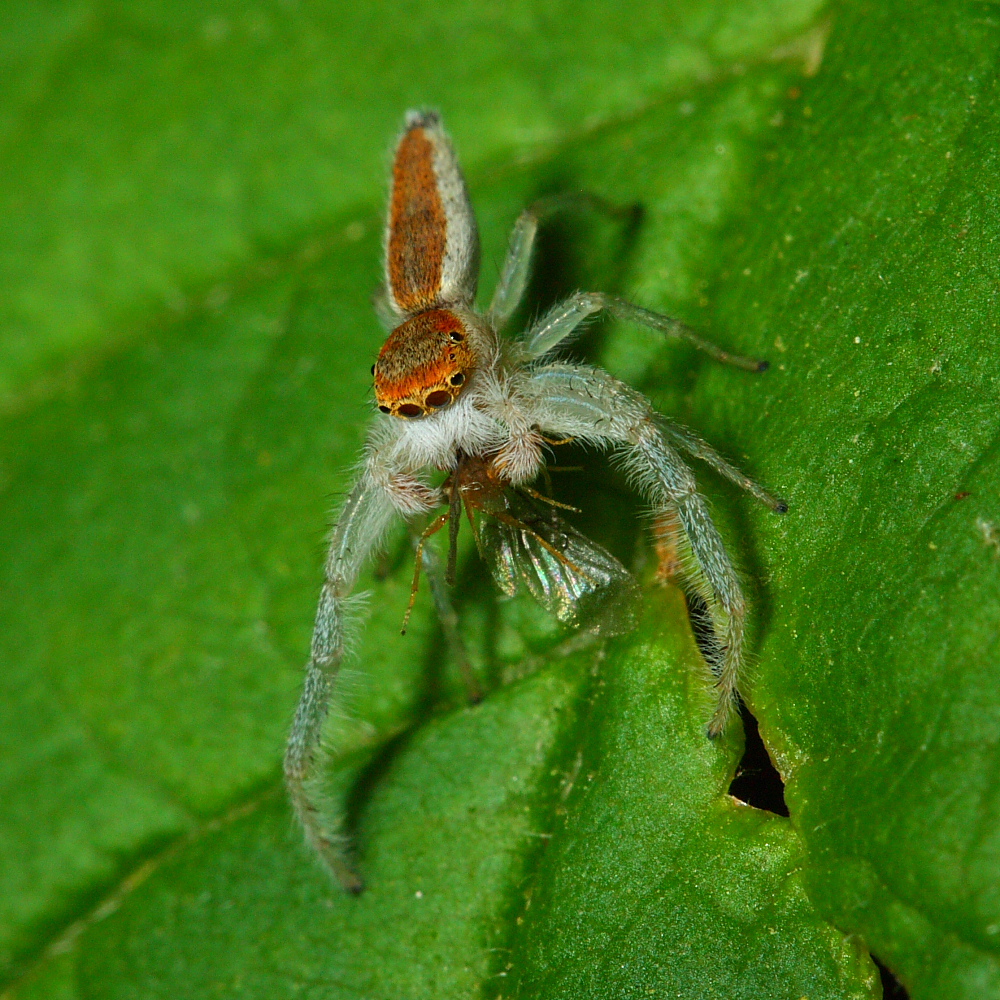
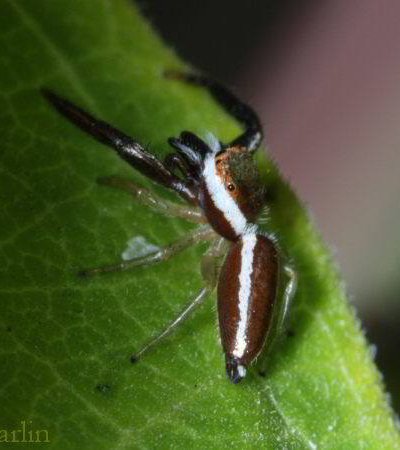
Jumping Spider – Hentzia mitrata
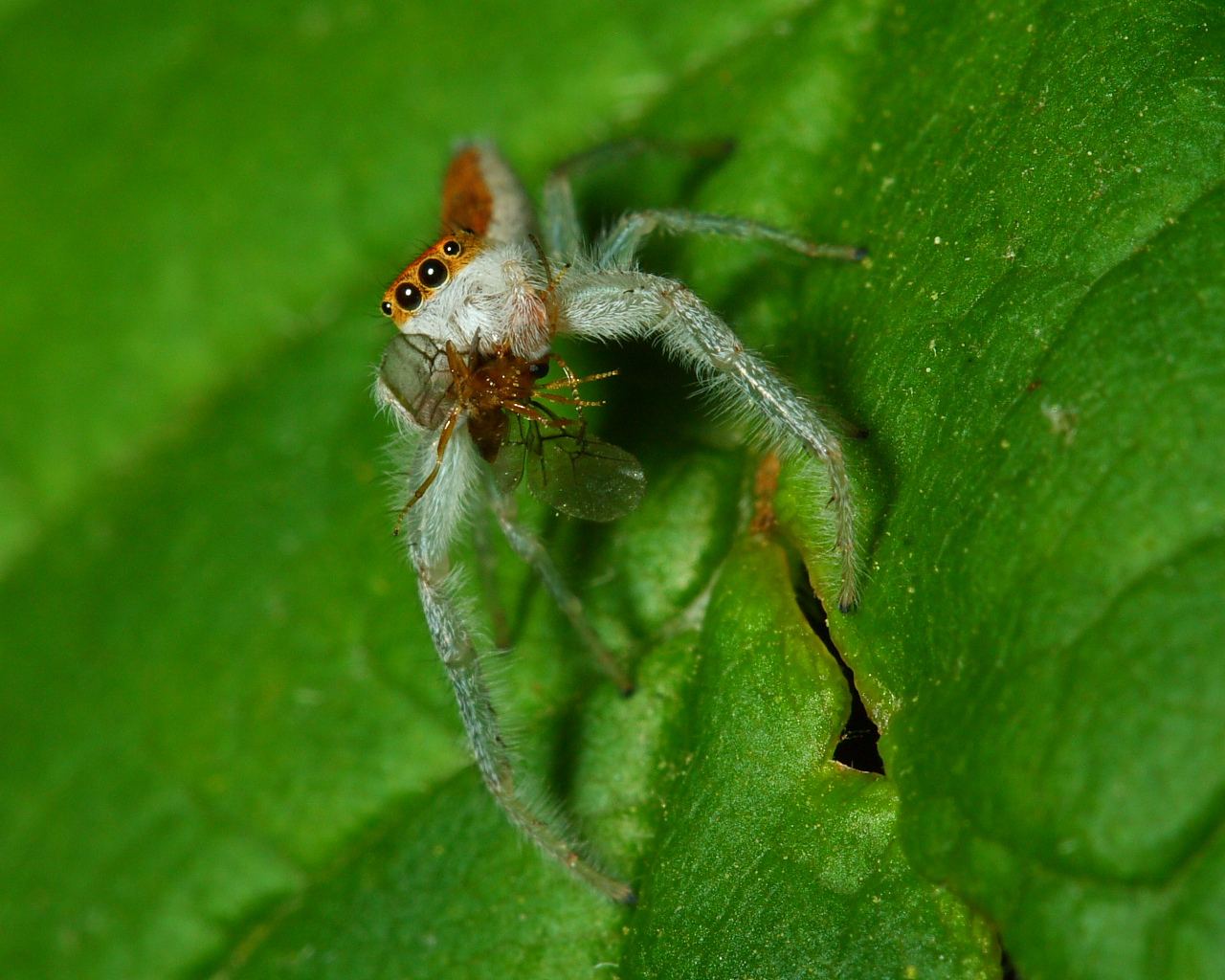 This tiny hunter has caught an even tinier lace bug. The spider is only 4mm (about 1/8 inch) long
Genus Hentzia is named for Nicholas Hentz (1797-1856), a French-born entomologist, engraver, and miniature painter, who spoke several languages and studied medicine in Paris and at Harvard. He also authored several school textbooks, a treatise on the American alligator, novels, and numerous articles. His posthumous Spiders of the United States, a collection of scholarly articles, paintings, and drawings on the subject, long remained a standard in the field of arachnology. [3]
Born in Versaille, France, Hentz fled with his family in 1816. He eventually settled in Philadelphia, where he became a member of The American Academy of Natural Sciences and remained one until his death in Florida in 1856. He illustrated numerous articles published in their Journal, and he named over 100 different species of spiders, mostly in Salticidae. [3]
 Being one of the first scientists to study and illustrate spiders, Hentz was a friend of Charles Alexandre Lesueur (1778-1846), president of the Academy of Natural Sciences of Philadelphia, and of the American Geological Society. Hentz also developed a productive collaboration and lasting friendship with Thomas Say (1787-1834), the putative father of American entomology. Say was a taxonomist, as were most of the early entomologists, and he described considerably more than 1,000 new species of beetles and over 400 insects of other orders, including species in every important insect order [4].
Say hoped Hentz would assist him in illustrating his own 3-volume American Entomology, or Descriptions of the Insects of North America, but distance prevented the successful conclusion of that project. [4] Being ever the benevolent man he was, Hentz named one orbweaver spider species, Araneus thaddeus, after another of his friends and collaborators, Dr. Thaddeus William Harris, a noted American naturalist and entomologist.
There are only four Hentzia species in eastern North America, and outside of
Florida and Southeastern Georgia, there are only two: mitrata and palmarum (below) [1]
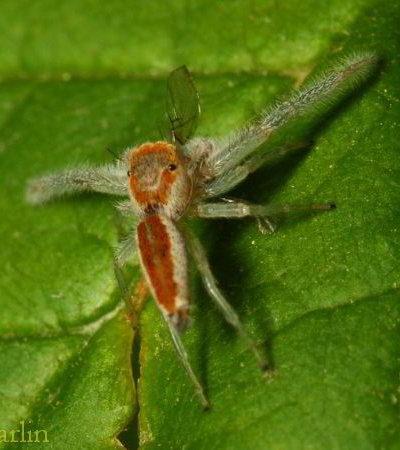 H. mitrata |
 H. palmarum |
References
- Bugguide.net, Hentzia
- Spider Vision David Edwin Hill, licensed under the Creative Commons Attribution 3.0 Unported license.
- Ewell Sale Stewart Library, Academy of Natural Sciences of Philadelphia, N Marcellus Hentz Watercolors.
- Clark Kimberling, University of Evansville, “Thomas Say, Father of American Entomology”
Tree Encyclopedia / North American Insects & Spiders
Online since 2002