Jumping Spider – Phidippus otiosus
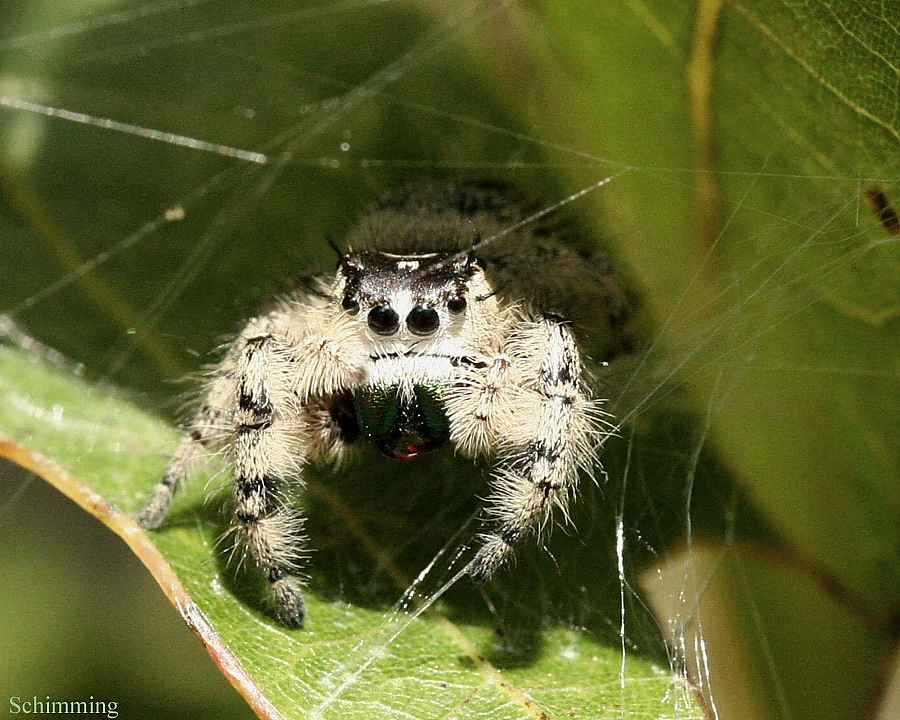
Salticids, with rare exceptions, do not build webs to snare prey, they only spin small silken retreat webs for moulting or hibernation. When hunting, jumpers always trail a silken strand from their spinnerets. If they are disturbed, they will rapidly descend on this lifeline to the ground and out of sight, or if they miss their jump, they can climb the thread back to their previous perch. These little guys are very adept at hiding, and if they do not want you to see them, you won’t. You can find an extensive article on the family at the Tree of Life Website.
Although a jumping spider can jump more than fifty times its body length, none of its legs has enlarged muscles. The power for jumping comes from a quick contraction of muscles in the front part of the body increasing the blood pressure, which causes the legs to extend rapidly much as the hydraulics in a low-rider car.
 The fangs are the red pointed objects, used to inject venom
Spiders Index | Spiders Main | Jumping Spiders | Orb Weavers | Nursery Web
Tree Encyclopedia / North American Insects & Spiders is dedicated to providing family-friendly educational
resources for our friends around the world through large images and macro photographs of flora and fauna.
Online since 2002