Jumping spider – Phidippus mystaceus
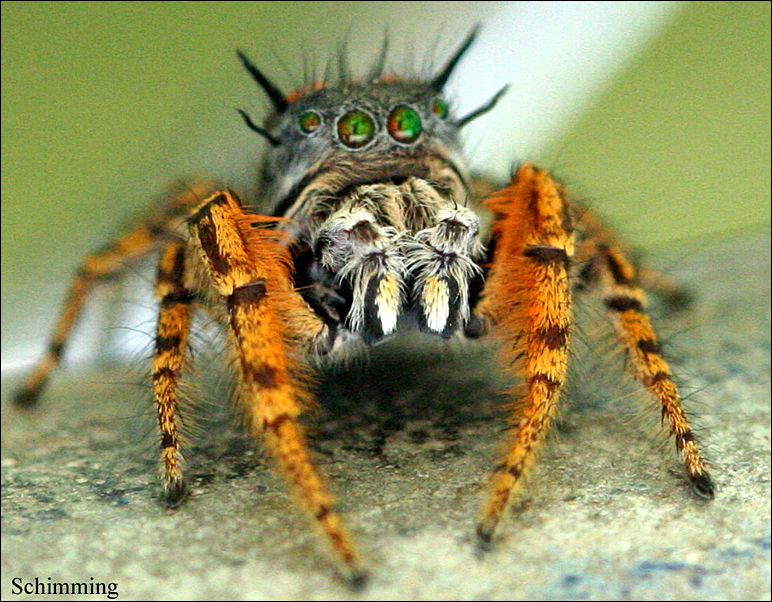
The ‘moustache’ jumping spider has my vote as one of the most colorful. (The species epithet mystaceus is derived from the Greek mystax, a cluster or row of hairs above an insect’s mouth, roughly analogous to a human moustache.) It is a spider that offers a photographer a good chance of capturing images of the spider’s retina, which is not fixed in place like our own. The jumping spider’s retina is moveable. Because the retina is the darkest part of the eye, you can sometimes look into the eye of a jumping spider and see it changing color as it moves to follow your actions. When it is darkest, you know the spider is looking straight at you, because then you are looking straight into its retina.
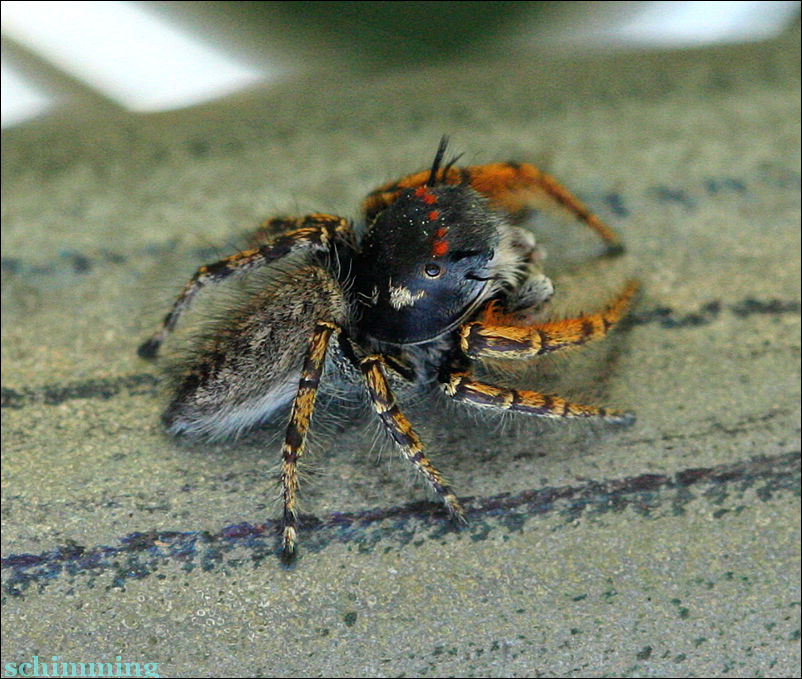
Jumping spiders have excellent vision, among the highest acuity in any invertebrate. The eight eyes are grouped four on the face and four on top of the carapace. The two large, forward-facing eyes (AME) are tubular behind the lens, with a well-developed musculature, unique to salticids, that supports and moves the retina – the opposite arrangement of our own eyes. [1]

Note: the function of the posterior medial eyes is unknown [2]
Spider musculature is also different from ours: in the spider, muscles operate from the inside to move external skeletal elements; our own skeletal muscles surround the elements they operate. But even these glaring differences are nothing compared to the jumping spider’s brain and digestive system – their esophagus passes right through the brain, and one branch of the gut (analogous to our intestines) actually sits on top of the eyes and brain. [1]
Spiders Index | Spiders Main | Jumping Spiders | Orb Weavers | Nursery Web
Tree Encyclopedia / North American Insects & Spiders is dedicated to providing family-friendly educational
resources for our friends around the world through large images and macro photographs of flora and fauna.
Online since 2002