Banded Garden Spider - Argiope trifasciata
Order: Araneae (Spiders) Family:  Araneidae (Orb Weavers)
Live adult female spiders photographed at Winfield IL USA during the month of August.
In Greek mythology, Telephassa, also known as Argiope, was Queen of Tyre.
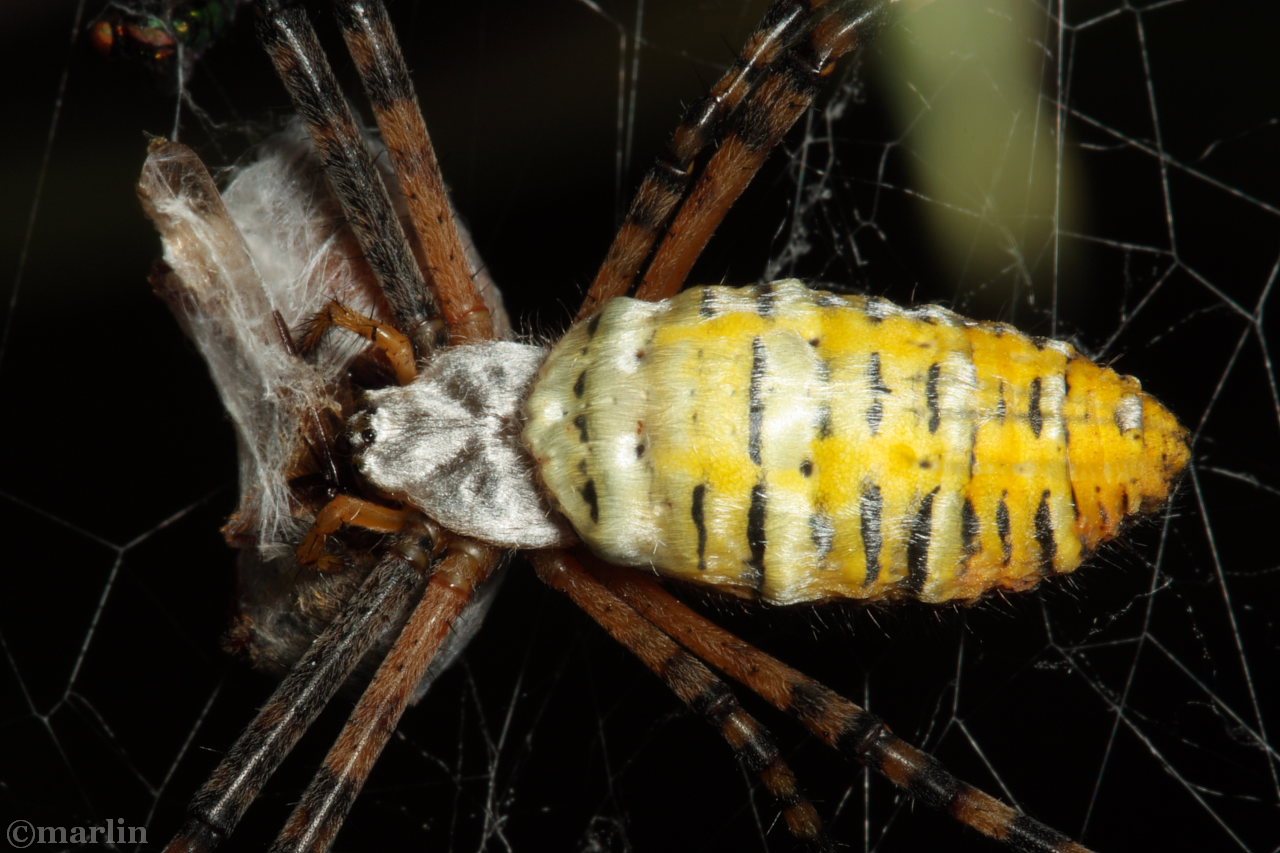
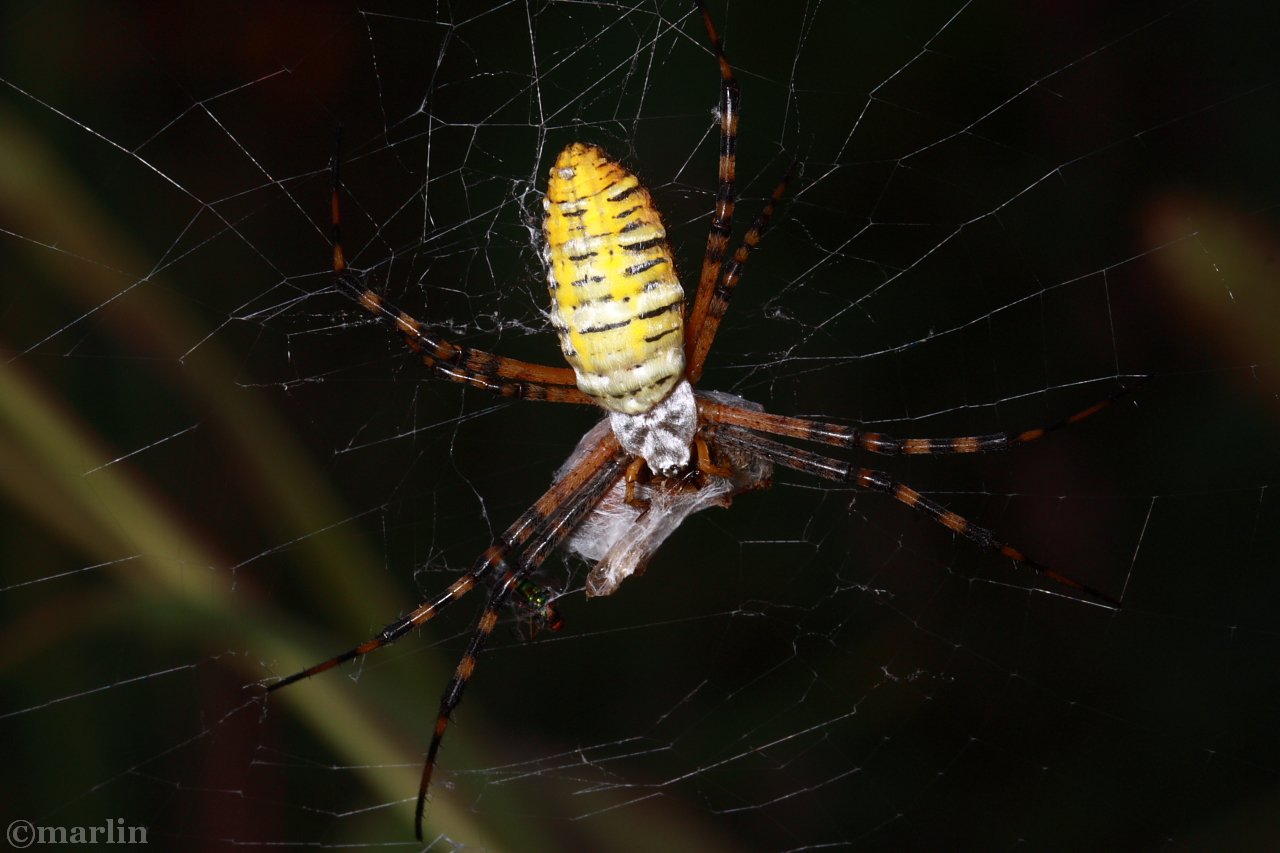
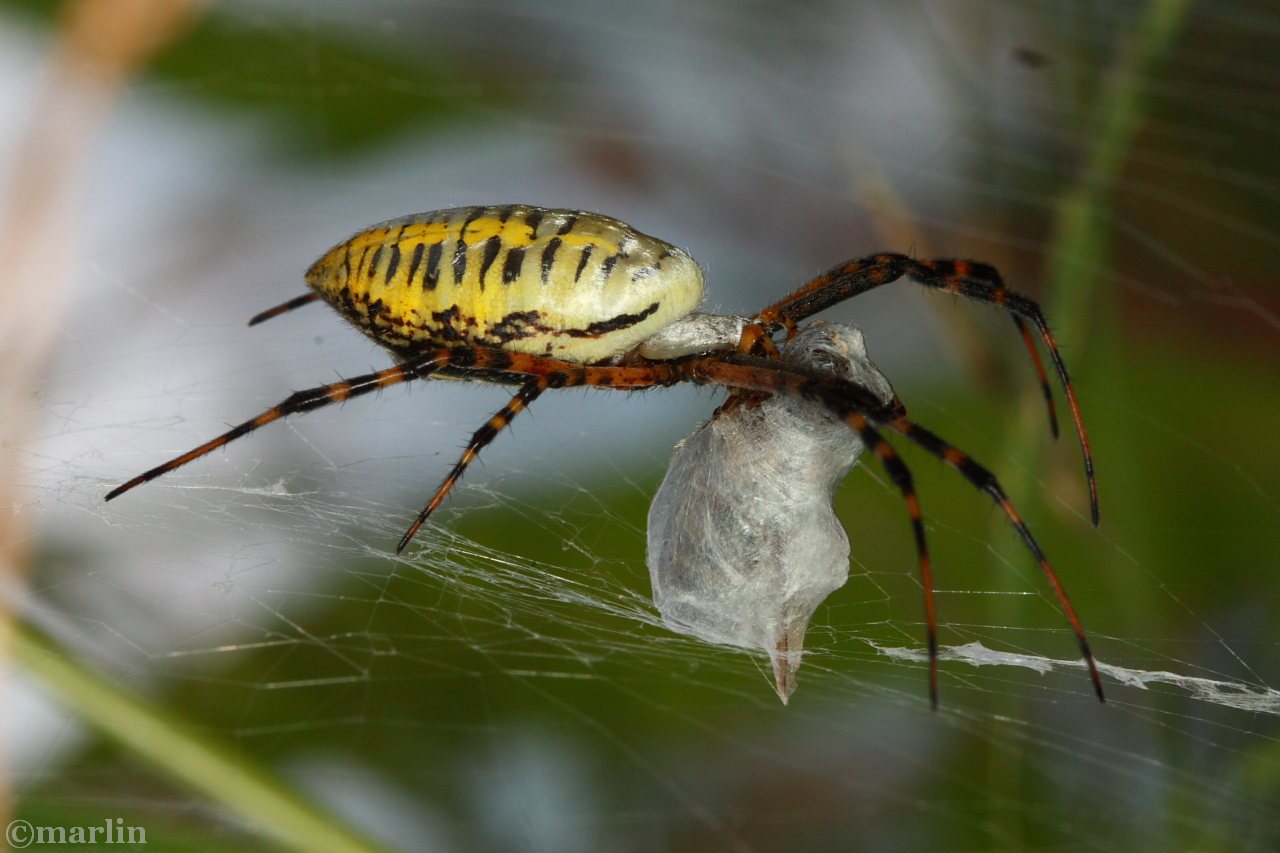
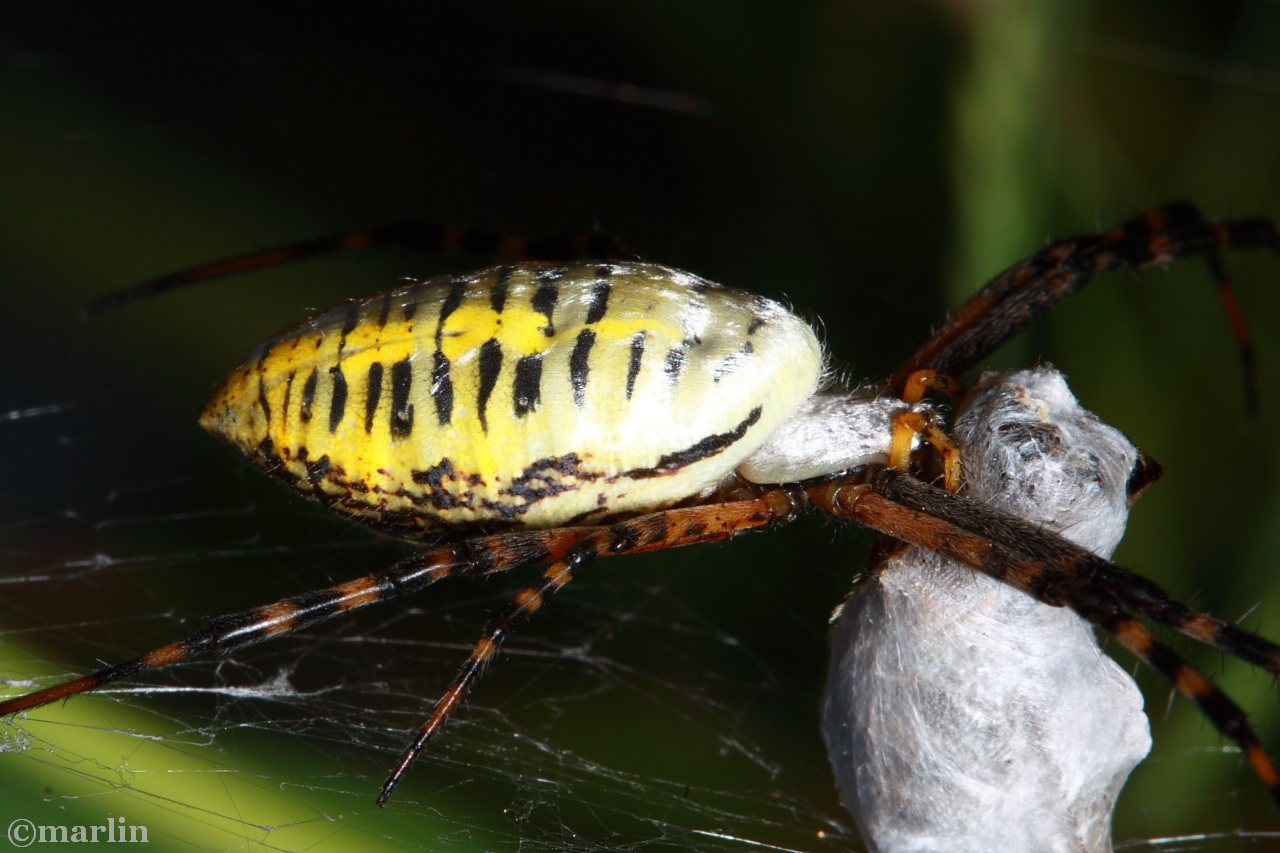
This spider is in "hurry-up" mode. Having just captured a paper wasp (a very dangerous prey for a spider), she is rapidly pulling silk from her spinnerets with her back legs and wrapping it around the wasp by spinning the prey with her front legs (you can see the "spin axis" formed by the unfortunate insect's legs) . As soon as the prey is immobilized sufficiently, she quickly bites the wasp several times, injecting her venom into the insect's head - avoiding the business end altogether - then retreats to a safe distance and allows the poison to work. The process takes roughly 15 - 30 seconds. When the wasp is completely paralyzed and no longer presents a stinging threat, the spider comes back to finish wrapping her dinner. I thoroughly enjoy watching this macabre spectacle.

This is the large female spider in the wasp attack pictures above.
Argiopes like to hold their legs so it appears they only have four.


Spider injecting venom into wasp prey

The black and yellow garden spiders become very active toward the middle of August, here in Illinois. Their huge orb webs (up to 2 feet in diameter) can be found nearly anywhere there are tall weeds. Argiope spiders are carnivorous predators, active in the daytime, attacking insects that are trapped in their web. The spider hangs, head down, in the center of their web while waiting for prey. Often, she holds her legs together in pairs so that it looks as if there are only four of them. Sometimes the spider may hide in a nearby leaf or grass stem, connected to the center of the web by a nonsticky thread which quivers when prey lands in the web.

Argiope spiders often add stabilimenta, or heavy zig-zagging portions, to their webs. Stabilimenta are conspicuous lines or spirals of silk, included by many diurnal spiders at the center of their otherwise cryptic webs. It has been shown spider webs using stabilimenta catch, on average, 34% fewer insects then those without. However, webs with the easily-visible markings are damaged far less frequently by birds flying through the web. It is an evolutionary tradeoff the spider can influence every time it builds a new web. The inclusion of stabilimenta is influenced by many factors, including prey density and web location.  Read the scientific study at Behavioral Ecology magazine.
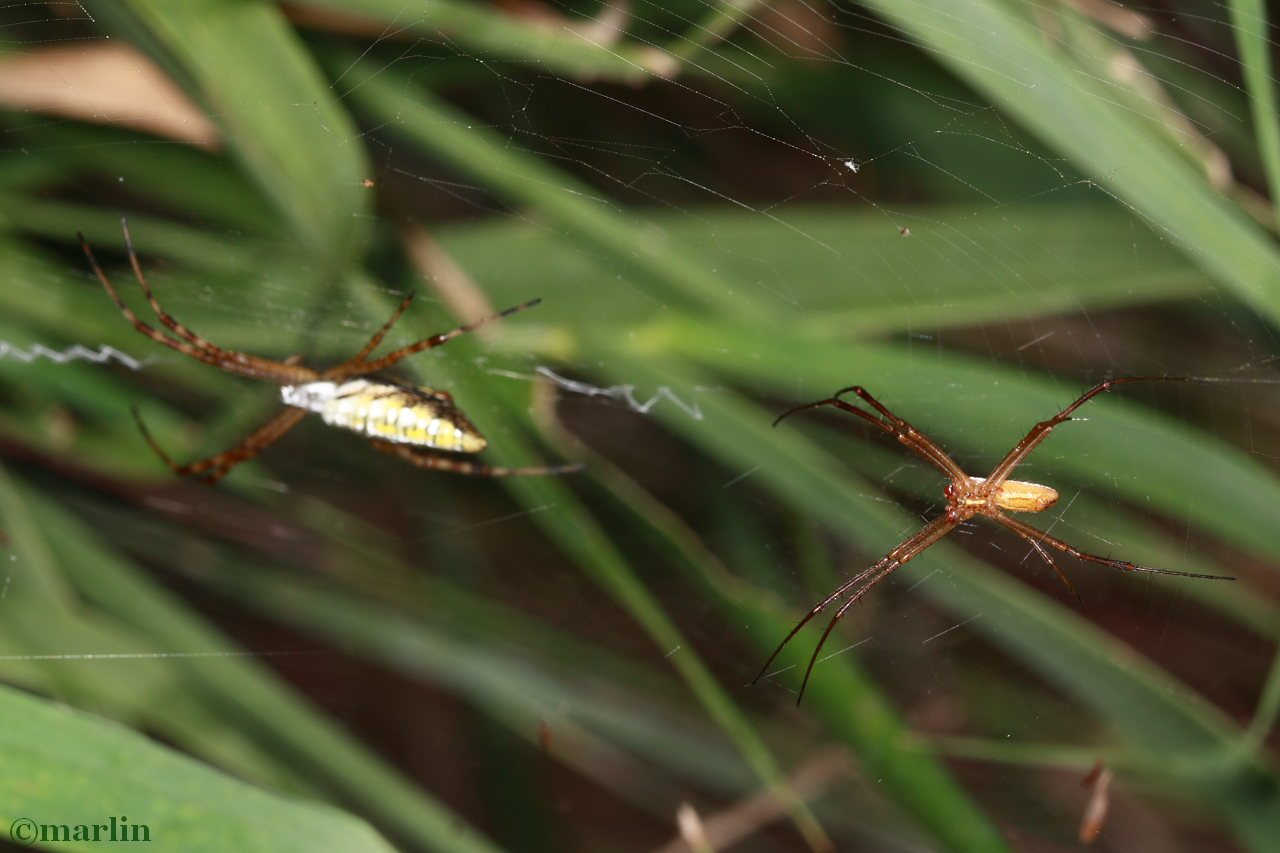
In any event, stabilimenta or no, a large Argiope planted firmly head-down in her web amongst tall weeds and grasses remains maddeningly invisible to man and beast. The black and yellow markings of the fat abdomen and striped legs function as camouflage much like the tigers' stripes do in the jungle - the geometric elements serve to break up the outline of the spiders' body and confuse the eye of the beholder into not recognizing the image. It is this principle upon which warships' hull camouflage was painted during the World Wars, with stark diagonal lines and shapes intended to keep an enemy from discerning the outline and identifying the size of the ship and the extent of its armaments.


These spiders, along with their somewhat larger kin, the Argiope aurantia, become active about the last week in August, at least, here in Northern Illinois. It's amazing - one day there are none, the next day they are seemingly everywhere! I hate this time of year, much as I love these spiders - I have to look very, very carefully where I'm walking when in the field. As large as these spiders are, they and their webs are difficult to see in tall grass and weeds - a fact, no doubt, very advantageous to the spider - and the chances of running into a web are very good if you're not wary. I'm worried about damaging the webs, sure - but the thing that gets me is, when you accidentally run into a web - "WHERE'S THAT SPIDER NOW!?" ARRRGH. Oh lordy, when I'm photographing them, even two inches away, that's fine. But don't you ever ever put one on me - I'LL FREAK. My skin crawls just writing these words!


      Web   www.cirrusimage.com

[Cirrus Home]    [Butterflies]    [Bugs]    [Beetles]    [Mantids]    [Spiders]    [Bees & Wasps]    [Dragon & Damselflies]    [Moths]   [Wildflowers]
[Fungi & Mushrooms]    [Flies]   [Butterflies of the World]  [Trees of North America]  [Cicadas & Grasshoppers]   [Ticks & Mites] 

 Please see these guidelines for free noncommercial use of our images. © 2007 Cirrus Digital Imaging
Photo researchers: Deadline approaching? We accept all major credit cards and can email your purchases same day. Contact: Bruce Marlin