Jumping Spider - Phidippus clarus
Family: Salticidae
Live adult jumping spiders photographed at Winfield, DuPage County Illinois, and Lake Crabtree County Park, Wake County, North Carolina.
 

Jumping Spider - Phidippus clarus
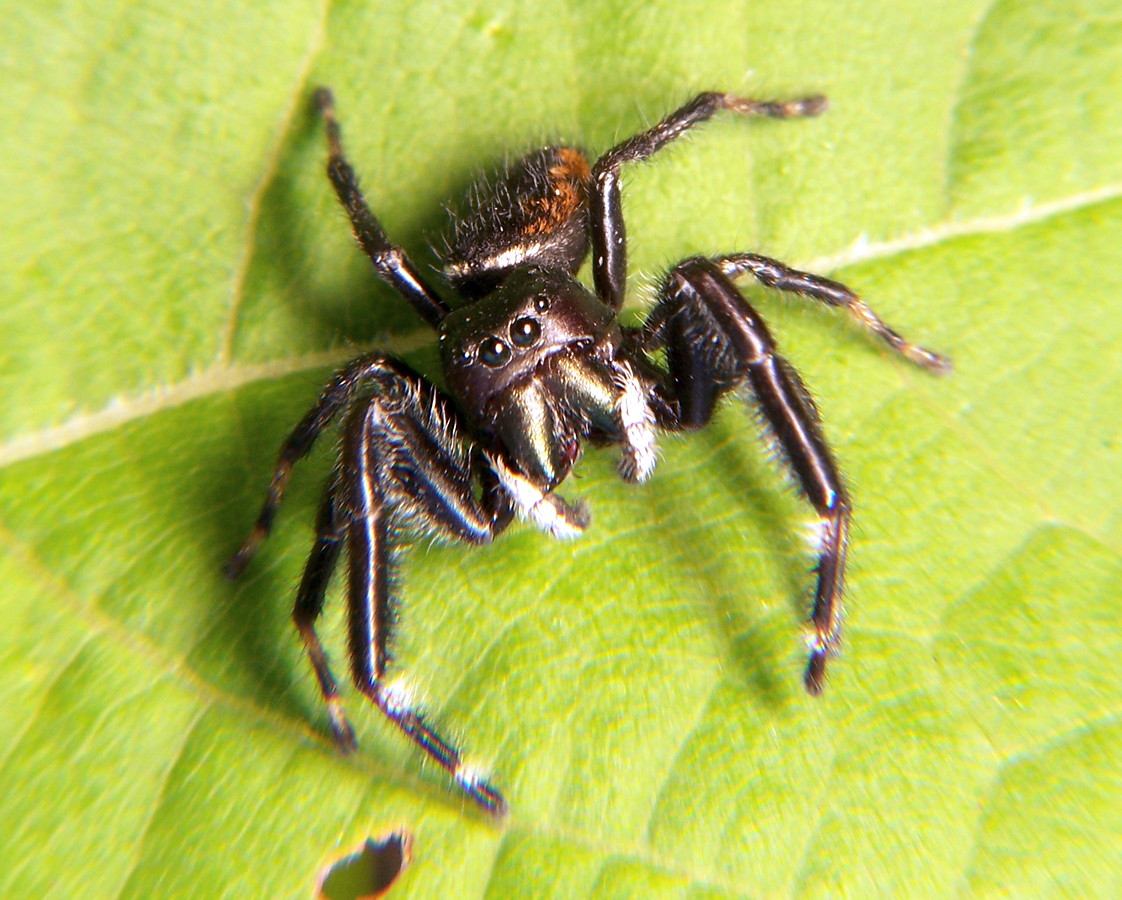
 This is a large male jumping spider: 10mm. You can actually see the moveable retina in this spider's eyes.
Jumping spiders don't move their eyeballs like we do, they move the retina inside the eye.
Jumping spiders in the genus Phidippus have iridescent green chelicerae.

Jumping Spider - Phidippus clarus
You can see the moveable retinas in this spider's eyes.

Jumping spiders are easily distinguished from other spiders by their four big eyes on the face and four smaller eyes on top of the head. Around the world there are probably more than 5000 species of jumping spiders. Jumping spiders are charming lil buggers that look up and watch you.  Although a jumping spider can jump more than fifty times its body length, none of its legs has enlarged muscles. The power for jumping comes from a quick contraction of muscles in the front part of the body increasing the blood pressure, which causes the legs to extend rapidly much as the hydraulics in a low-rider car.

Their vision also allows communications by visual means, such as the elaborate courtship dances that males perform. Salticids are perhaps as old and diverse as mammals, though not many humans know their world. Many salticids are colorful, they take on a variety of body forms, and some have disguises, looking like ants and other organisms. The bright colors and elaborate forms of some jumping spider species are involved in courtship.


Jumping spiders are small to medium in size, stout-bodied and short-legged, with a distinctive eye pattern. The body is rather hairy (pubescent) and frequently brightly colored or iridescent. Some species are antlike in appearance. The jumping spiders forage for their prey in the daytime. They approach prey slowly and, when a short distance away, make a sudden leap onto the unfortunate animal. They are good jumpers and can leap many times their own body length.

Phidippus audax is one of the most common jumping spiders in North America. It is commonly called the "bold" or "daring" jumping spider. Most casual photographers capture only this species.

Phidippus clarus
Phidippus male keeps a close watch on me. The long forelegs are adapted for rapidly capturing prey. The red patch under the green chelicerae are the venom-delivery fangs.


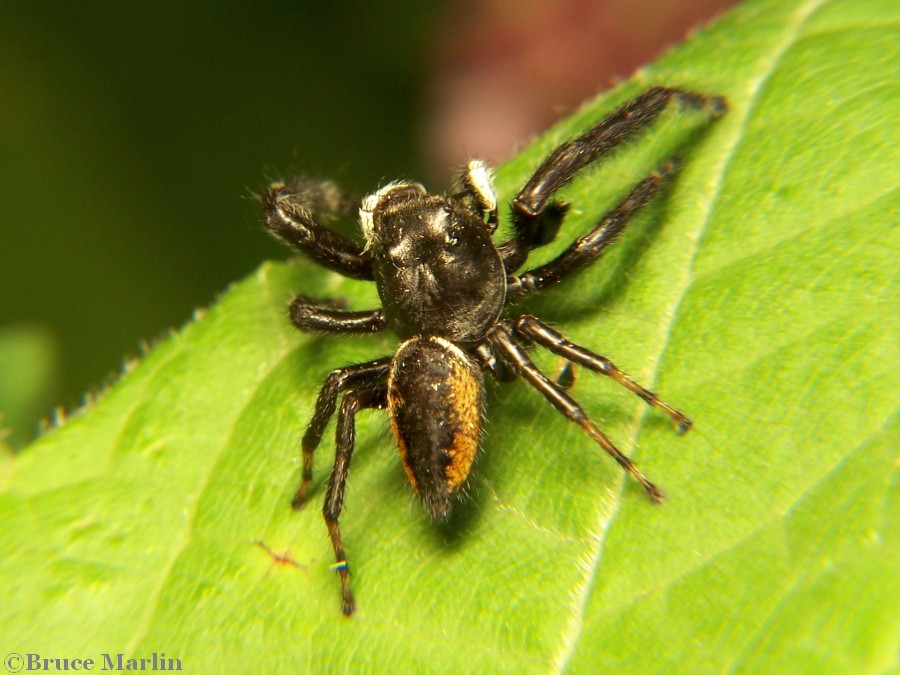
Female

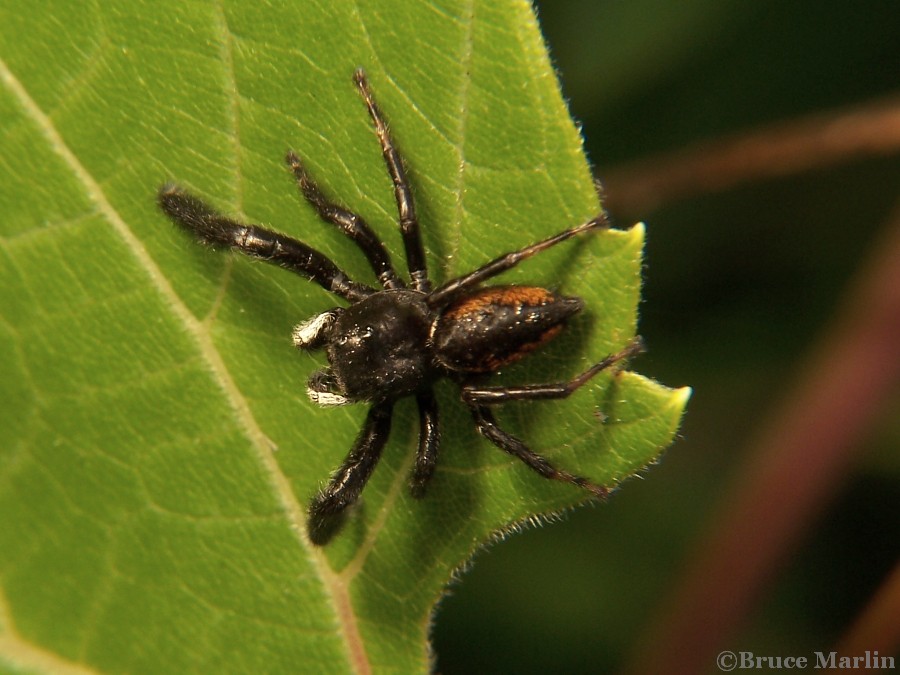
Small male 6mm

Female with ambush bug prey
Jumping Spider - Phidippus clarus
Female hunting


       web       www.cirrusimage.com