|
Hummingbird Clearwing Moth - Hemaris thysbe
Order Lepidoptera / Suborder Macrolepidoptera / Superfamily
Sphingoidea / Family Sphingidae -- hawk moths, hornworms, sphinx moths
Species Hemaris thysbe (Fabricius) -- common clear-wing,
hummingbird moth, sphinx colibri
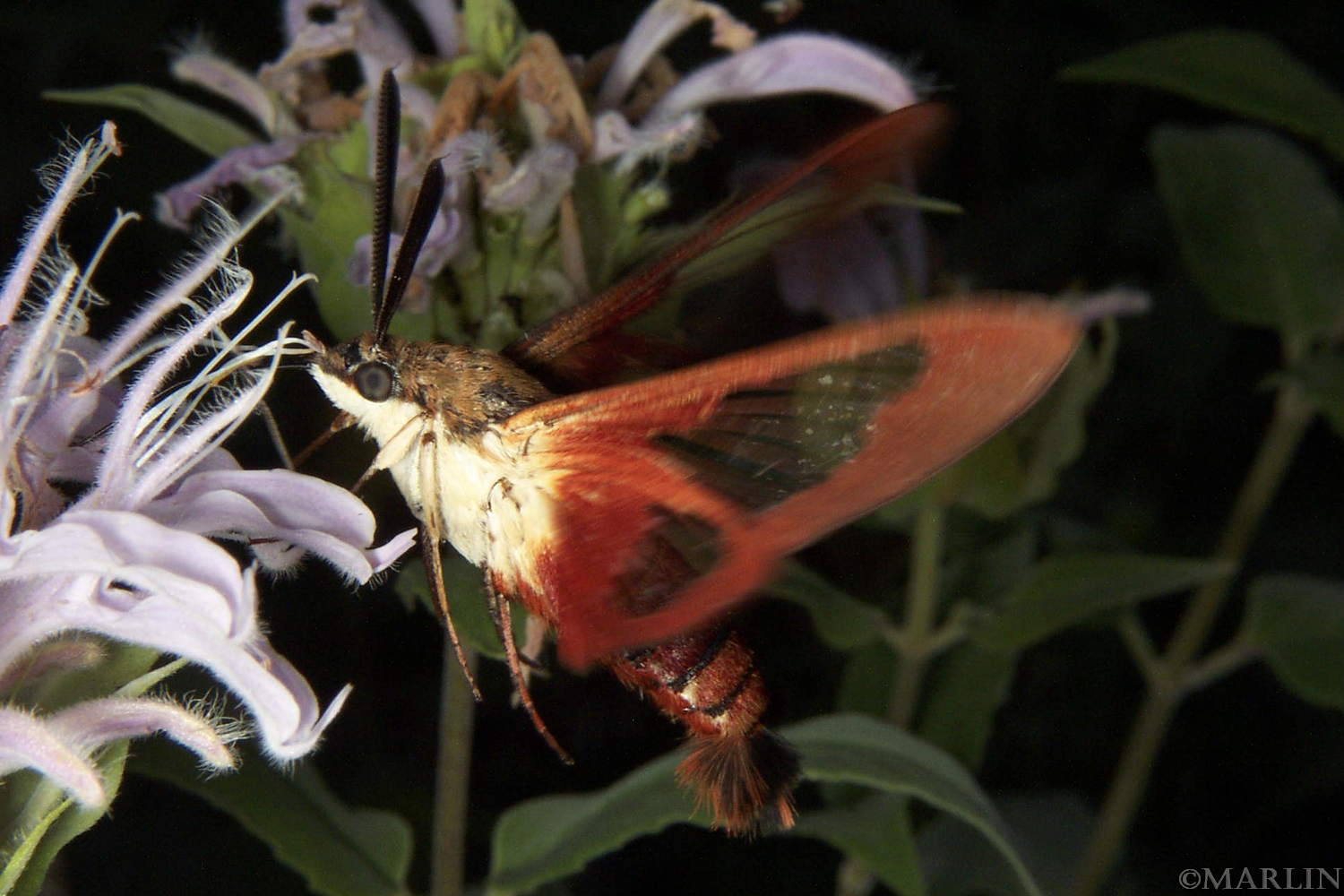
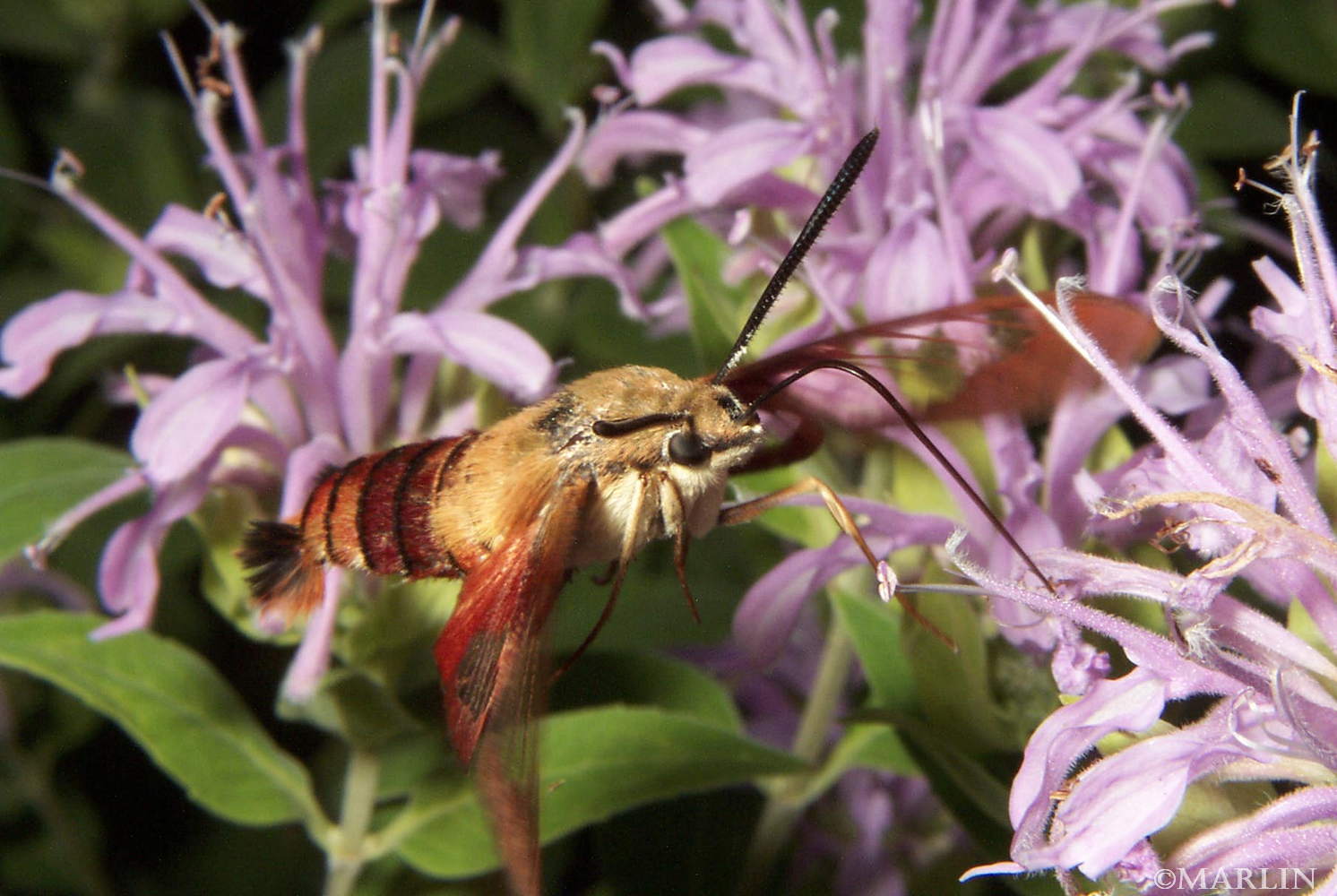
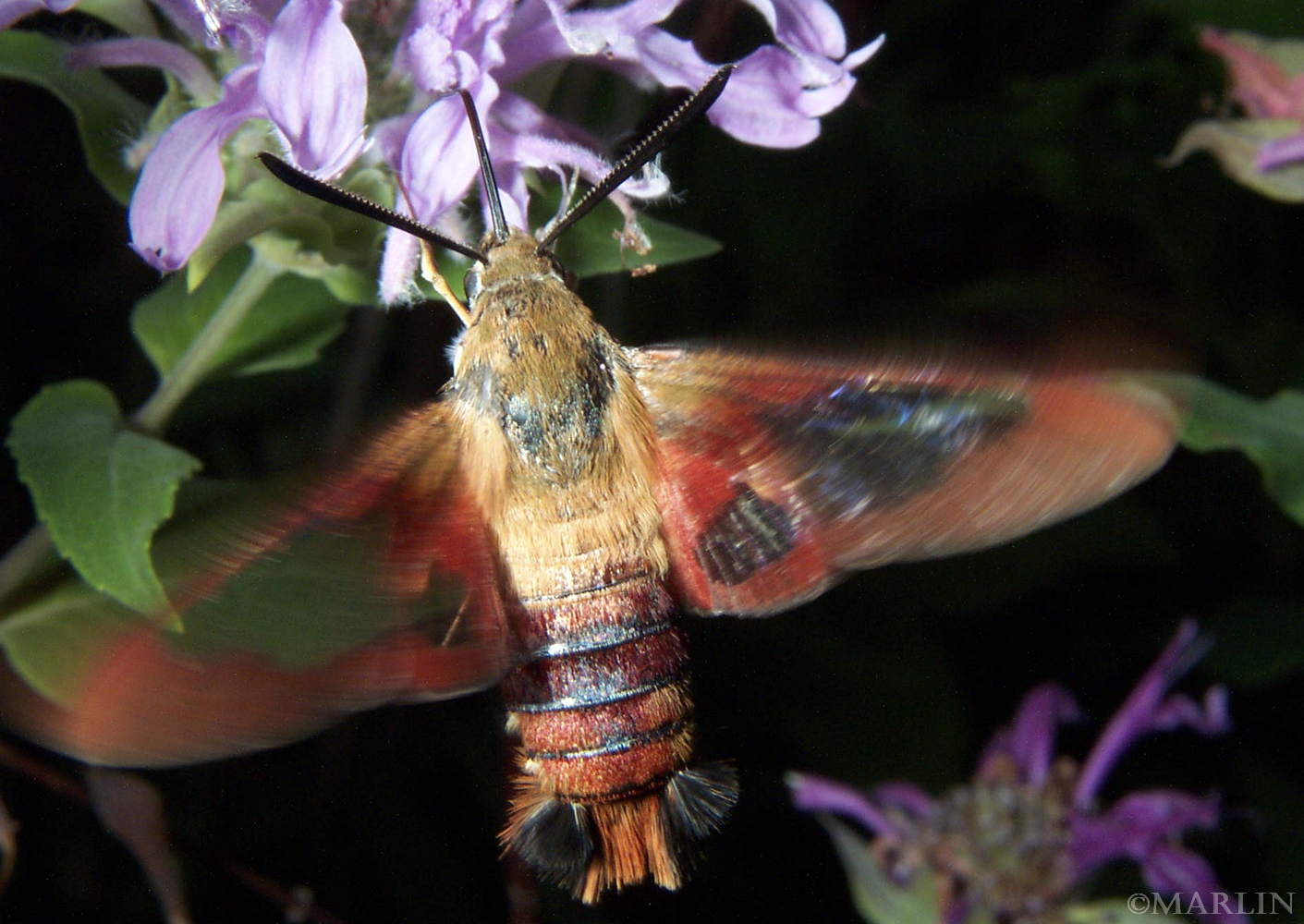
Live adult moths photographed in the wild at Winfield, Illinois, USA.
Thanks to Michael W. Nelson, Invertebrate Zoologist, Massachusetts
Natural Heritage & Endangered Species Program, for identifying these
specimens.
|
|
|

Hummingbird Clearwing Moth, Hemaris thysbe |
|
Hemaris thysbe, the Hummingbird Clearwing Moth or Common Clearwing
(wingspan 38-50 mm), readily visits flowers by day throughout the
eastern half of the U.S. and Canada, where it ranges far to the north,
even into the Yukon. It is not difficult to see why many gardeners would
mistake an Hemaris thysbe moth for a small hummingbird as it hovers,
sipping nectar from flowers through a long feeding tube. The moth hovers
briefly, sipping for only a few seconds before darting off to a new
flower. Green body "fur" and burgundy wing scales suggest a small ruby
throated hummingbird. |

|
Adult sphinx moths are medium to large moths with wingspans ranging
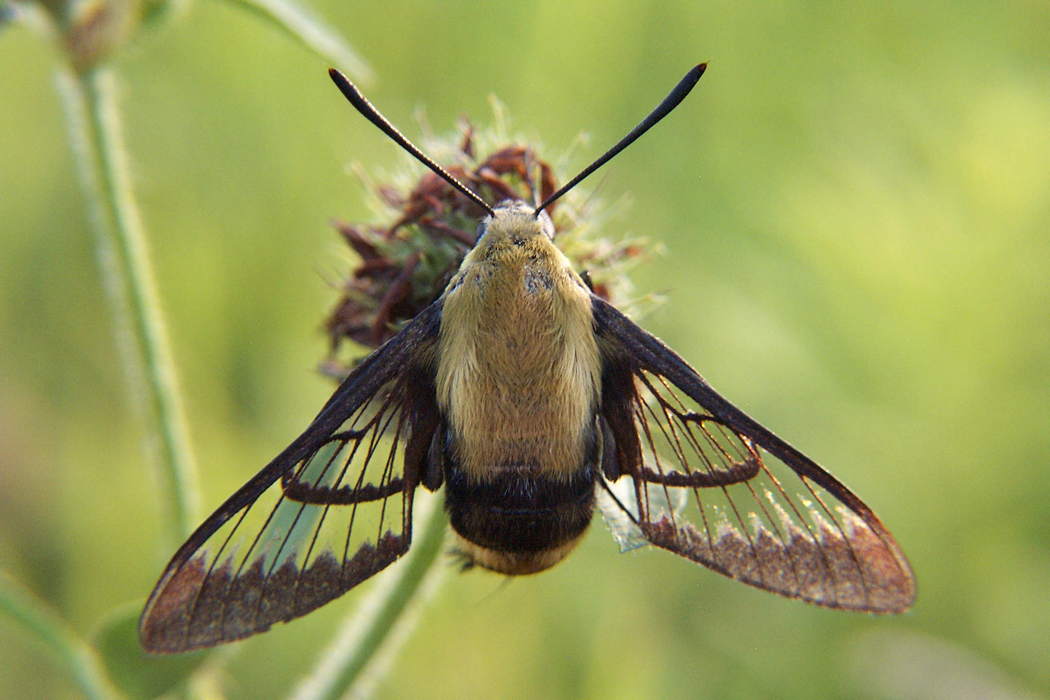
from about 1.25 inches to 4.75 inches. The snowberry clearwing is
one of the smallest moths in this group, while the five-spotted hawk
moth is one of the largest. Its larva is the familiar tomato
hornworm. The Carolina sphinx, whose larva is known as the tobacco
hornworm, weighs only one to two grams, but it flaps its wings an
astonishing 25 to 30 beats per second. Some sphinx moths have been
clocked at speeds as high as 30 mph.
Sphinx moths are often mistaken for hummingbirds and bumblebees
because of their similarities in size, foraging behavior and feeding
structures. Many sphinx moths are nocturnal, but several species are
diurnal, meaning they are active during the daytime when
hummingbirds and bumblebees are also foraging. Adult sphinx moths
have a long, straw-like "tongue," called the proboscis, which they
keep curled under the head. They use it to suck nectar from the
flower. The nectar is rich in sugar, which fuels the energy required
for hovering. Hummingbirds also have a long tongue to lap up nectar.
|

|
The hummingbird clearwing is relatively common in North America.
Its larvae feed on honeysuckle, buckbrush, wild cherry and plum. Adults
hover and sip nectar at many different flowers, including honeysuckle,
beebalm, phlox, lilac and bergamot. All the specimens pictured here are
feeding at bergamot. The
snowberry clearwing, a close
relative, is nearly as abundant. This bumblebee mimic is yellow with
black wings and abdomen. At 1.25 to 2 inches, its wingspan is slightly
smaller than that of the hummingbird clearwing. Its larvae feed on
honeysuckle, dogbane and buckbrush. Adults eat from many flowers,
including thistles, milkweed and lilac. |
|
|
Google Pack is:
-
Software specifically
selected by Google
-
Always FREE - no trial
versions or spyware
-
Ready to use in just a
few clicks
|

I heartily recommend the extremely
useful software in the Google Pack.
Choose only the software you want! |
- Google Earth / Picasa / Norton Security
Scan
- Google Desktop / Firefox with Google
Toolbar
- Adobe Reader / Skype / StarOffice
(includes Java)
- Google Toolbar for IE / Spyware Doctor
- Google Photos Screensaver / Google Talk
|
|
|
|