Milkweed Tussock Moth Caterpillars
Hodges#8238
Subfamily Arctiinae (Tiger and Lichen Moths)
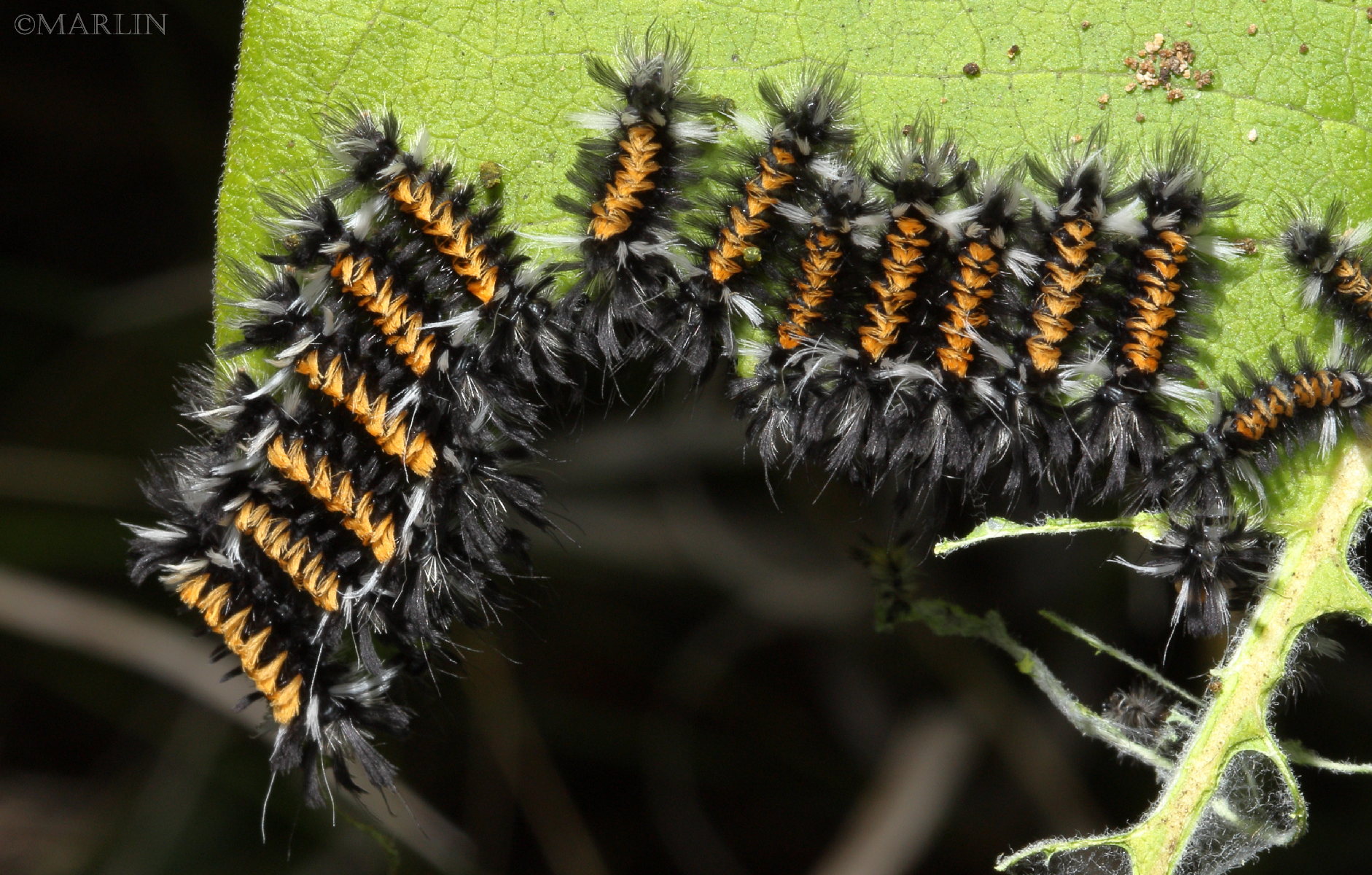
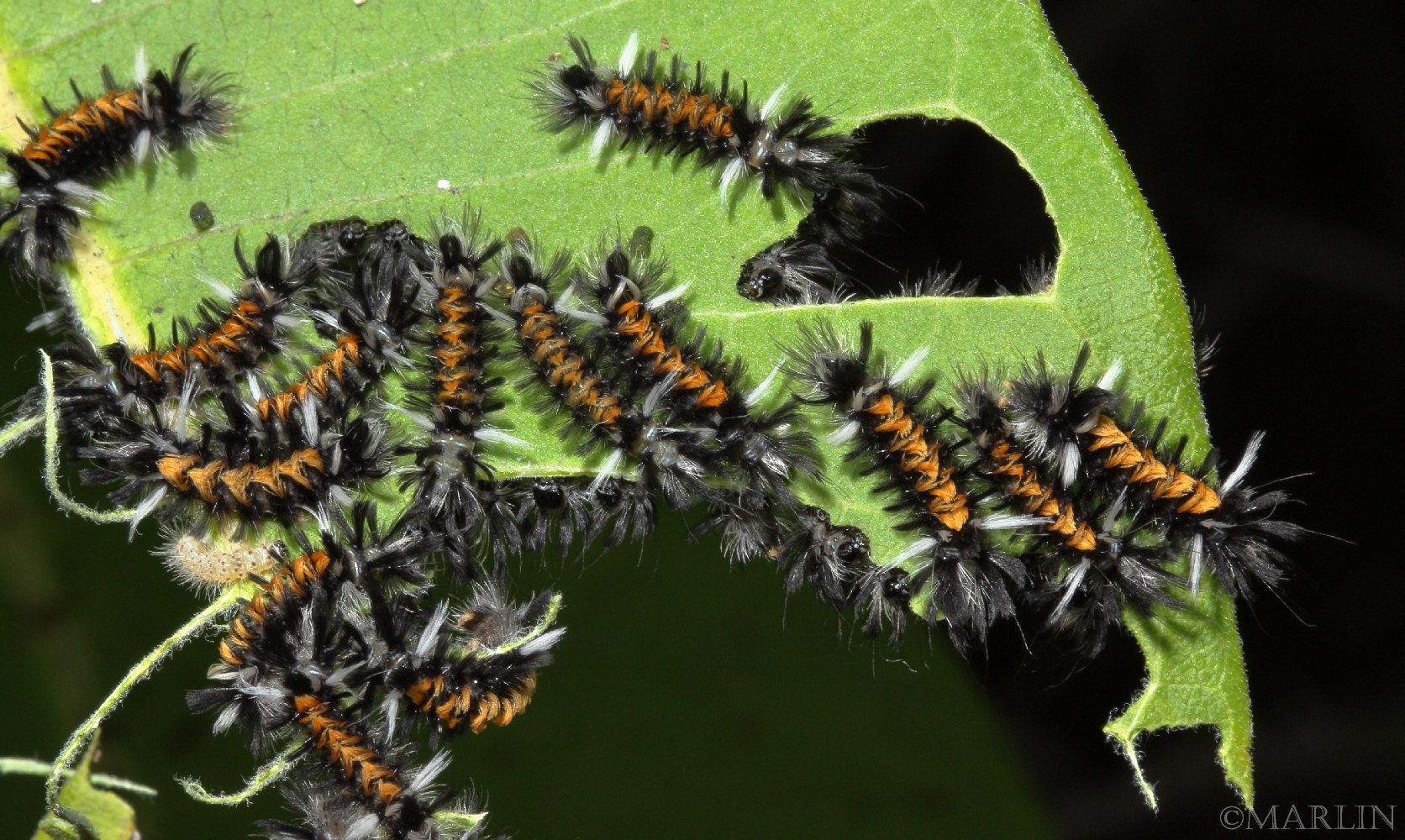
Live caterpillars gregarious feeding on milkweed photographed at Blackwell Forest Preserve, DuPage County, Illinois, USA. I estimate there were 200 caterpillars on a single milkweed plant.
Like most species in this family, the milkweed tussock moth’s larvae obtain a chemical defense from their host plants, in this case, cardiac glycosides from milkweed or dogbane. These are retained into the adult stage and deter predators. Only very high cardiac glycoside concentrations deterred bats, however (Hristov and Conner 2005). Inedibility is also advertised with clicks from the tymbal organs.
Sporting tufts of black, white and orange (sometimes yellow) setae, larvae skeletonize whole leaves gregariously, leaving a lacy remnant. The head capsule is black. The later instars wander much more, and may appear alone or in small clusters. Mature caterpillars are found from June onwards (Wagner 2005). Grows to a length of 35 mm. [2]
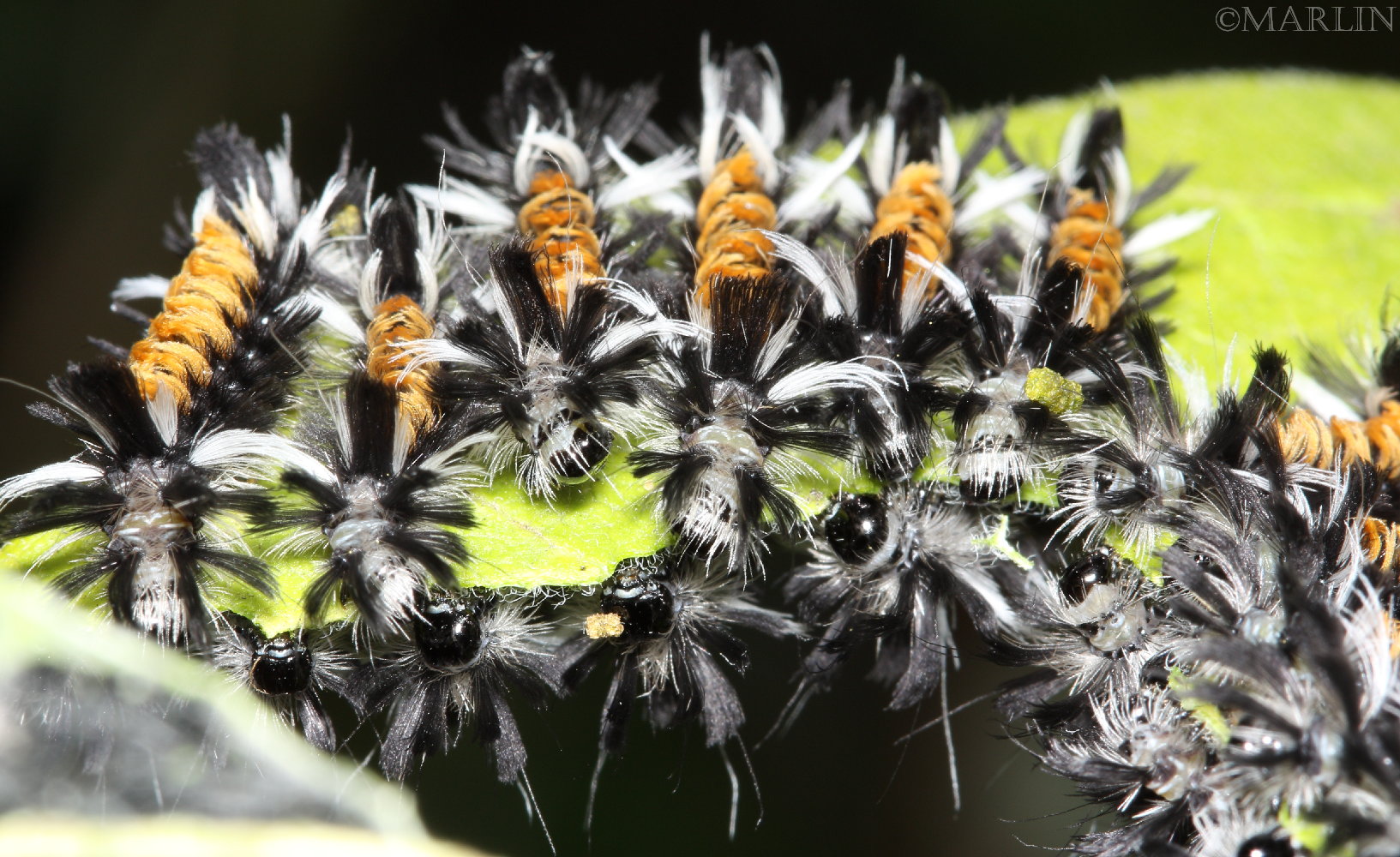
They feed on both top and bottom of the leaf – the “idea” being they quickly consume the entire plant and so do not leave evidence of their feeding, (i.e., holes in the plant) to attract predators. They are ravenous and milkweeds do not stand a chance. There must be some evolutionary limiting pressure, as I do not see these cats very often even among the vast fileds of milkweed I frequent.
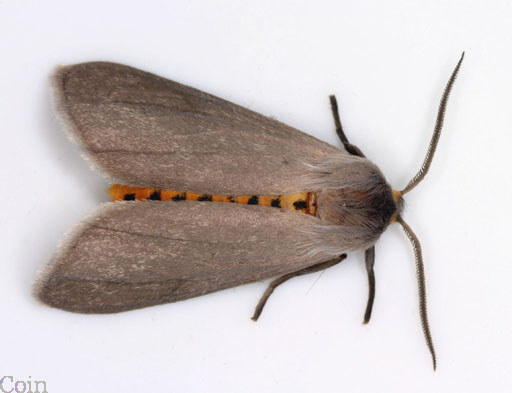
Adult Milkweed Tussock Moth
Photo: Patrick Coin

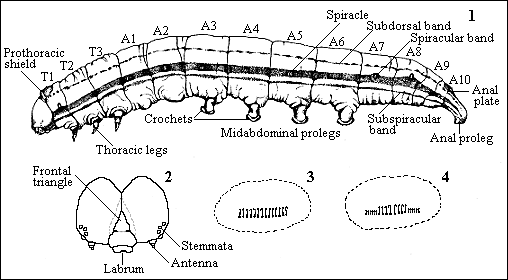
Fig. 1 Diagram of a caterpillar. Fig. 2 Frontal view of caterpillar head
The head (figure 2) bears 6 lateral eyes (the stemmata) that are usually arranged in a crude circle. Other insect larvae resembling caterpillars have only a single lateral eye.
Short antennae are positioned between the mouthparts and the lateral eyes. The labrum, or upper lip, may be cleft, with the notch engaging the leaf while the larva is feeding. A second diagnostic feature shared by all true caterpillars is an inverted Y that runs down the middle of the face (figure 2). The lower arms of the Y delimit the frons, or frontal triangle; the upper portion extends back to the thorax. The 3 thoracic segments each bear a pair of segmented (true) legs with a terminal claw, the thoracic legs. On the dorsal, or upper side, of the first thoracic segment, there is commonly a hardened plate called the prothoracic shield. The abdomen is composed of 10 segments. Most caterpillars possess 4 pairs of fleshy, unsegmented midabdominal prolegs on their third, fourth, fifth, and sixth segments and a pair of anal prolegs on the last segment. Because exceptions are numerous, the number and relative size of the prolegs is often important in the recognition of families. The prolegs bear a series of hooks, called crochets, that are used by the caterpillar to engage the substrate and maintain their purchase (figures 3 and 4). The number, size, and arrangement of the crochets are often useful in identification. Sawfly immatures are caterpillar-like, but differ in the possession of more than 4 pairs of midabdominal prolegs, none of which bear crochets. (3)
References
- BugGuide.net, Euchaetes egle
- Wikipedia, the free encyclopedia, Euchaetes egle
- United States Geological Survey, Caterpillars of Eastern Forests (morphology)
Moths Index | Moths | Butterflies Main | Butterflies Index | Skippers
Tree Encyclopedia / North American Insects & Spiders is dedicated to providing family-friendly educational
resources for our friends around the world through large images and macro photographs of flora and fauna.
Online since 2002