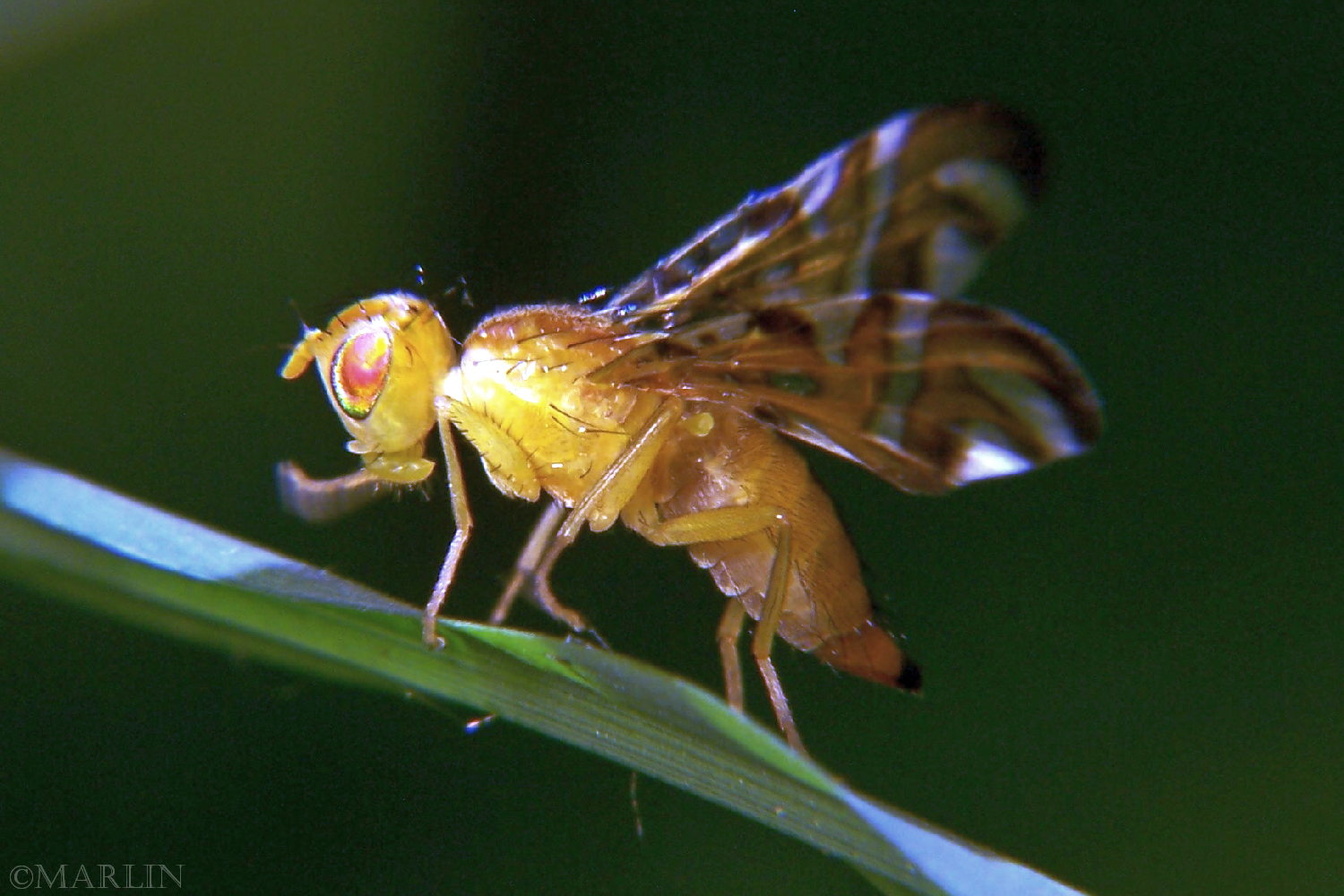
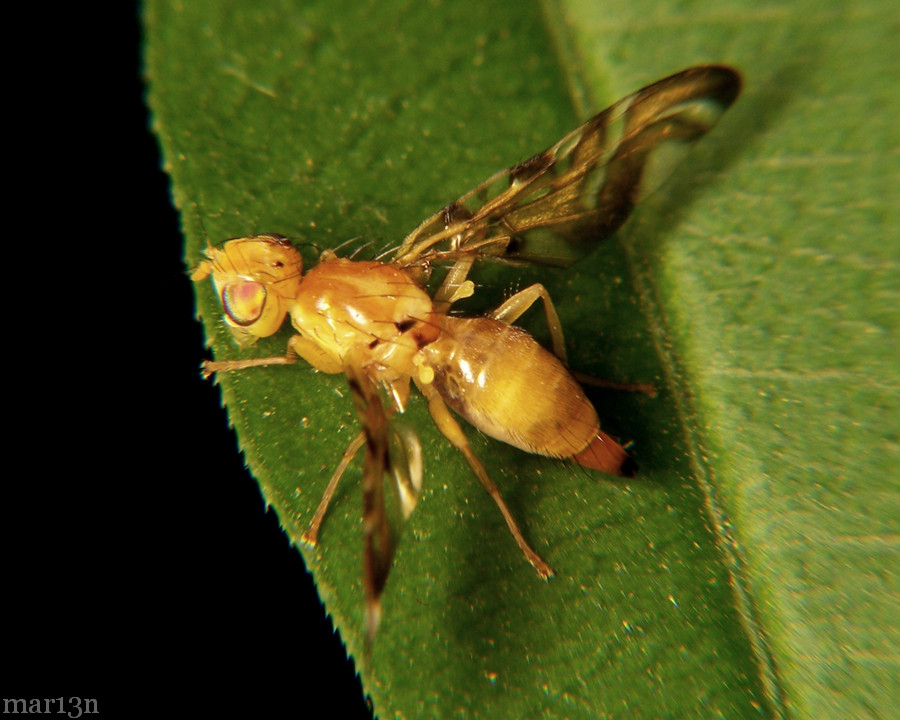
|
There are three species of
sunflower maggots that are pests of cultivated
sunflower and attack different parts of the plant.
These include the sunflower receptacle maggot,
Gymnocarena diffusa (Snow), the sunflower maggot,
Strauzia longipennis (Wiedemann), and the sunflower
seed maggot, Neotephritis finalis (Loew) (Diptera:
Tephritidae). The adult forms of all three sunflower
maggots have wings with a distinct brown or
yellowish‑brown pattern. While all three fly species
are similar in appearance, they do have
distinguishing differences.

The sunflower receptacle maggot is the largest of
the three with a body about 10 mm long and a wing
span of approximately 19 mm. The eyes of this
species are bright green and the wings have a
yellowish‑brown and somewhat mottled appearance. The
larvae are yellowish‑white in color attain a length
of nearly 8 mm at maturity. The adult has a wing
spread of about 13 mm and a body 6 mm long. The
wings bear broad, dark bands that form a fairly
distinct F‑shaped mark near the tips. The larvae of
the sunflower maggot are creamy-white and attain a
length of about 7 mm at maturity. The sunflower seed
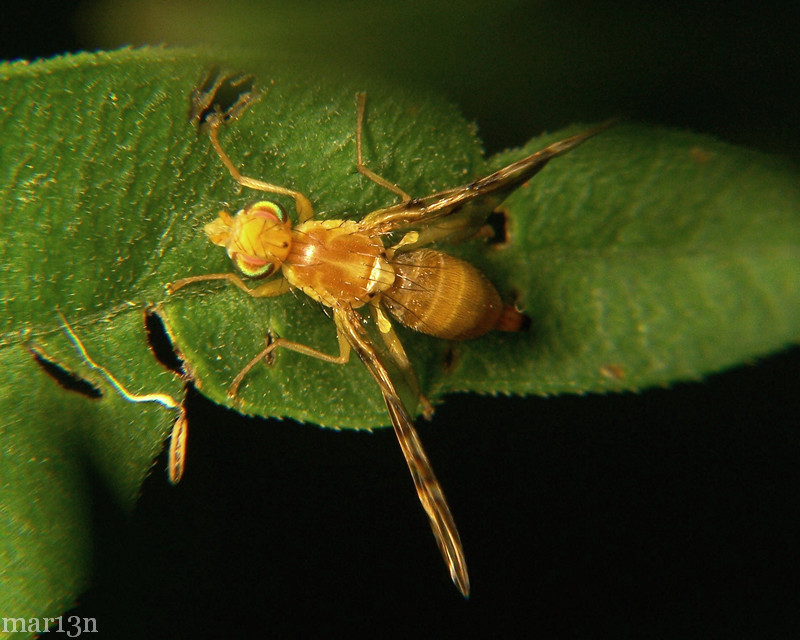
maggot is the smallest of the three species with a
body length of the adult about 6 mm and a wing span
of approximately 7 mm. The wings have a brown
lace‑like appearance. The larvae attain a length of
4.5 mm at maturity. The small, brown pupae are found
in the face of the sunflower bud, usually surrounded
by a small number of damaged disk flowers. Adults of
the sunflower receptacle maggot emerge in late June
to early July after sunflower buds reach 5 to 10 cm
in diameter. Eggs are laid on the bracts of the
developing sunflower heads. Egg laying occurs from
mid-July through August. The hatched larvae tunnel
into the spongy tissue of the receptacle. Damage to
the head is negligible. After 30 days, the mature
larvae cut a small emergence hole on the underside
of the receptacle and drop into the soil to pupate.
Overwintering pupae are found about 19 cm deep in
the soil by August or early September. Some larvae
will pupate in the sunflower head.

The sunflower maggot has
one generation per year. This species overwinters as
a larva in plant debris in the soil; pupation and
adult emergence are completed in early June. Females
lay eggs in stem tissue of young sunflower, and
larvae feed in the stem pith tissue. Unlike the
other two species of sunflower maggots, two complete
generations per year of N. finalis occur in North
Dakota. Adults of sunflower seed maggot emerge
during the first week of July and oviposition occurs
on the corolla of incompletely opened sunflower
inflorescences. The total larval period is 14 days.
The first generation pupates in the head; the second
generation overwinters in the soil as pupae.
Economic damage from any of these species is rare.
The magnitude of damage to sunflower seeds by
sunflower seed maggot larvae largely depends on the
larval stage and seed development. Seed sterility
occurs when newly hatched larvae tunnel into the
corolla of young blooms; a single larva feeding on
young flowers will tunnel through 12 ovaries. Mature
larvae feeding on older sunflower heads destroy only
one to three seeds. While infestation levels of the
sunflower maggot have occasionally reached nearly
100 percent, damage within sunflower stalks from
larval feeding usually is light. (1)
|