Locust Borer Beetle – Megacyllene robiniae
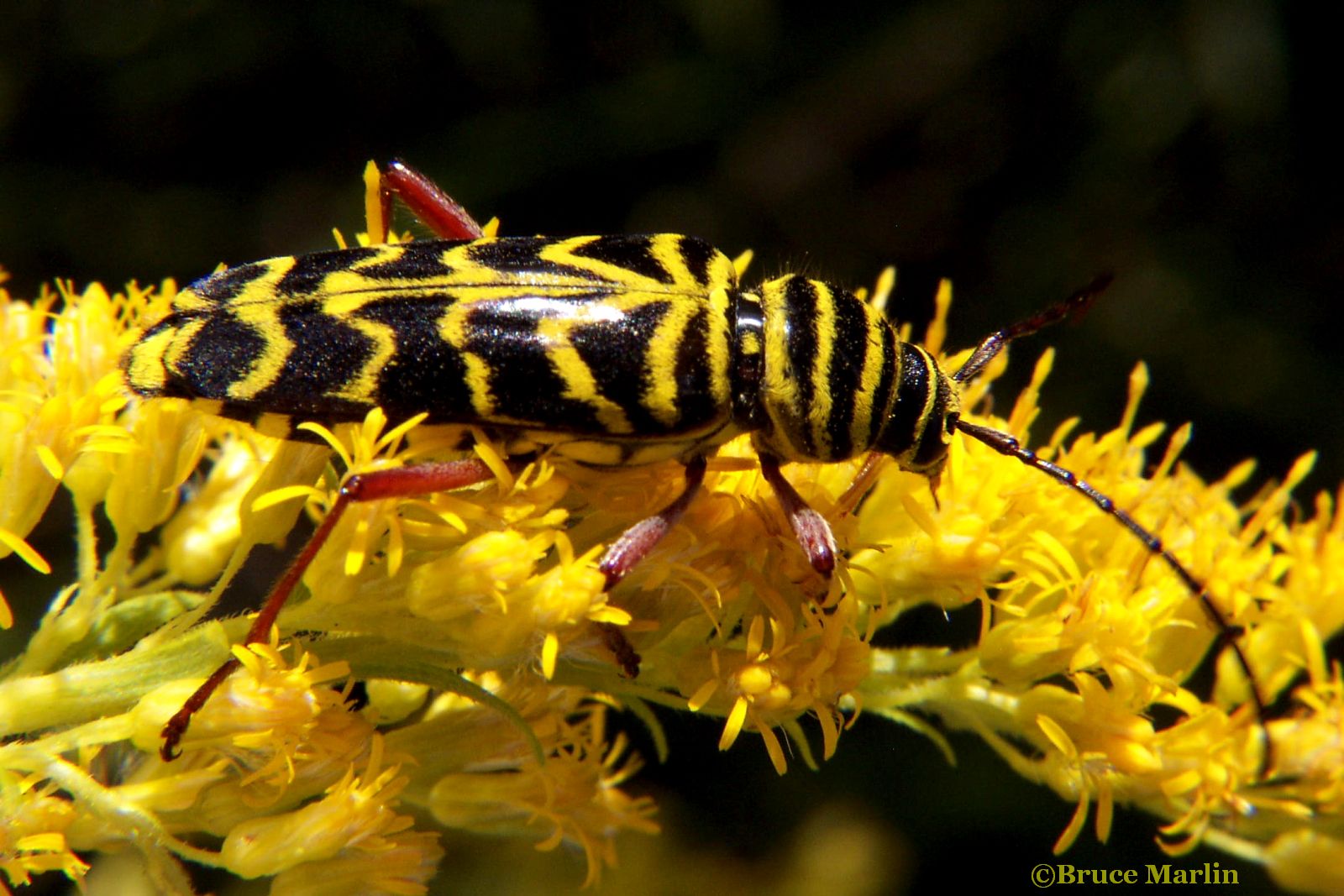
Family Cerambycidae — capricornes, long-horned beetles, longicornes
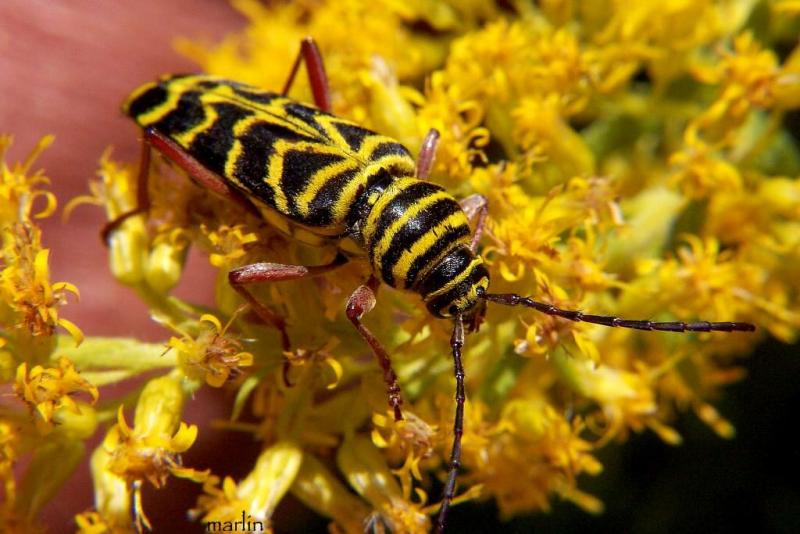
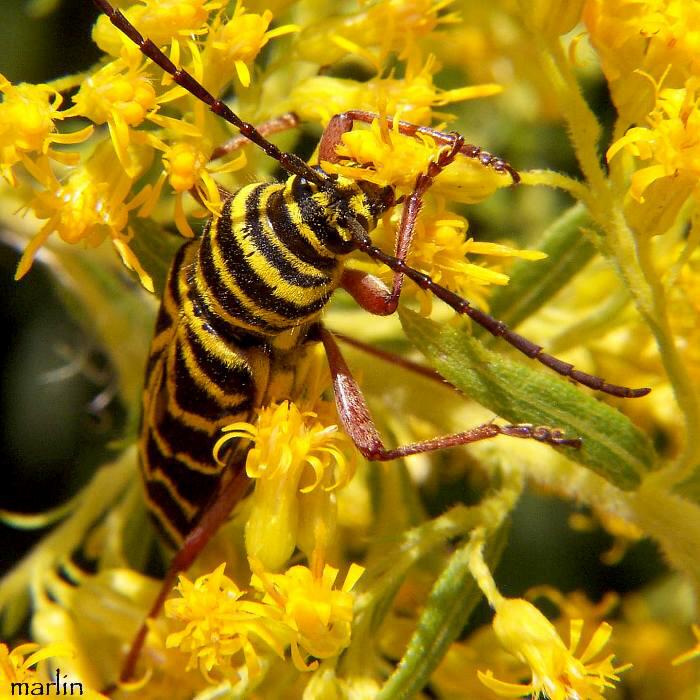
Live adult beetles photographed at Winfield, Illinois, USA. Shown with Goldenrod (Solidago sp.)
Habitat and Life Cycle: The brightly colored adults appear when goldenrod (Solidago sp.) is in bloom, generally mid-August through October here in the midwest. I took photos of this specimen feeding on goldenrod pollen in the midst of a large mown field, hundreds of yards from trees of any variety, and so it’s obvious to me the beetles will range far from their host plants in search of food.
Females start laying eggs in the early afternoon and continue until dusk, August – October. Eggs are laid under the bark, around pruning wounds and wind breakage and in cracks in the bark – rarely where they can be easily detected. About a week later, the eggs hatch and small white larvae bore into the inner bark, where they make a small hibernation cell and overwinter. In the spring, the larvae bore into the woody part of the tree, eventually enlarging their tunnels until they are 3-4 inches long and 1/4 inch in diameter. By mid-July, most of the larvae begin the pupal stage, which lasts about 2 weeks. The mature adult beetles emerge through the holes made by the larvae.
Mature larvae are white, about 1 inch (2.5 cm) long and one-quarter of an inch (0.6 cm) in diameter. Newly formed pupae are creamy white and about three-quarters of an inch (1.9 cm) long. Both the larval and pupal stages are spent inside the tree [1].
The locust borer beetle is native to North America. It attacks only black locust trees of the genus Robinia, which originally grew only in the Allegheny and Ozark mountain regions. Due to its ability to thrive in poor soils, the black locust has been widely used as a shade tree and in reclaiming land damaged by farming and strip mining. The locust borer beetle has extended its range as a result. It is now found over most of the U.S. and southern Canada.
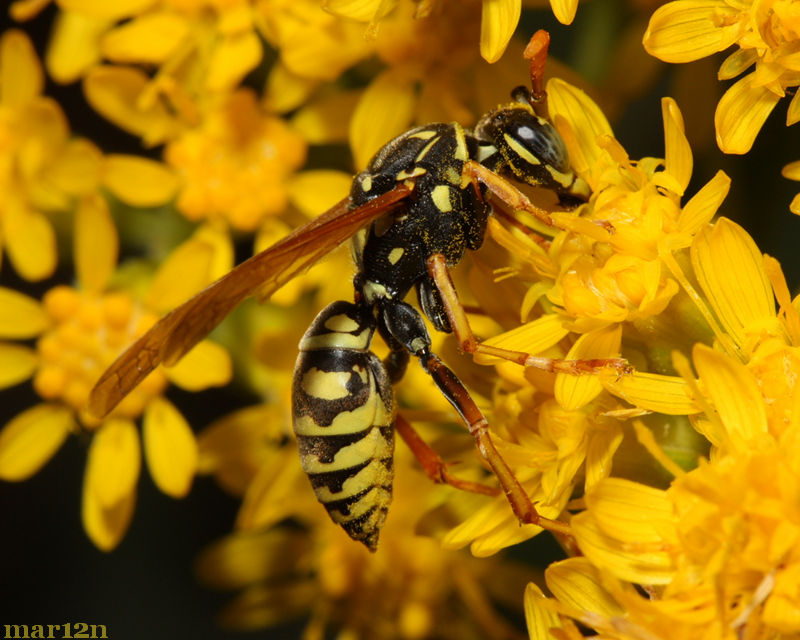 Paper wasp Polistes dominula: same food source, same aposematic coloring
This is one magnificent insect – about 1″ long, stately and impressive. I’d never seen one before I stumbled across this guy. The whole time I was shooting, I was saying, “What the hell is this thing!? What a COOL bug!” (Yes, I frequently talk to myself and my subjects when photographing them. Passersby must think me crazy).
Unfortunately, locust borer larvae tunnel into a tree’s trunk and branches, weakening the tree and making it susceptible to wind breakage. The damage from borer tunneling and wind breakage often results in deformed trees or clumps of sprout growth.
Borer injury is usually less serious when black locust is grown with other tree species. Mixed stands usually produce denser shade and more leaf litter than do pure stands of locust. Trees are more vigorous when nutrients from decomposed leaf litter are available. In pure locust stands, the addition of several inches of hardwood leaves results in accelerated growth for several years after the treatment and should reduce chances of serious borer damage.
Old black locust trees with dying tops serve as brood trees for the borer. Removing these trees from the vicinity of planting areas should be helpful in reducing damage to the young planted trees. These large brood trees should be cut during the dormant period and either peeled or burned to destroy the borer larvae. [1]
References
- Jimmy R. Galford, Entomologist, Northeastern Forest Experiment Station, Forest Service, U.S. Department of Agriculture, Leaflet 71, The Locust Borer
- Josef Nissley Knull, The long-horned beetles of Ohio: (Coleoptera: Cerambycidae)
- Bugguide.net, Locust Borer Beetle – Megacyllene robiniae
Beetles Main | Beetles Index | Longhorns | Leaf Beetles | Soldier | Blister | Lady | Scarab
Tree Encyclopedia / North American Insects & Spiders is dedicated to providing family-friendly educational
resources for our friends around the world through large images and macro photographs of flora and fauna.
Online since 2002