
Ladybugs / Ladybirds – Family Coccinellidae
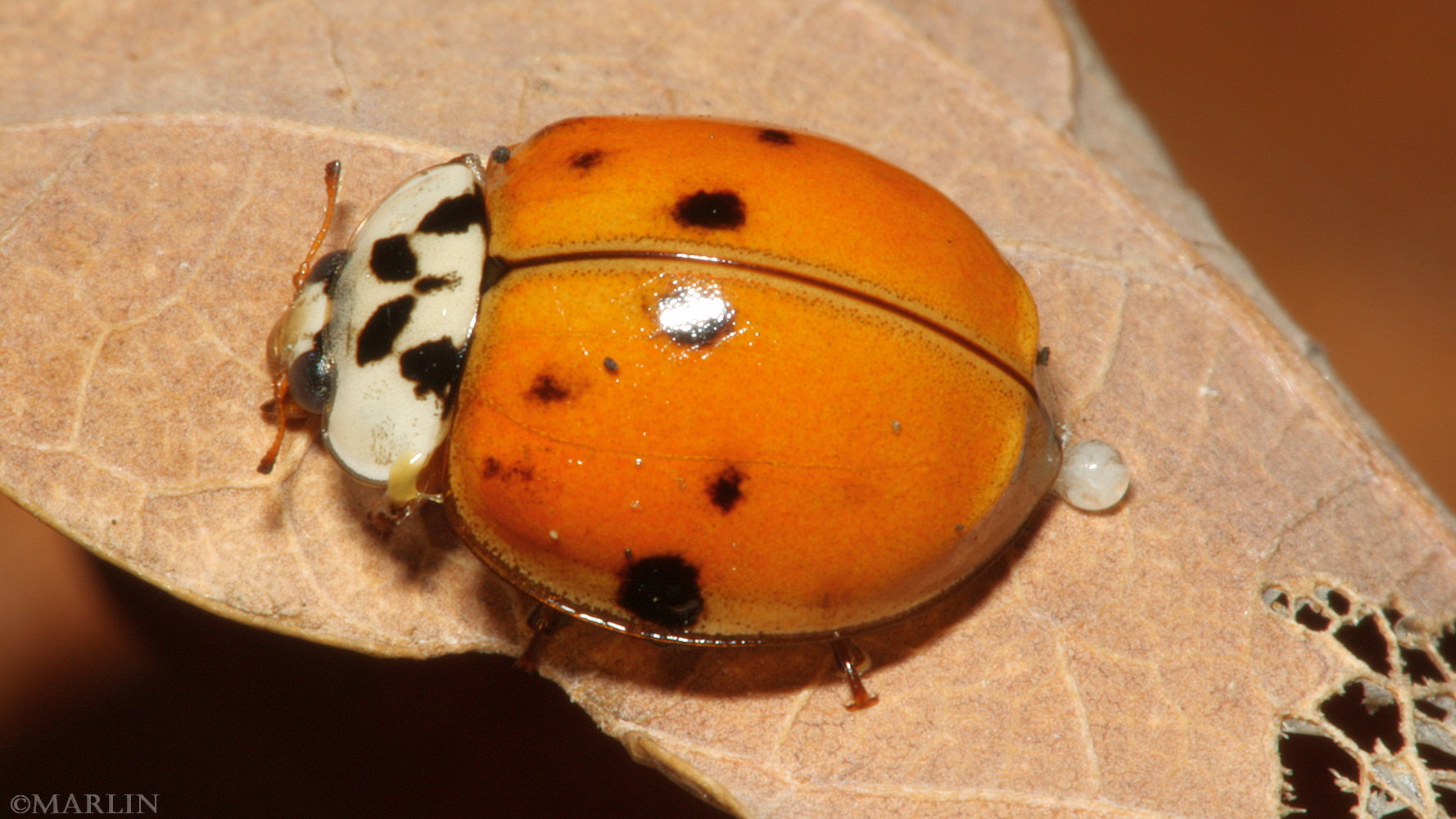 Late Season Ladybug, Harmonia axyridis
First and foremost let it be known these creatures are NOT bugs – they are beetles. Their houses are not on fire and their children will not burn.
Adult ladybugs have convex, hemispherical shaped elytra (the hardened wings used to cover the soft flying wings underneath) that can be yellow, pink, orange, red, or black, and usually are marked with distinct spots. This is a type of warning coloration (aposematic coloring), thought to discourage predators. Lady beetles also have another defense: an odorous, noxious fluid that seeps out of their leg joints when the insects are disturbed. I can truthfully say, I’ve been fooling with ladybugs since I was a child, but I’ve never noticed such a thing. It must be that the quantity of such fluid is so small as to affect only small creatures.
Ladybugs are among the most widely recognized beetles, for their bright colors and round, spotted elytra. Many people who are afraid of insects in general are fond of the ladybug, and will croon the oft quoted ditty, “Ladybug, ladybug, fly away home!” (Your house is on fire and your children will burn. Egads, how gruesome) while blowing on the insect to encourage its flight.
As insects go, they are a very beneficial group, being natural enemies of many insects, especially aphids and other critters that damage plants by feeding on their sap. A single ladybug can consume vast quantities of aphids in its lifetime, as many as 5,000 or more. There is a brisk business in commercial ladybugs for aphid control, and some of the species found in North America are actually invasives brought from Europe or Asia for such purpose.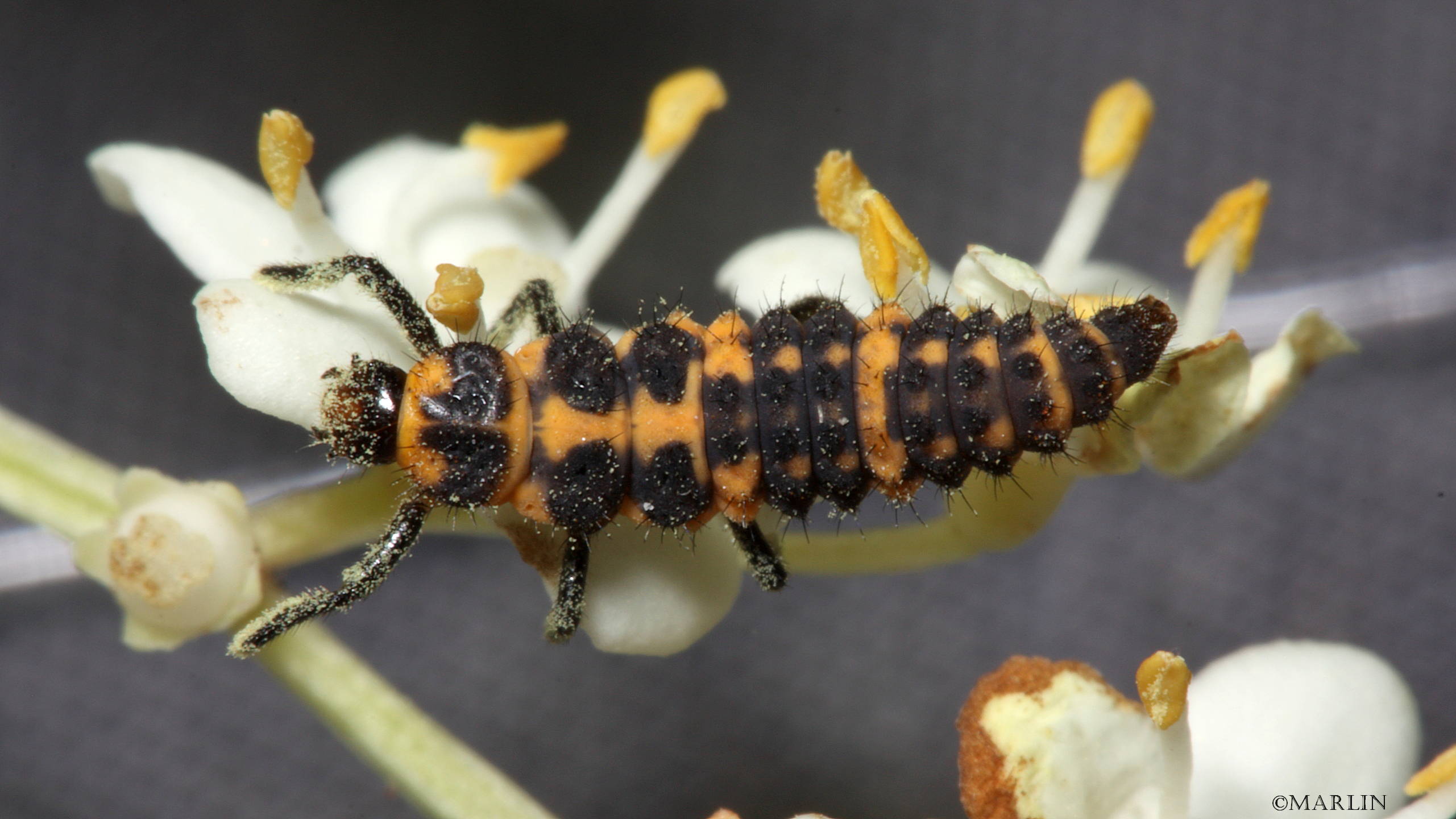
Lady beetle larva eating plum pollen while hunting for aphids
Ladybugs, both adults and larvae, are well-known primarily as predators of aphids (plant lice), but they prey also on many other pests such as soft-scale insects, mealybugs, spider mites and eggs of the Colorado Potato Beetle and European Corn Borer. A few feed on plant and pollen mildews. One larva will eat about 400 medium-size aphids during its development to the pupal stage. An adult will eat about 300 medium-size aphids before it lays eggs. About three to ten aphids are eaten for each egg the beetle lays. More than 5,000 aphids may be eaten by a single adult in its lifetime. The lady beetle’s huge appetite and reproductive capacity often allow it to rapidly clean out its prey.
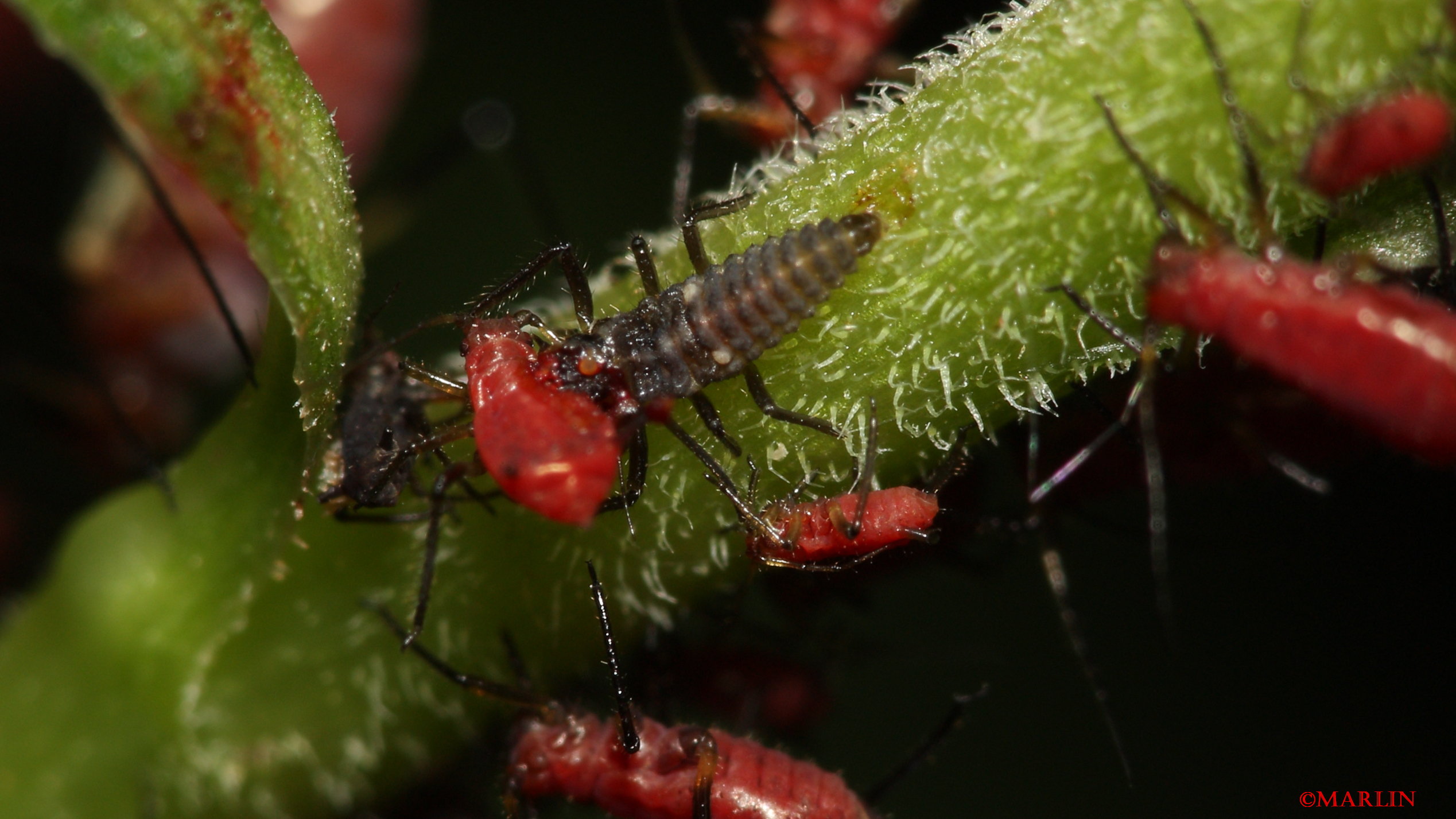 Ladybeetle larva attacking red aphid colony
Coccinella septempunctata, the seven-spotted ladybug, sometimes called ‘C-7’, is a medium-sized, orange beetle with seven black spots. It is a European species that was introduced into the US to aid in managing some aphid pests. Harmonia axyridis, the Multicolored Asian lady beetle, was introduced to North America many times, finally taking hold and becoming established in the 1980’s. This invasive has become far and away the most numerous of the Coccinellids here in the midwest, and they are becoming one of the most annoying insect pests, invading homes to overwinter, much as the box elder bug.
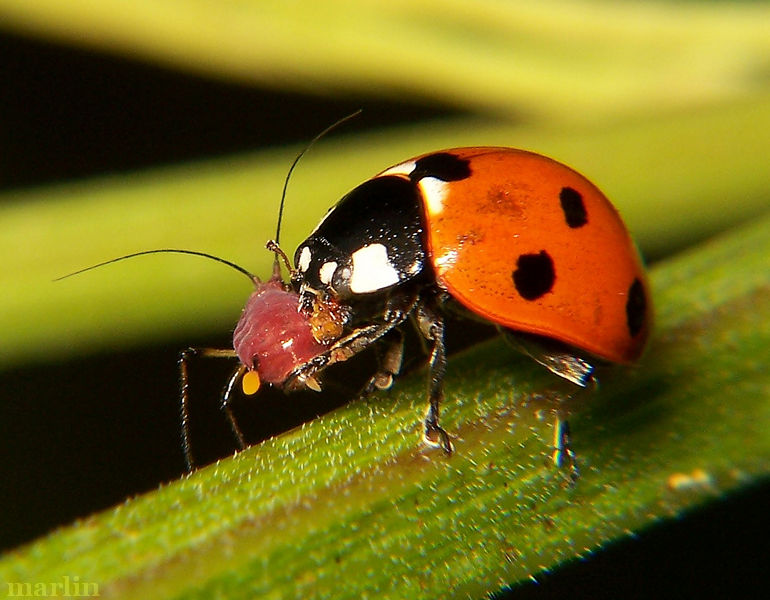
Seven-spotted Ladybug attacks an aphid – see the whole story HERE
Ladybugs often overwinter as adults in large swarms under fallen leaves, bark, or inside outbuildings. The active spindle-shaped larvae are usually covered with spines and are brightly colored in their own right. During the Middle Ages, these beetles were used to control aphid infestations of grapevines in vineyards; in appreciation, they were dedicated to “Our Lady,” hence the common name. In The U.K. they are known as ladybird beetles.
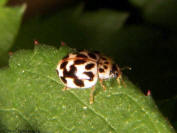
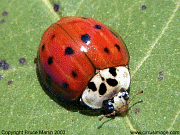 Harmonia axyridis |
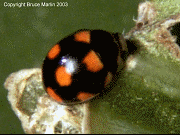 Brachiacantha ursina |
|
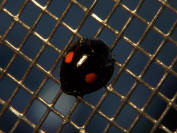 Twice-stabbed ladybug |
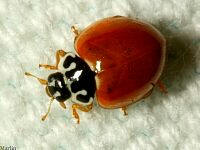 Spotless Ladybug |
|
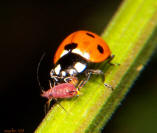 Lady Beetle attacks aphid |
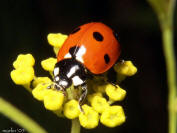 Coccinella septempunctata |
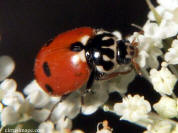 Variegated Lady Beetle |
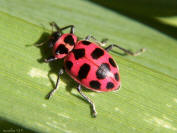
Order Coleoptera: Beetles are the dominant form of life on earth: one of every five living species is a beetle. Coleoptera is the largest order in the animal kingdom, containing a third of all insect species. There are about 400,000 known species worldwide, ~30,000 of which live in North America. Beetles live in nearly every habitat, and for every kind of food, there’s probably a beetle species that eats it.
Beetles Index | Longhorns | Leaf Beetles | Soldier | Blister | Lady | Scarab
Tree Encyclopedia / North American Insects & Spiders is dedicated to providing family-friendly educational
resources for our friends around the world through large images and macro photographs of flora and fauna.
Online since 2002