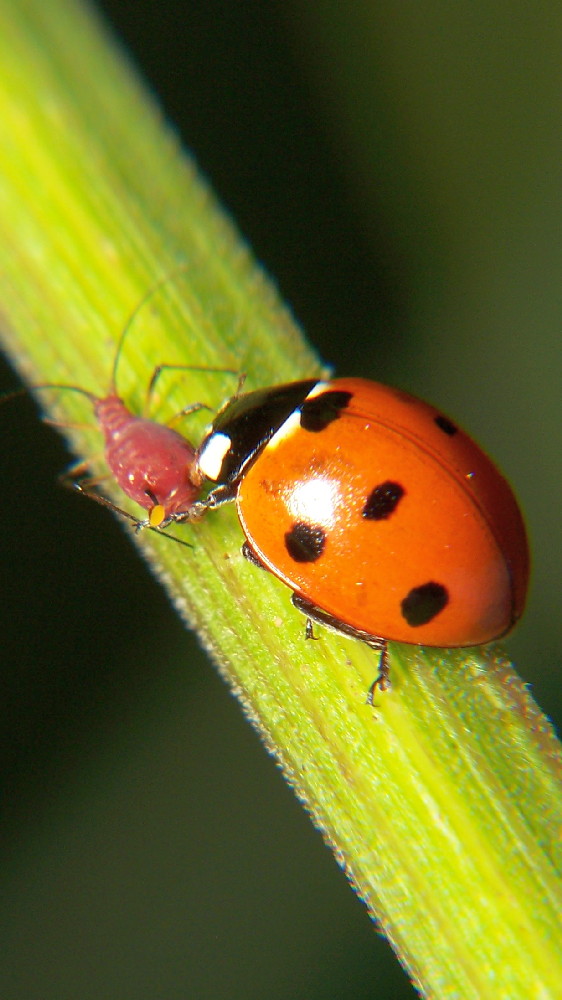
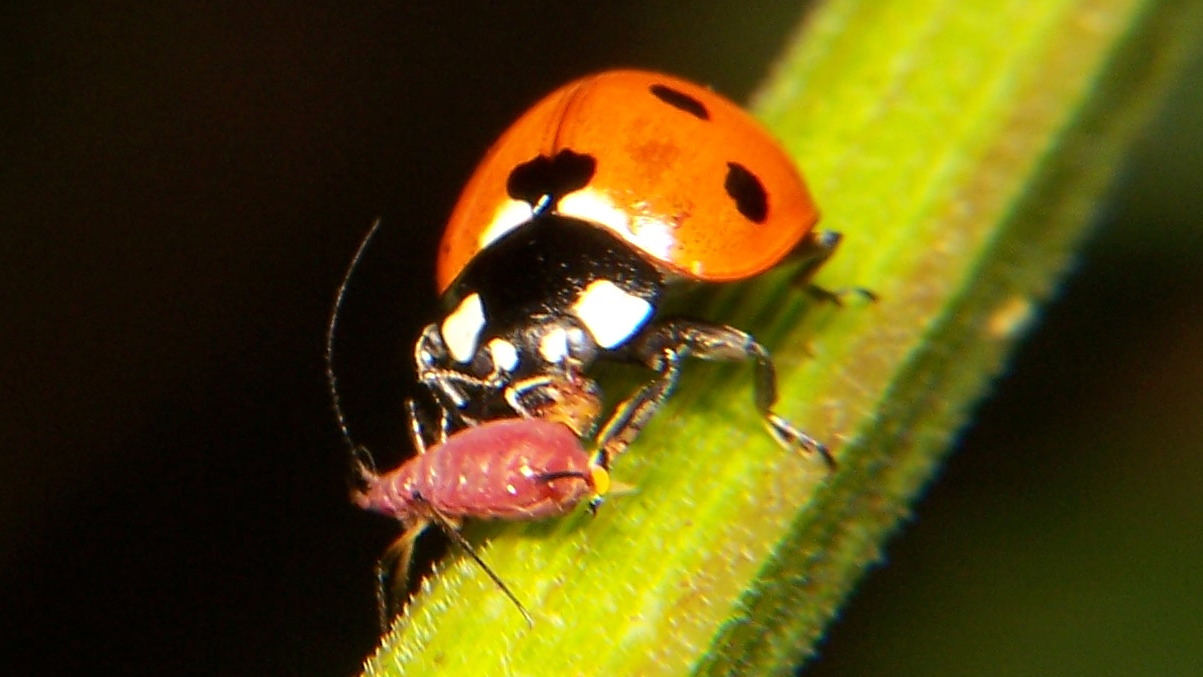
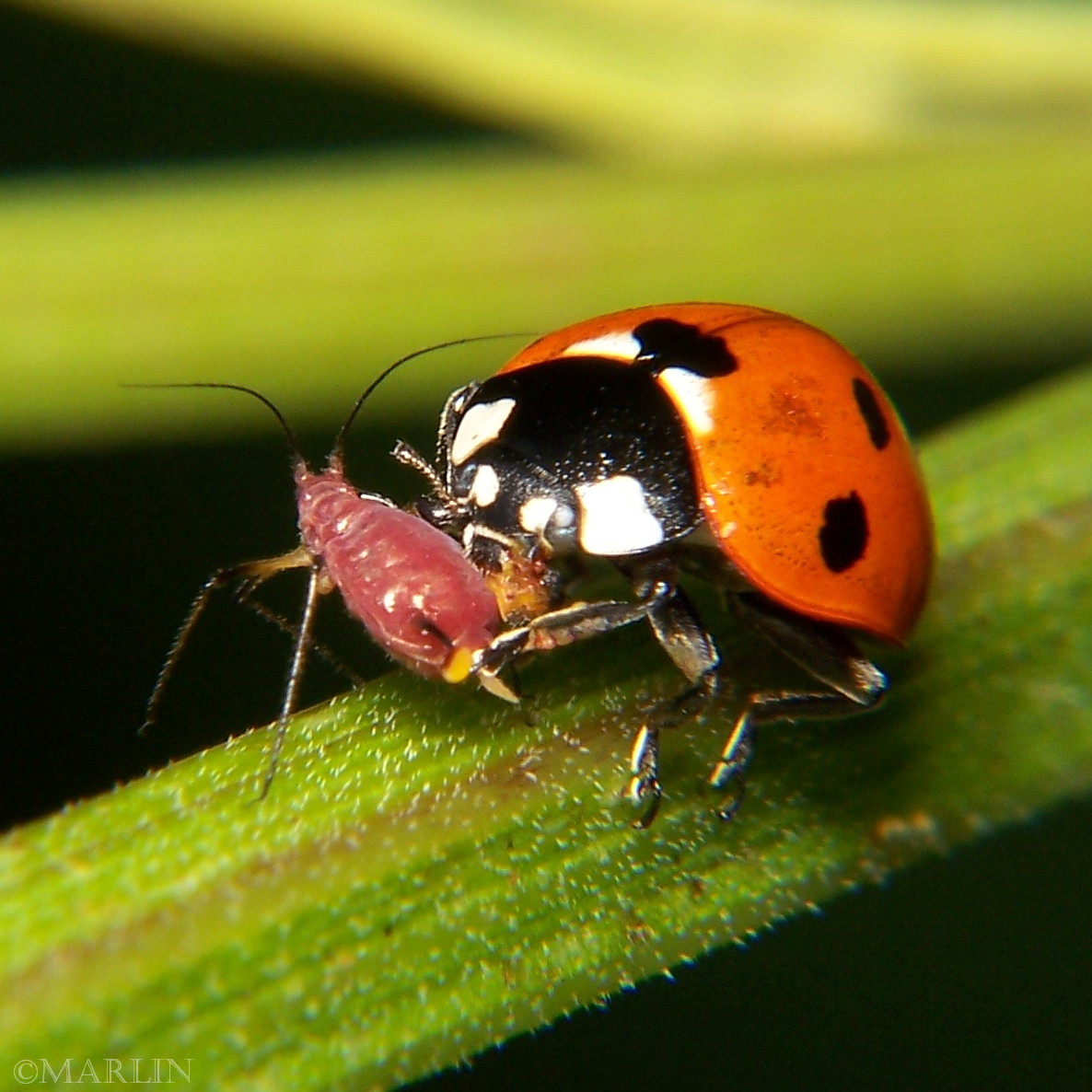
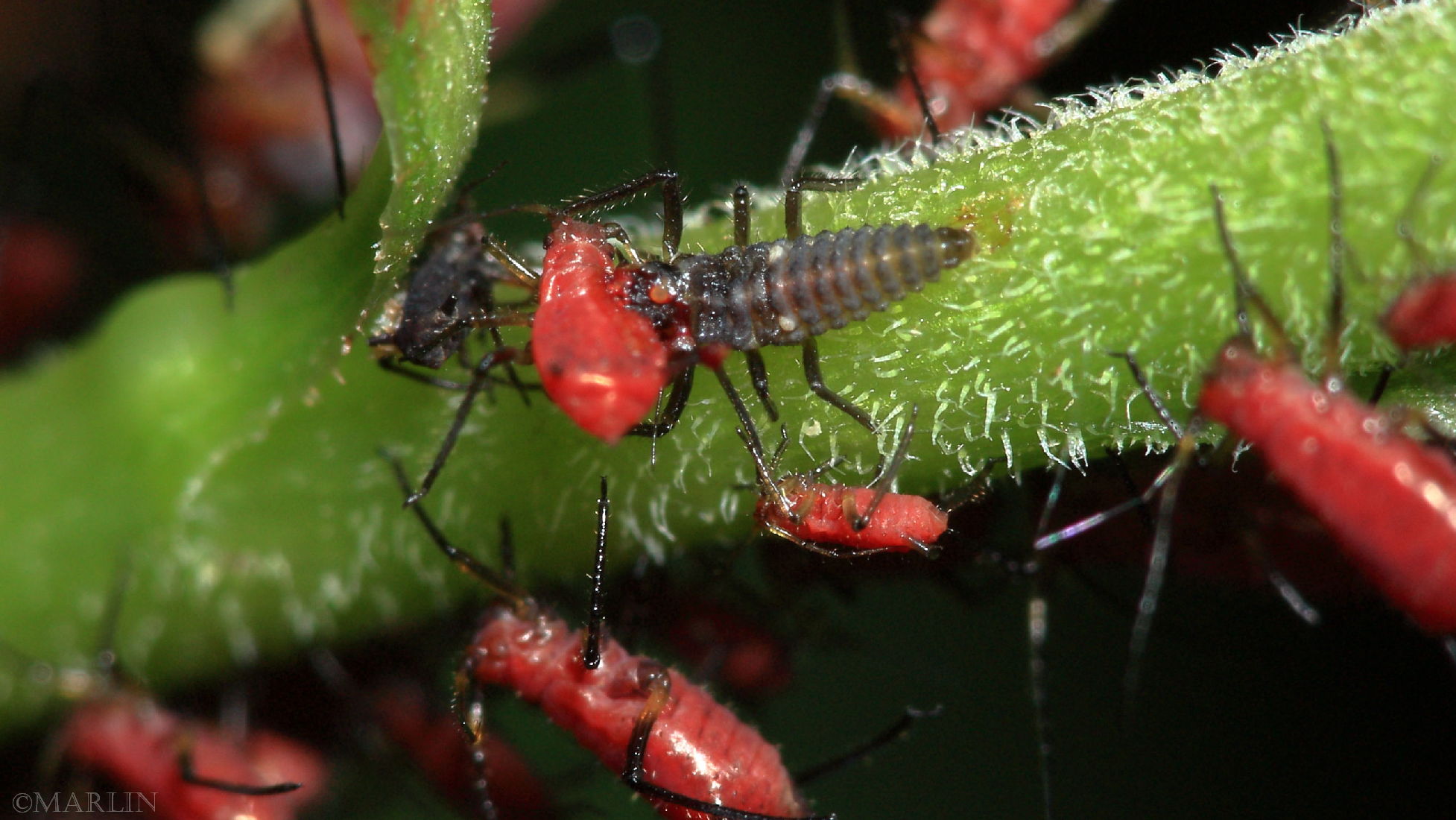
Seven-Spotted Lady Beetle eats an Aphid
Order Coleoptera / Suborder Polyphaga / Superfamily Cucujoidea / Family Coccinellidae -- coccinelles, ladybird beetles, lady beetles, ladybugs
Genus Coccinella / Species: Coccinella septempunctata Linnaeus -- coccinelle à sept points, sevenspotted lady beetle
Adult live beetles photographed at Winfield IL USA August 2002 and June 2005. Length: 7mm
These pictures demonstrate the beneficial aspects of ladybugs - they eat aphids and other enemies of the backyard gardener.

Ladybugs often overwinter as adults in large swarms under fallen leaves, bark, or inside outbuildings. The active spindle-shaped larvae are usually covered with spines and are brightly colored in their own right. During the Middle Ages, these beetles were used to control aphid infestations of grapevines in vinyards; in appreciation, they were dedicated to "Our Lady," hence the common name. In The U.K. they are known as ladybird beetles.


Aphid Infestation

About 4,000 species of aphids are known, classified in 10 families; of these, around 250 species are serious pests for agriculture and forestry as well as an annoyance for gardeners. They vary in size from 1-10 mm long. Important natural enemies include the predatory ladybugs, hoverfly larvae (Diptera: Syrphidae), and lacewings (Neuroptera: Chrysopidae)


Seven-spotted Ladybug - Coccinella septempunctata

Ladybugs, also called lady beetles or ladybird beetles, are actually beetles in the Coleoptera family Coccinellidae. As insects go, they are a very beneficial group, being natural enemies of many insects, especially aphids and other critters that damage plants by feeding on their sap. A single ladybug can consume vast quantities of aphids in its lifetime, perhaps as many as 5,000 or more. There is a brisk business in commercial ladybugs for aphid control, and some of the species found here in North America are actually "invasives" brought from Europe or Asia for such purpose. Coccinella septempunctata, the seven-spotted ladybug, sometimes called ‘C-7', is a medium-sized, orange beetle with seven black spots. It is a European species that was introduced into the US to aid in managing some aphid pests. Harmonia axyridis, the Multicolored Asian lady beetle, was introduced to North America many times, finally taking hold and becoming established in the 1980's. This invasive has become far and away the most numerous of the Coccinellids here in the midwest, and they are becoming one of the most annoying insect pests, invading homes to overwinter, much as the box elder bug.
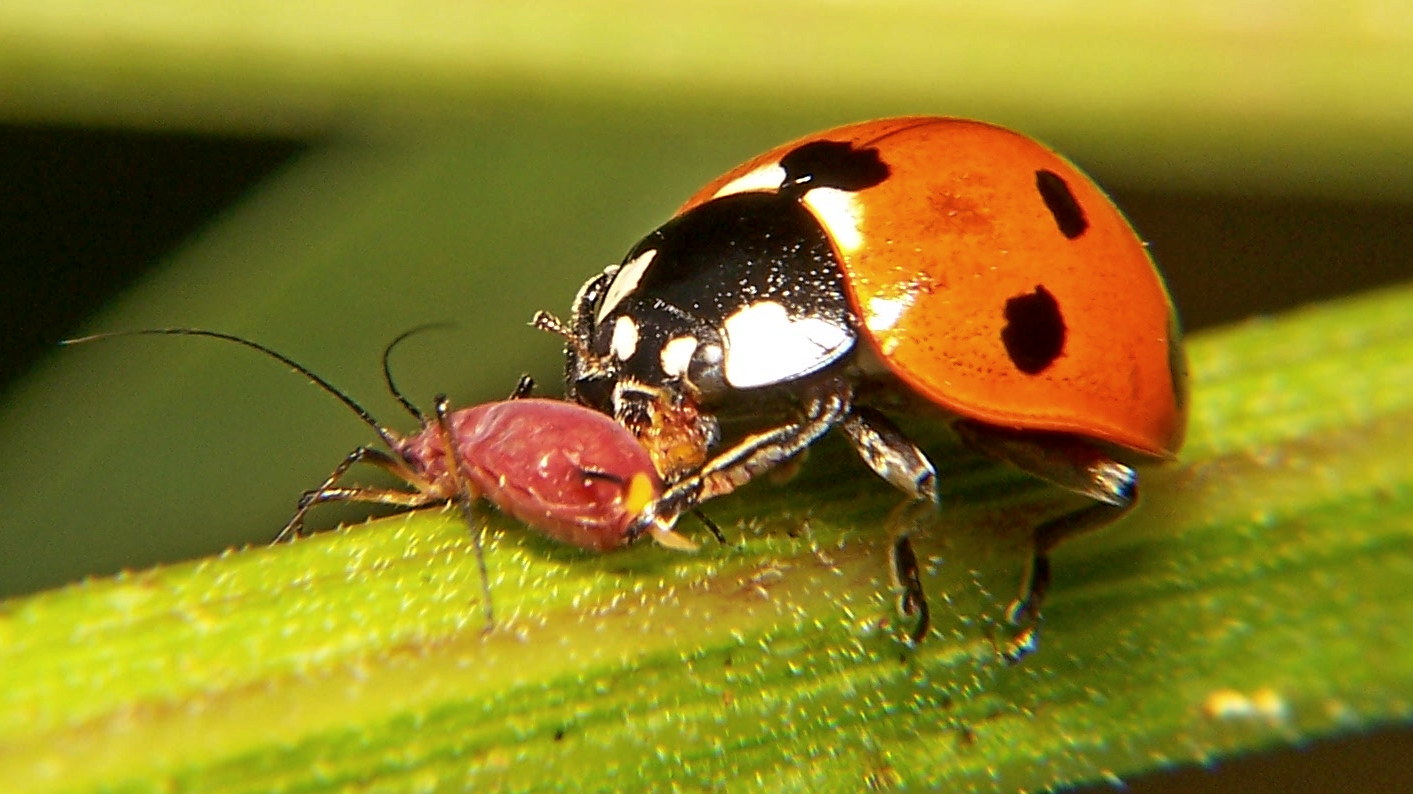
Adult ladybugs have convex, hemispherical shaped elytra (the hardened wings used to cover the soft flying wings underneath) that can be yellow, pink, orange, red, or black, and usually are marked with distinct spots. This is a type of warning coloration (aposematic coloring), thought to discourage predators. Lady beetles also have another defense: an odorous, noxious fluid that seeps out of their leg joints when the insects are disturbed. I can truthfully say, I've been fooling with ladybugs since I was a child but I've never noticed such a thing. It must be that the quantity of such fluid is so small as to affect only small creatures.

Ladybugs, both adults and larvae, are well-known primarily as predators of aphids (plant lice), but they prey also on many other pests such as soft-scale insects, mealybugs, spider mites and eggs of the Colorado Potato Beetle and European Corn Borer. A few feed on plant and pollen mildews. One larva will eat about 400 medium-size aphids during its development to the pupal stage. An adult will eat about 300 medium-size aphids before it lays eggs.


       web       www.cirrusimage.com