Six-spotted Green Tiger Beetle - Cicindela sexguttata
White Beach Tiger Beetle - Cicindela dorsalis media
Order: Coleoptera / Family: Carabidae (ground beetles) / Subfamily: Cicindelinae (tiger beetles)
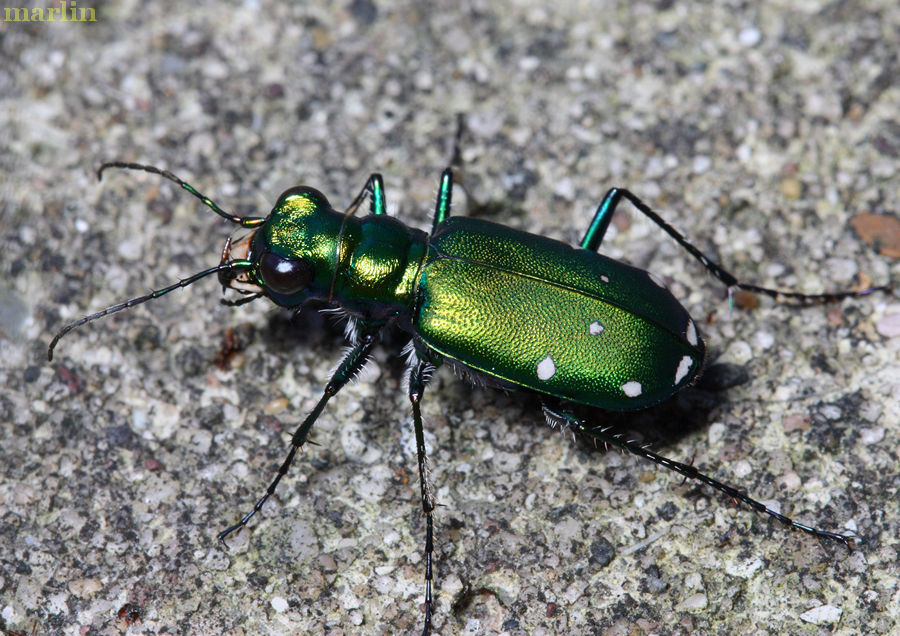
Live adult tiger beetles photographed at Winfield, Illinois, and Florida, USA.
 

The tiger beetles (family Cicindelidae) are members of the suborder Adephaga within the Order Coleoptera. Adult tiger beetles are characterized by large, prominent compound eyes and eleven-segmented, filiform antennae. The antennae are inserted on the frons above the clypeus and below the eyes. The head, at the eyes, is wider than the pronotum (in most common genera of cicindelids). The tarsi are five-segmented. Adult beetles of the families Cicindelidae (tiger beetles) and Carabidae (ground beetles) are quite similar morphologically, and some entomologists place the tiger beetles in the subfamily Cicindelinae within the family Carabidae. The ground beetles differ in the following ways: antennae inserted above the mandibles to the side of the clypeus, and below the eyes. Most ground beetles have a head, at the eye, which is narrower than the pronotum.


White Beach Tiger Beetle, Cicindela dorsalis media
Photo ©Sean McCann used with permission

Cicindela dorsalis was named by Thomas Say in 1817 and Cicindela media by John LeConte in 1857; currently, these two are considered subspecies of the same species. C. dorsalis media occurs long the southeast coast of the United States, including South Carolina and C. dorsalis dorsalis occurs along the northeast coast. Two other subspecies, C. dorsalis saulcyi and C. dorsalis venusta, are found along the coasts of Florida, the Gulf of Mexico and Mexico (Boyd 1982).


The white beach tiger beetle ranges from 10.5 to 13.5 mm (0.41 to 0.53 inches) in length. Like all tiger beetles, its legs and antennae are long and slender and its jaws are large. The elytra (wing coverings) are white with narrow sinuous bronze markings; the head and pronotum are bronze. The pronotum and sides of the under surface are densely covered with white hairs. The sides of the elytra of males are nearly parallel whereas females are somewhat more broadly rounded. The pale coloration renders the beetle well camouflaged on the light sand where it lives. [1]


Adult Male Six-spotted Green Tiger Beetle


This beetle has a parasite attached
at the joint of the middle leg closest.


This beetle was hunting on mud along a stream.
He attacked, dismembered and ate a sawfly in a
matter of two minutes. All that was left of the fly was
the wings. You can get a good idea of how swift and
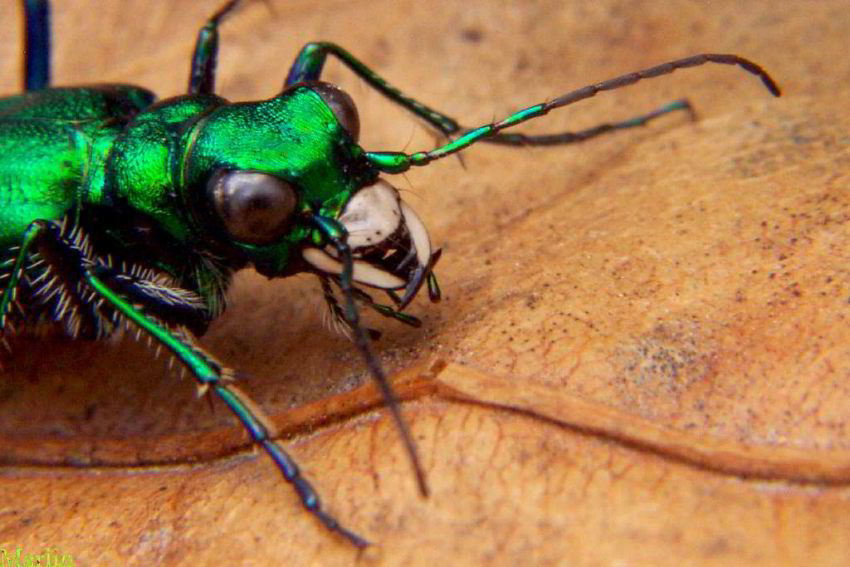
brutal the attack was by looking at the close-up of the
mandibles on this puppy. (fig. 1)


Fig. 1- Mandibles are the white structures

This tiger beetle is an active predator and can frequently be found hunting along footpaths and walkways through deciduous or mixed woodlands. Since the adults overwinter in their original pupal burrows, they are some of the earliest "big" flying insects out and about come springtime. I love the metallic color, and have followed these guys around quite a bit lately (2nd week April)- you can sneak up on them if you move slowly and approach from a low angle - they'll fly off if you blot out large areas of sky. These pictures were taken from about 4 inches away.


References:
1. Janet C. Ciegler and Joey Holmes, White Beach Tiger Beetle South Carolina Department of Natural Resources
2. Boyd, H.P. 1982. Checklist of Cicindelidae: The tiger beetles. Plexus Publishing, Inc. New Jersey. 31 pp.
3. Knisley, C.B. and T.D. Schultz. 1997. Tiger beetles and a guide to the species of the South Atlantic states. Virginia Museum of Natural History, Martinsville. 209 pp.


       web       www.cirrusimage.com