Wild Parsnip: Pastinaca sativa
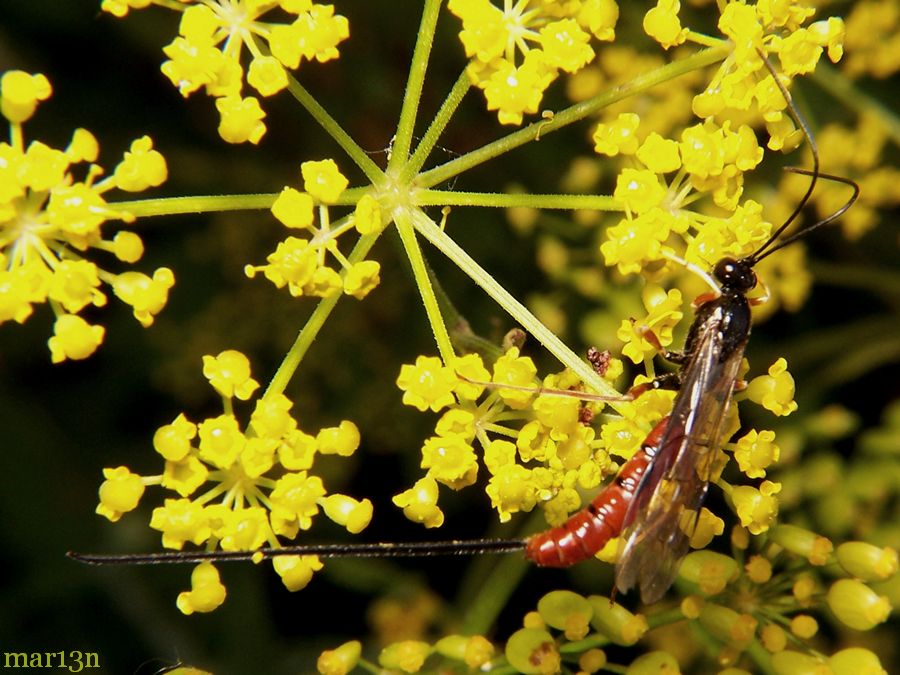
Ichneumon wasp nectaring at wild parsnip
This plant attracts a great variety of insects. Unfortunately, it is invasive in the American Midwest and crowds out native species.
Wild parsnip is an eye-catching weed that hails originally from Europe and Asia. Wild parsnip grows in large patches or as scattered plants along roadsides, in abandoned fields, on pastures, on restored prairies, and in disturbed open areas.
“There are chemicals in wild parsnip called psoralens (precisely, furocoumarins) that cause what dermatologists call “phyto-photo-dermatitis.” That means an inflammation (itis) of the skin (derm) induced by a plant (phyto) with the help of sunlight (photo). When absorbed by skin, furocoumarins are energized by ultraviolet light (present during sunny and cloudy days) causing them to bind with nuclear DNA and cell membranes. This process destroys cells and skin tissue, though the reaction takes time to produce visible damage.”
– From “Burned by Wild Parsnip” – Wisconsin Natural Resources Magazine
 Tachinid fly |
 Scape moth |
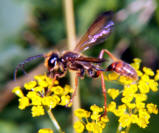 Sphecid wasp |
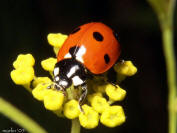 Ladybeetle |
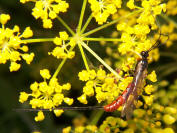 Ichneumonidae |
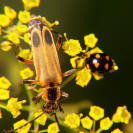 Soldier beetle |
Insects LOVE this plant. I only know of one patch of these plants at the Winfield Mounds Forest Preserve, and I spend a lot of time there when the yellow weeds are in bloom. They attract almost every variety of insect in search of nectar and pollen. Here are pictures of just a few of the larger ones – I don’t bother usually with small ants and tiny beetles, of which there are thousands competing for space at the trough.
Family Aceraceae – Maples
Trees Index | Pine Family | Beech, Oak | Nut Trees | Birch Family | Magnolias
Tree Encyclopedia / North American Insects & Spiders is dedicated to providing family-friendly educational
resources for our friends around the world through large images and macro photographs of flora and fauna.
Online since 2002