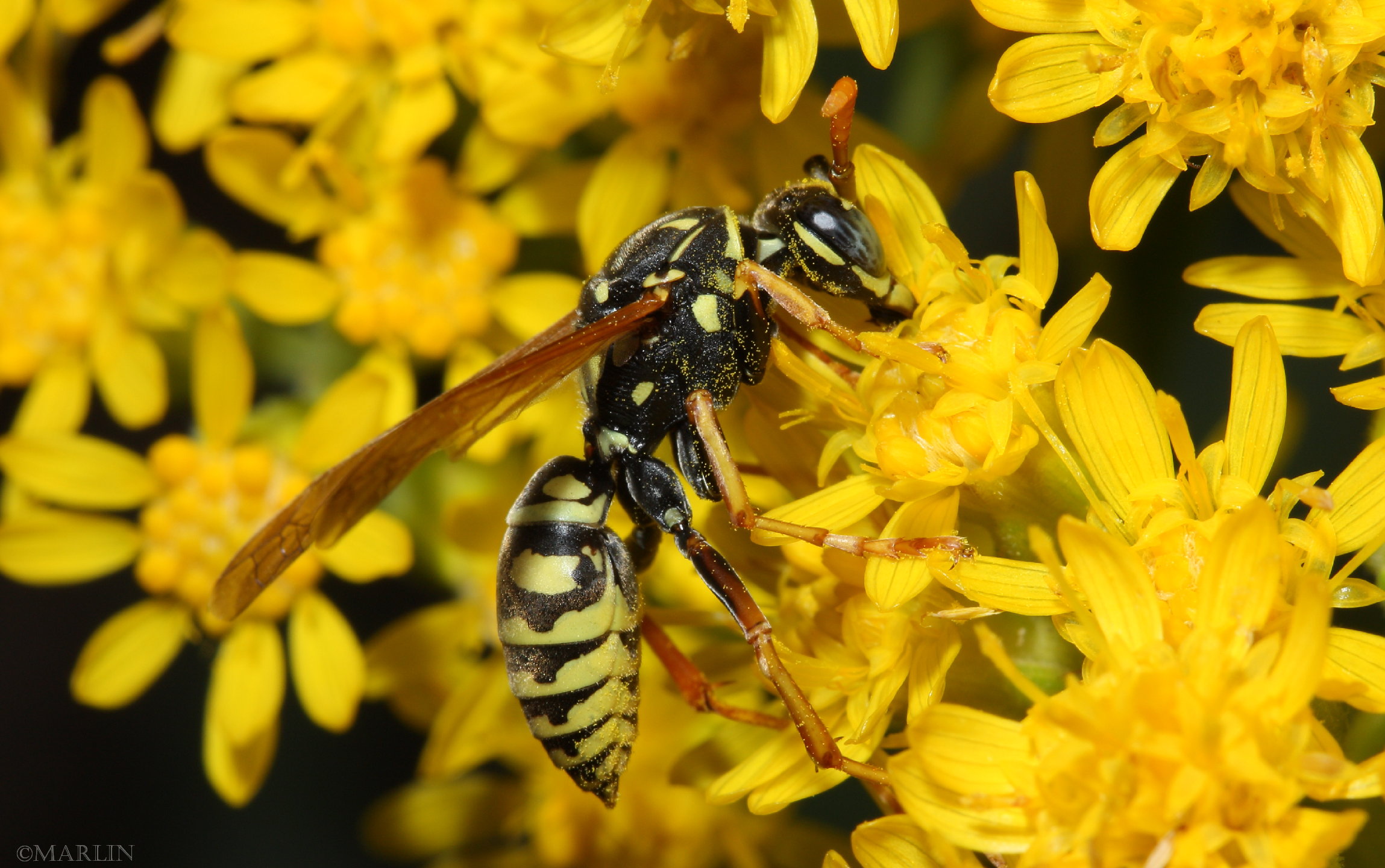
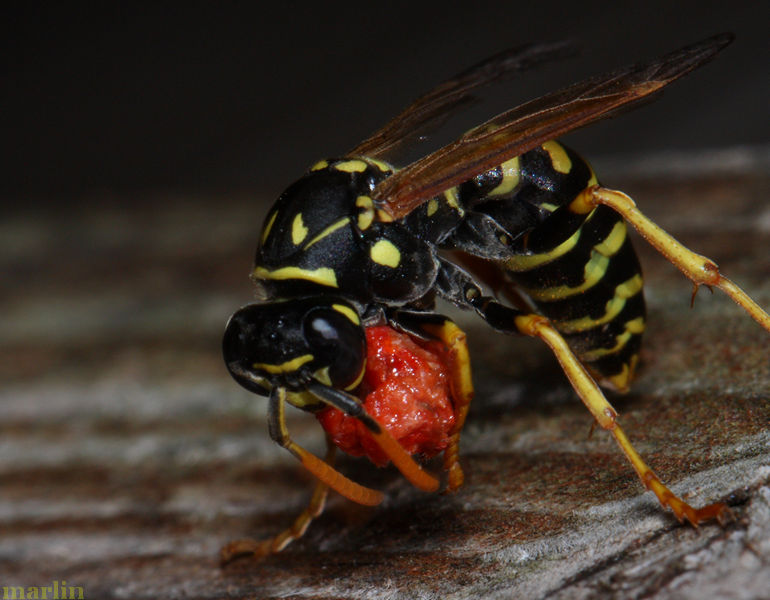
Paper Wasp - Polistes dominula
This invasive species has caused great commotion amongst birders and other naturalists.
It appears to be rapidly replacing the common native paper wasp Polistes fuscatus.
Live adult wasps photographed in the wild at DuPage County, Illinois, USA.
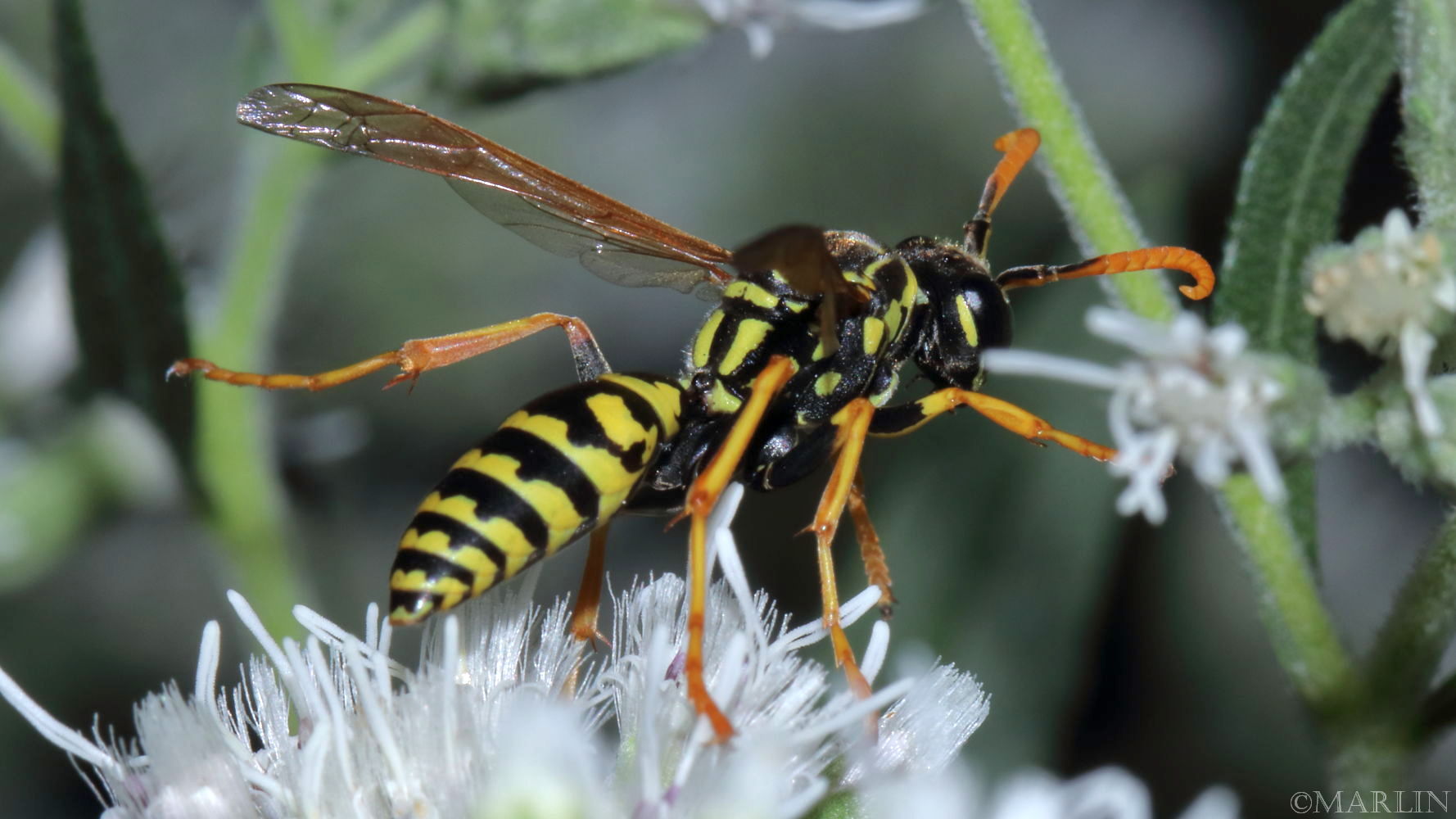
Paper Wasp - Polistes dominula
This species was accidentally introduced into North America from Europe and has been spreading throughout the U.S. There has been a great flap among those who promote the purple martin and other bird species by building and maintaining bird houses; it has been said these wasps are more aggressive than the native variety, and greatly appreciate the environment inside such (wooden) structures.
Whether the species is aggressive has not been established; neither is the assertion they are harming native species (butterflies are most-often mentioned). As in many cases of internet hyperbole, a single article seems to be the source of numerous erroneous or unsupported assertions. In the case of P. dominulus, this article is the Penn State College of Agriculture diatribe. In it, the author offers no evidence to support any of his claims, but rather offers vague pronouncements such as "The increased risk for stings is an obvious concern" and "Some entomologists worry" the wasps are adversely affecting butterfly populations. (What butterflies? What entomologists? Why do they think that?) The article in Wikipedia parrots much of the nonsense in the Penn State article. (Why doesn't that surprise us?)

 Paper Wasp
Polistes dominula is covered with goldenrod pollen

The Penn State article goes on to advise (homeowners) to "make every attempt" at eliminating the nests, going so far as to claim "It is easy to knock down exposed nests and kill the queen." (This, after claiming the additional danger posed by the wasps is because they nest in enclosed, hidden spaces). The article also advises the use of  "wasp and hornet sprays (that) produce a stream of insecticides that can shoot up to 20 feet from the nozzle." Oh, don't forget: you're supposed to spray the nests at night. Just what we need - more idiots running around spewing insecticides.

I can tell you from experience: these wasps will studiously ignore you under every circumstance unless you blunder into or purposely attack their nest. I have been inches from hundreds of wasps and dozens of nests, and I have never been stung or attacked or even noticed. The danger posed by these creatures is negligible.

I have noticed Polistes dominula does not appear as susceptible to infestation by Strepsiptera, the endoparasitic "twisted-wing" parasites. I frequently see P. fuscatus infected, but never P. dominula.


Strepsiptera - infected Paper Wasp - Polistes annularis

Wasps that construct nests made of a papery material are commonly called paper wasps. The nests consist of a single upside-down layer of brood cells. There are 22 species of paper wasps in North America and about 700 species world-wide. Most are resident in the tropics of the western hemisphere. The two most common paper wasps in the American midwest are Polistes dominula, an introduced species, and Polistes fuscatus, the native "golden paper wasp." It is my opinion, after 5 years of careful field work and observance, that dominulus is replacing fuscatus, at least in the environs of DuPage County, Illinois.

Most paper wasps measure about 2 cm (0.75 in) long and are black, brown, or reddish in color with yellow markings. Paper wasps will defend their nest if attacked. Adults forage for nectar, their source of energy, and for caterpillars to feed the larvae (young). They are natural enemies of many garden insect pests.

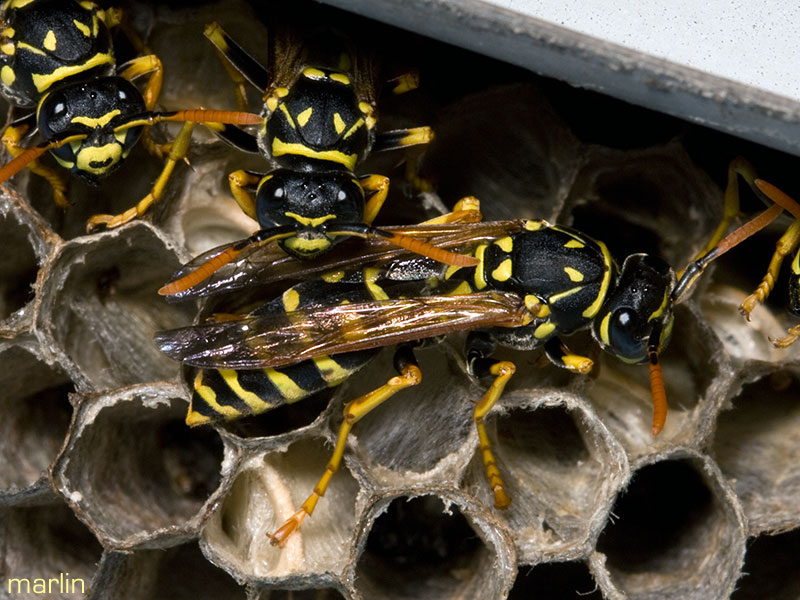
The nests of most species are suspended from a single, central stalk, or pedicle, and have the shape of an upside-down umbrella. Some tropical species make nests that hang in a vertical sheet of cells. Plant and wood fibers are collected by the wasps, mixed with saliva, and chewed into a paper-like material that is formed into the thin cells of the nest. The nests are constructed in protected places, such as under the eaves of buildings or in dense vegetation. The nest pictured here was constructed under the iron railing of a bridge over the DuPage River West Branch. Normally a colony of several to several dozen paper wasps inhabit the nest.

The colony is founded in early spring, soon after the queens emerge from hibernation. As the colony matures, males and the next year's queens are produced. These queens mate with males and are the only members of the colony to survive through winter. In late summer or fall, the founding queen, workers (sterile females), and males all die. The newly mated queens hibernate, in piles of wood, in vegetation, or in holes. The following spring they emerge and begin the cycle anew. A similar life cycle is found in bumble bees.


The hexagonal structure of the brood cells is apparent in this wasp's nest made of "paper" - chewed up plant tissue and saliva.

Wasps Versus Drug Smugglers
According to Discover Magazine, the antennae of common wasps are as sensitive to smell as the nose of drug-sniffing dogs used by the United States Drug Enforcement Agency (DEA). Scientists at the University of Georgia at Tifton have invented a gadget that takes advantage of the wasps ability to sniff out odors such as those emitted by corpses, drugs, bombs or toxins. It's called The Wasp Hound: a canister the size of an ordinary soda can, containing insects trained via classical conditioning to associate  a certain odor with food (a simple sugar syrup). When the wasps in the Wasp Hound canister detect the chemical odor they are trained for, they cluster around the source. A minicam inside detects the wasps' movements and transmits the results to a laptop computer.

The scientists point out the advantages of insect sniffers over our canine pals: The wasps are small and portable, and the training only takes 5 - 10 minutes. They don't eat much, and nobody gets attached to the darned things. They die after 48 hours, but they just insert a new batch and the device is again ready for action. They claim the wasps can be trained to recognize most chemicals.