Lone Star Tick - Amblyomma americanum
According to the Center for Disease Control and Prevention, the lone star tick is a concern, but not for Lyme disease. A rash similar to the rash of Lyme disease has been described in humans following bites of the lone star tick. The rash may be accompanied by fatigue, fever, headache, muscle and joint pains. This condition has been named southern tick-associated rash illness (STARI). [2]


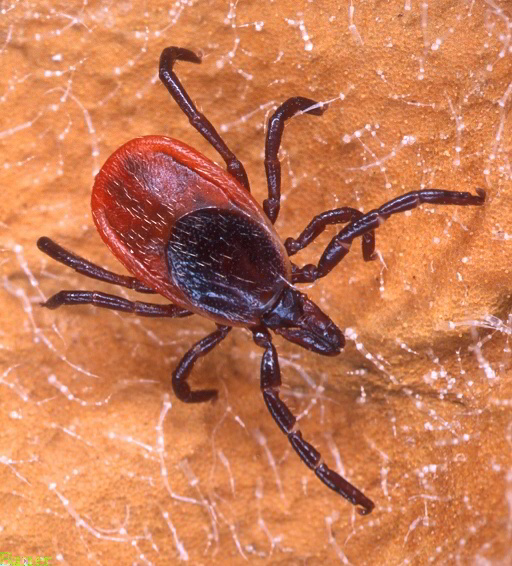
Adult Female Lone Star Tick
Recent media reports have generated some confusion about the lone star tick and its relationship to Lyme disease. The lone star tick does not transmit Lyme disease. Patients bitten by lone star ticks will occasionally develop a circular rash similar to the rash of early Lyme disease. The cause of this rash has not been determined; however, studies have shown that is not caused by Borrelia burgdorferi, the bacterium that causes Lyme disease. The rash may be accompanied by fatigue, headache, fever, and muscle and joint pains. This condition has been named southern tick-associated rash illness (STARI). In the cases of STARI studied to date, the rash and accompanying symptoms have resolved following treatment with oral antibiotics. STARI has not been linked to any arthritic, neurological, or chronic symptoms. [2]


"Lone Star"

The lone star tick, Amblyomma americanum, is found throughout the southeastern and south-central states. The distribution, range and abundance of the lone star tick have increased over the past 20-30 years, and lone star ticks have been recorded in large numbers as far north as Maine and as far west as central Texas and Oklahoma. All three life stages (larva, nymph, adult) of the lone star tick will feed on humans, and may be quite aggressive. Lone star ticks will also feed readily on other animals, including dogs and cats, and may be brought into the home on pets. The saliva from lone star ticks can be irritating; redness and discomfort at a bite site does not necessarily indicate an infection.

Tick-borne illness may be prevented by avoiding tick habitat (dense woods and brushy areas), using insect repellents containing DEET or permethrin, wearing long pants and socks, and performing tick checks and promptly removing ticks after outdoor activity. Persons should monitor their health closely after any tick bite, and should consult their physician if they experience a rash, fever, headache, joint or muscle pains, or swollen lymph nodes within 30 days of a tick bite.

CDC is conducting studies to learn more about STARI. Physicians seeing patients with a recent lone star tick bite and an expanding rash at least 5 centimeters in diameter are encouraged to contact CDC at 970-221-6400 for more information. Patients must be at least 4 years old to participate. [1]


The rash of STARI is a red, expanding bulls eye lesion that develops around the site of a lone star tick bite. The rash usually appears within 7 days of tick bite and expands to a diameter of 8 centimeters (3 inches) or more. The rash should not be confused with much smaller areas of redness and discomfort that can occur commonly at tick bite sites. Unlike Lyme disease, STARI has not been linked to any arthritic, neurological, or chronic symptoms.

The cause of STARI is unknown. Studies have shown that is not caused by Borrelia burgdorferi, the bacterium that causes Lyme disease. Another spirochete, Borrelia lonestari, was detected in the skin of one patient and the lone star tick that bit him. However, subsequent study of over two dozen STARI patients has found no evidence of B. lonestari infection. In the cases of STARI studied to date, the rash and accompanying symptoms have resolved promptly following treatment with oral antibiotics.

STARI is specifically associated with bites of Amblyomma americanum, known commonly as the lone star tick. Lone star ticks can be found from central Texas and Oklahoma eastward across the southern states and along the Atlantic coast as far north as Maine. The adult female is distinguished by a white dot or “lone star” on her back. All three life stages of A. americanum aggressively bite people.

In general, tick-borne illness may be prevented by avoiding tick habitat (dense woods and brushy areas), using insect repellents containing DEET or permethrin, wearing long pants and socks, and performing tick checks and promptly removing ticks after outdoor activity. Persons should monitor their health closely after any tick bite, and should consult a physician if they experience a rash, fever, headache, joint or muscle pains, or swollen lymph nodes within 30 days of a tick bite. In most circumstances, treating persons who only have a tick bite is not recommended. [1]


Photo courtesy Centers for Disease Control and Prevention


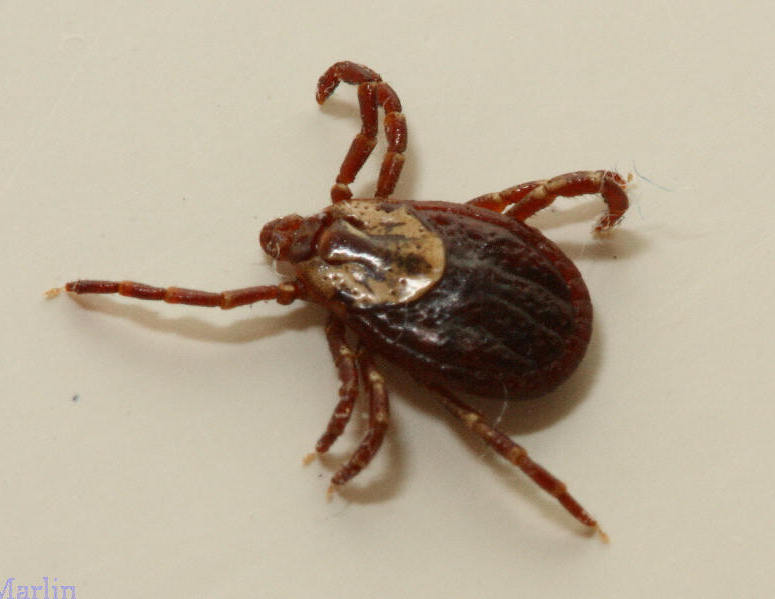
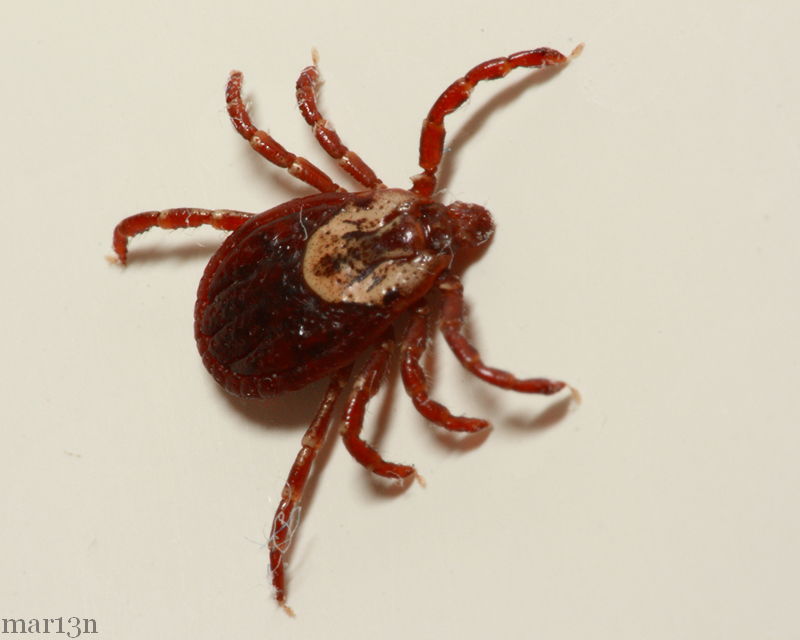
American Dog Tick, Dermacentor variabilis

Ticks have flattened bodies designed to fit into small cracks and crevices - advice to "tuck your pants into your socks" is ludicrous on its face; ticks will crawl under your clothing at will. I have found deet-based insect repellents marginally effective at keeping them off me. I cannot speak for flea and tick dog collars or the like, I have not a dog. I can tell you this: if you go into the weeds at the Winfield Mounds Forest Preserve in Winfield, Illinois during the months of April and May, you will have dog ticks on you when you come out.

Deer ticks (not shown) can carry Lyme disease, the most commonly diagnosed tick-borne bacterial disease in the United States. It has also become a veterinary problem, believed to cause joint-related problems in animals (dogs and horses, mostly) exposed to the Lyme bacteria.  Lyme disease was first reported in Connecticut in 1975, and is named after the town of Lyme in which the disease was first observed.

References:
1. Centers for Disease Control and Prevention, Southern Tick-Associated Rash Illness
2. Centers for Disease Control and Prevention, Lone Star Tick a Concern, but Not for Lyme Disease


       web       www.cirrusimage.com