American Dog Tick – Dermacentor variabilis
Class Arachnida / Order Ixodida / Family Ixodidae
Live adult dog ticks (also known as wood ticks) photographed in the wild at DuPage County, Illinois
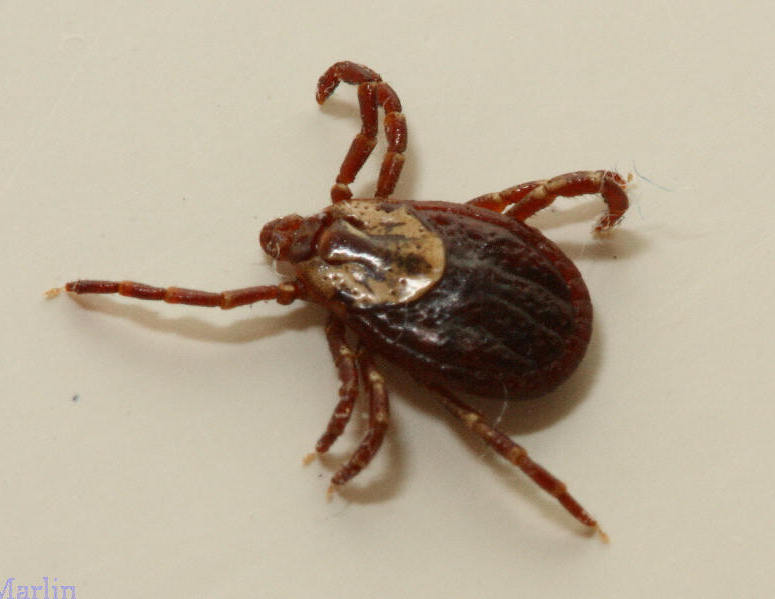
The American dog tick is the largest of the eastern wood ticks, and the most common tick found in Illinois. They are most active during the moths of April and May, but I have encountered them into July and August; 2005, with its dreadful drought here near Chicago was particularly bad. (However, that may be because I rarely used mosquito repellent at all that summer.)
Ticks are arachnids, and adult ticks have eight legs like spiders. The American dog tick is reddish brown, with white or pale yellow markings. The male tick is about 1/8 inch long, with the female slightly larger. She will be much bigger, about 1/2 inch after feeding.
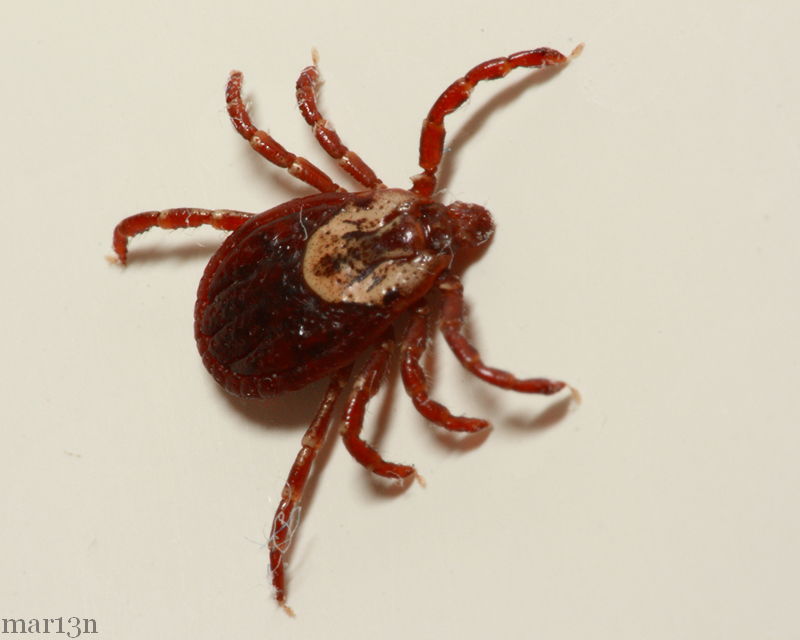
Ticks are parasites, and American dog ticks are known as “three host” ticks because they use three different hosts during their development. When the larva hatches from the egg (eggs are laid in the soil), it has only six legs, like an insect.
The larva will generally latch onto the first small mammal that happens by – a vole, shrew, chipmunk, mouse or the like. After drinking blood for about four days, the larva drops off the host, and molts (sheds its skin) to become an eight-legged nymph.
It then finds the next host – generally a larger mammal such as a raccoon, deer or opossum. Once again, the process repeats and the nymph becomes an adult tick. Adult ticks will find a third host, a large mammal such as a deer, dog, or (shudder) human.
American dog ticks do not carry Lyme disease, but they can carry Rocky Mountain spotted fever.
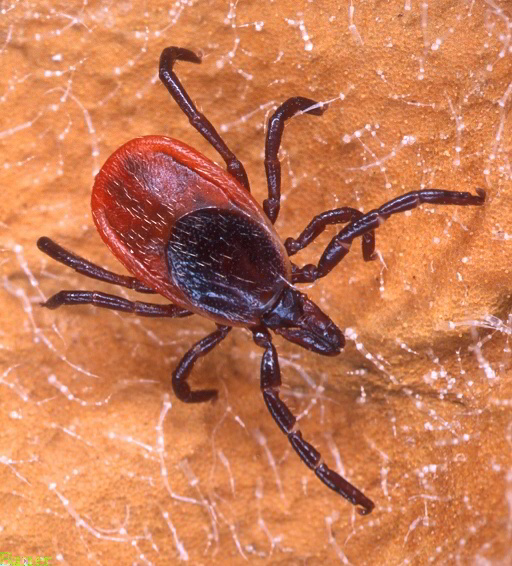 Adult Blacklegged Tick, also commonly called a deer tick [1]
Deer ticks can carry Lyme disease, the most commonly diagnosed tick-borne bacterial disease in the United States. It has also become a veterinary problem, believed to cause joint-related problems in animals (dogs and horses, mostly) exposed to the Lyme bacteria. Lyme disease was first reported in Connecticut in 1975, and is named after the town of Lyme in which the disease was first observed.
“Ötzi the Iceman,” a 5,300-year-old Bronze Age hunter found frozen in the Alps in 1995 had the DNA sequence of Borrelia burgdorferi, making him the earliest known human with Lyme disease.
Listening to
Tree Encyclopedia / North American Insects & Spiders
Online since 2002