|
 |
Black Willow - Salix nigra
Salicaceae -- Willow family
Black willow is the largest and the only commercially important willow of
about 90 species native to North America. Commonly called Gooding willow,
Dudley willow, swamp willow, and sauz (Espanol). |
|
|

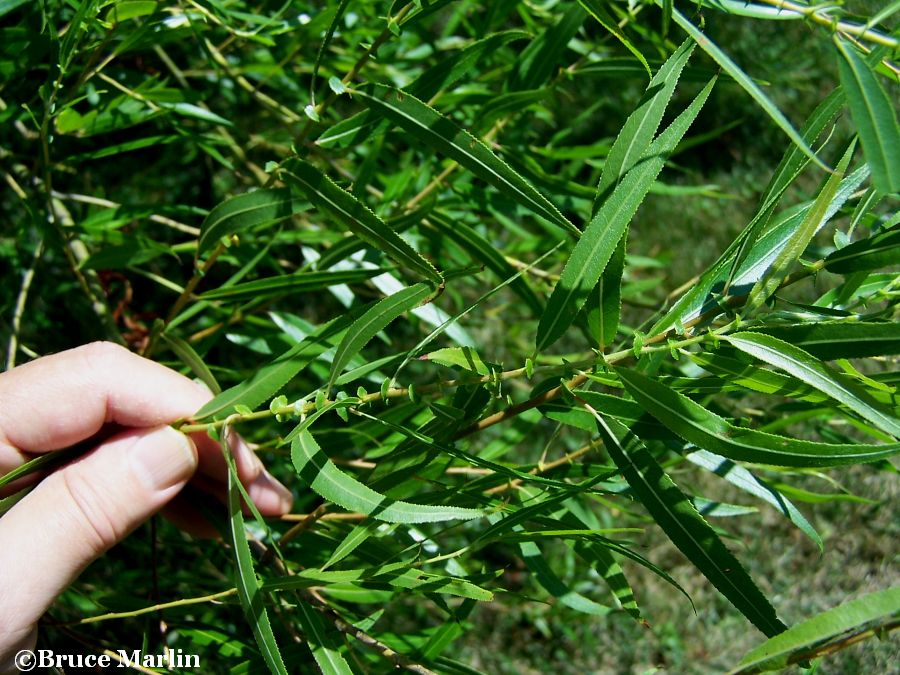
Black Willow Foliage |
|
Black willow (Salix nigra) is the
largest and the only commercially important willow
of about 90 species native to North America. It is
more distinctly a tree throughout its range than any
other native willow; 27 species attain tree size in
only part of their range. Other names sometimes used
are swamp willow, Goodding willow, southwestern
black willow, Dudley willow, and sauz (Spanish).
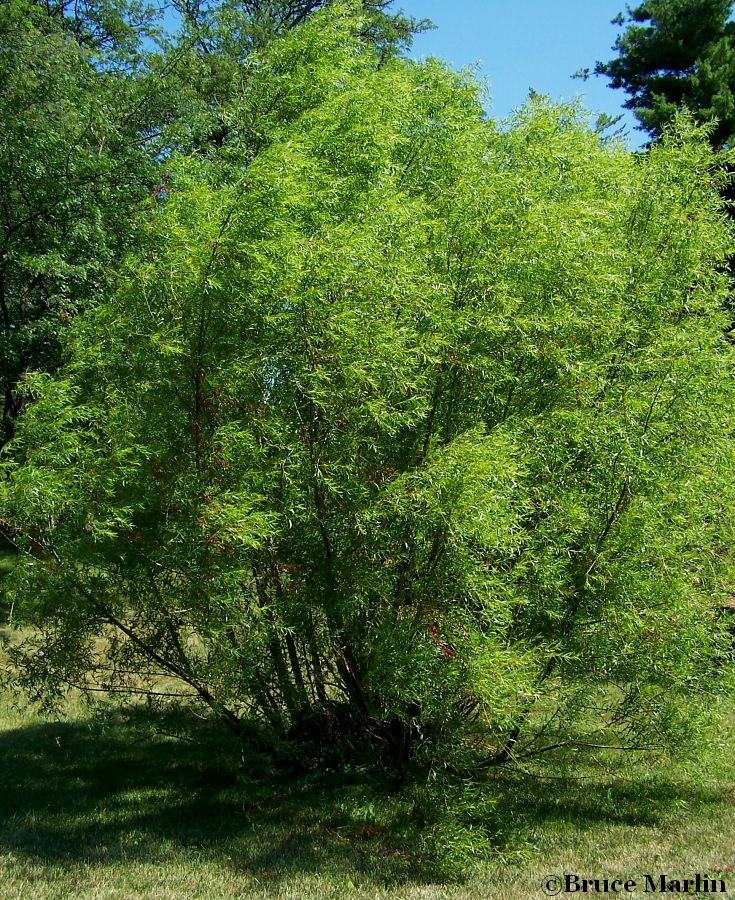
This short-lived, fast-growing tree reaches its
maximum size and development in the lower
Mississippi River Valley and bottom lands of the
Gulf Coastal Plain. Stringent requirements of seed
germination and seedling establishment limit black
willow to wet soils near water courses, especially
floodplains, where it often grows in pure stands.
Black willow is used for a variety of wooden
products and the tree, with its dense root system,
is excellent for stabilizing eroding lands.
Black willow is found throughout the Eastern United
States and adjacent parts of Canada and Mexico. The
range extends from southern New Brunswick and
central Maine west in Quebec, southern Ontario, and
central Michigan to southeastern Minnesota; south
and west to the Rio Grande just below its confluence
with the Pecos River; and east along the gulf coast,
through the Florida panhandle and southern Georgia.
Some authorities consider Salix gooddingii as a
variety of S. nigra, which extends the range to the
Western United States.
Rooting Habit- Willow tends to be shallow rooted,
especially on clay-capped alluvial soils. It is
seldom found on soil types that undergo seasonal
dehydration but is more often present on soils with
higher water tables throughout the summer months.
Floods may deposit more layers of alluvium in
established stands. New roots often develop from
adventitious buds formed within the previously
exposed trunk. By this means, soil is captured and
held to form additional land areas along river
courses. Willows also sucker readily. Under certain
conditions, an essentially pure willow stand of 1 or
more hectares (2.5 acres) may consist of relatively
few clones.
Reaction to Competition- Black willow is less
tolerant of shade than any of its associates and may
most accurately be classed as very intolerant. It
usually grows in dense, even-aged stands, in which
natural mortality is very heavy from sapling stage
to maturity. Trees fail to assert dominance, so
willow stands periodically stagnate. Stands not
properly thinned may lose up to 50 percent of their
volume in 5 to 8 years. Because of its intolerance
and the absence of exposed mineral soil under
existing stands, willow does not succeed itself
naturally unless fresh sediment is deposited as the
stand begins to open up. Thinning should remove the
understory trees and must be light to prevent the
heavy windthrow and stem breakage, which is common
in very open stands. Light, early, and frequent
thinning forestalls stagnation and mortality. An
apparently satisfactory thinning prescription is to
leave a stand of about 14.9 to 17.2 m²/ha (65 to 75
ft²/acre) of basal area. Heavy epicormic branching
may result if weak trees are released. |
|

Damaging Agents- Several insects attack
live willow but few cause serious damage.
The forest tent caterpillar (Malacosoma
disstria), the gypsy moth (Lymantria
dispar), the cottonwood leaf beetle
(Chrysomela scripta), the willow sawfly
(Nematus ventralis), and the imported willow
leaf beetle (Plagiodera versicolora)
sometimes partially, occasionally
completely, defoliate willow trees, reducing
growth but seldom killing. Stem borers, such
as the cottonwood borer (Plectrodera
scalator) attack willows and may kill by
girdling the base. Twig borers, like the
willow-branch borer (Oberea ferruginea),
feed on the branches and cause deformities
that may be undesirable in ornamentals.
Insects are frequently the vectors for
disease organisms. Willow blight, the scab
and black canker caused by Pollaccia
saliciperda, is transmitted by borers.
Members of the genus Salix are the only
known hosts. Phytophthora cactorum causes
bleeding canker, lesions on the lower trunk
that discharge a dark-colored, often slimy
liquid. Confined to the phloem and cambium
area, it can result in death if the canker
girdles the trunk. Cytospora chrysosperma
causes canker in poplar and willow. Under
forest conditions, cytospora canker is of
little consequence but when trees become
weakened by drought, competition, or
neglect, losses can be heavy. In nursery
beds, losses of up to 75 percent of cuttings
have been reported. Leaf rust caused by
Melampsora spp. is common on seedlings
throughout the range of black willow.
Mistletoes (Phoradendron spp.) damage and
deform but seldom kill willows.
The yellow-bellied sapsucker feeds on sap
from holes they peck through the bark; this
early injury to the tree degrades the lumber
sawn later. Hot fires kill entire stands.
Slow, light fires can seriously wound
willow, allowing woodrotting fungi to enter.
Once dead, willow deteriorates very rapidly.
Top and branch rot account for 86 percent of
the cull in willow.
The wood is light (specific gravity 0.34 to
0.41), usually straight grained, without
characteristic odor or taste, weak in
bending, compression, and moderately high in
shock resistance. It works well with tools,
glues well, and stains and finishes well but
is very low in durability. The wood was once
used extensively for artificial limbs,
because it is lightweight, doesn't splinter
easily, and holds its shape well. It is
still used for boxes and crates, furniture
core stock, turned pieces, table tops, slack
cooperage, wooden novelties, charcoal, and
pulp.
Ancient pharmacopoeia recognized the bark
and leaves of willow as useful in the
treatment of rheumatism. In 1829, the
natural glucoside salicin was isolated from
willow. Today it is the basic ingredient of
aspirin, although salicyclic acid is
synthesized rather than extracted from its
natural state.
--Read the entire article from the
USDA Forest Service
|
|
|