Balsam Fir - Abies balsamea (L.) Mill.
Balsam fir is one of the most popular Christmas trees.
Also commonly called balsam, Canadian balsam, eastern fir, and bracted balsam fir.
Insects & Spiders | Tree Encyclopedia | Tree Index | Rosaceae Index | Pinaceae Main | Pinaceae Index


Balsam Fir - Abies balsamea
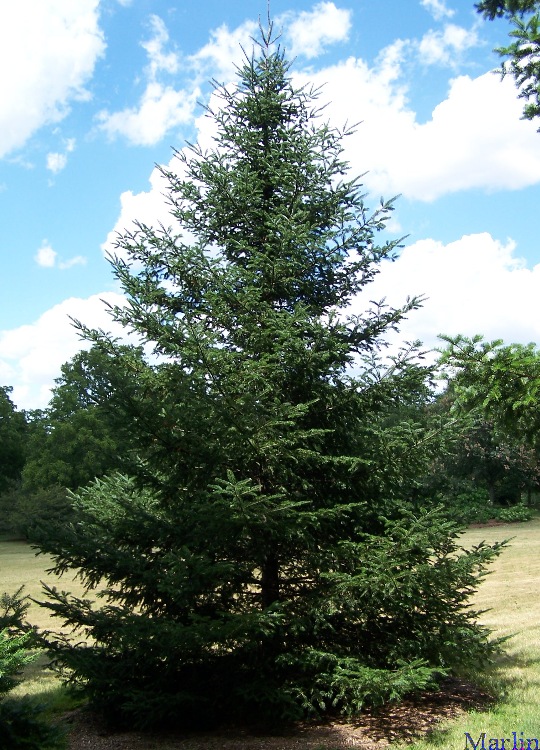
This Balsam Fir is a 57-year-old Morton Arboretum specimen.

Family: Pinaceae. Also placed in: Abietaceae

Balsam fir is a native, coniferous, evergreen, small to medium-sized, upright tree.  At maturity it may reach a height of 40 to 90 feet (12-27 m) and a d.b.h. of 12 to 30 inches (30-75 cm).  Maximum age is about 200 years.  Balsam fir has a dense, narrowly pyrimidal crown terminating in a slender, spirelike top.  Open-grown trees may have live branches extending to the ground, but trees in well-stocked stands have dead, persistent lower branches.  The needles are flat, resinous, and 0.4 to 1.2 inches (1-3 cm) long.  Erect cones occur on the upper side of 1-year-old branches in the upper crown.  The bark is gray and smooth and contains numerous raised resin blisters.  On older trees the bark becomes brown and scaly but is less than 0.5 inch (1.2 cm) thick.

Balsam fir has a shallow root system that is mostly confined to duff and upper mineral soil layers.  Roots rarely penetrate more than 30 inches (75 cm) below the ground surface, except in sandy soils.

Balsam Fir Bark and Foliage
The Balsam Fir is listed as endangered by the State of Connecticut (3)
Soils:  Balsam fir grows on sites underlain by a variety of parent materials, including gneiss, schist, anorthosite, diabase, slate, sandstone, and limestone.  It grows mostly on acid Spodosol, Inceptisol, and Histisol soil orders.  It grows on all soil textures, from heavy clay to rocky.  It tolerates a wide range of soil acidity.  In the Lake States, balsam fir is most common on cool, wet-mesic sites with soil pH values between 5.1 and 6.0.  In northeast Wisconsin it commonly grows on limestone outcrops.  (6)

Balsam fir wood is used primarily for pulpwood and lumber for light frame construction.  It is also used extensively for cabin logs.  The wood is lightweight, relatively soft, low in shock resistance, and has good splitting resistance.  Balsam fir is not well suited for use as posts and poles because it decays rapidly.  Minor wood products include paneling, crates, and other products not requiring high structural strength.

Balsam fir is a major food of moose during winter.  It tends to be utilized more when snow is deep and moose populations are high. Moose may browse balsam fir in winter to save energy because the twigs weigh 8 to 13 times more than deciduous twigs of similar length and therefore it requires less time and effort to consume equivalent amounts.  Balsam fir is unimportant in the diets of caribou and white-tailed deer.  Spruce and ruffed grouse feed on balsam fir needles, tips, and buds, which often make up 5 to 10 percent of the fall and winter diet.  Red squirrels feed on balsam fir male flower buds, and less frequently on leader and lateral buds in late winter and spring when other foods are scarce.  Stands attacked by the spruce budworm attract numerous insect-eating birds, especially warblers and woodpeckers.

Balsam fir provides important winter cover for white-tailed deer and moose.  Balsam fir stands attract ungulates because snow is not as deep as in adjacent hardwood stands.  Lowland balsam fir stands are used extensively by white-tailed deer as winter yarding areas, and by moose with calves during severe winters.  During summer, deer, bear, and moose often rest under the shade of balsam fir trees. Young balsam firs provide cover for small mammals and birds.  Martens, hares, songbirds, and even deer hide from predators in balsam fir thickets.  Grouse and songbirds seek shelter during winter within the evergreen foliage.  In Maine, fishers often nest in witches brooms in balsam fir trees.

Balsam fir is a popular Christmas tree in the East and grown on plantations for this purpose.  The branches are used to make Christmas wreaths.  The fragrant needles are used as a stuffing in souvenir pillows sold in New England. Balsam fir is occasionally used in landscaping.  It can be used in screenings, mass plantings, and windbreaks but requires abundant soil moisture for these purposes.

Bark blisters contain oleoresin, which is used in the optics industry as a medium for mounting microscope specimens and as a cement for various parts of optical systems. (6)

Balsam Fir Range Map
U.S. Range Map courtesy USDA Plants database

Over 60 species of insects are indigenous to Douglas-fir cones, but only a few species damage a significant proportion of the seed crop. Damage by insects is frequently more pronounced during the years of light or medium seed crops that may follow good or heavy crops. The most destructive insects include: (a) the Douglas-fir seed chalcid (Megastigmus spermotrophus), which matures in the developing seed and gives no external sign of its presence; (b) the Douglas-fir cone moth (Barbara colfaxiana) and the fir cone worm (Dioryctria abietivorella) whose larvae bore indiscriminately through the developing cones and may leave external particles of frass; and (c) the Douglas-fir cone gall midge (Contarinia oregonensis) and cone scale midge (C. washingtonensis), which destroy some seed but prevent harvest of many more by causing galls that prevent normal opening of cones. The Douglas-fir cone moth is perhaps a more serious pest in the drier, interior portions of the Douglas-fir range and the Contarinia spp. in the wetter regions. Any of these insects, however, may effectively destroy a cone crop in a given location.

Insects are generally not a severe problem for Douglas-fir regeneration, although both the strawberry root weevil (Otiorhynchus oratus) and cranberry girdler (Chrysoteuchia topiaria) may cause significant damage to seedlings in nurseries; damage to plantations by rain beetles (Pleocoma spp.) and weevils (Steremnius carinatus)- the latter particularly damaging to container-grown-plants-has been reported.

Special Uses
Douglas-fir is grown as a Christmas tree on rotations ranging from 4 to 7 years. Trees are sheared each year to obtain a pyramid shaped crown. Attempts to grow Douglas-fir as a Christmas tree in North America outside its native range have failed. Coastal Douglas-fir is usually killed by frost, and the interior variety suffers too much from the needle cast disease, Phaeocryptopus gaeumanni. [6]

References:
1. United States Forest Service Silvics Manual Conifers / Balsam Fir
2. USDA, NRCS. 2008. The PLANTS Database (http://plants.usda.gov, 27 June 2008).
3. USDA NRCS Threatened and Endangered species
4. USDA, ARS, National Genetic Resources Program. Germplasm Resources Information Network
5. University of Michigan Native American Ethnobotany
6. Uchytil, Ronald J. 1991. Abies balsamea. In: Fire Effects Information System, U.S. Department of Agriculture
 

Insects & Spiders Home | Tree Pictures | Tree Index | Rosaceae Index | Pinaceae Main | Pinaceae Index

Custom Search


© Red Planet Inc.