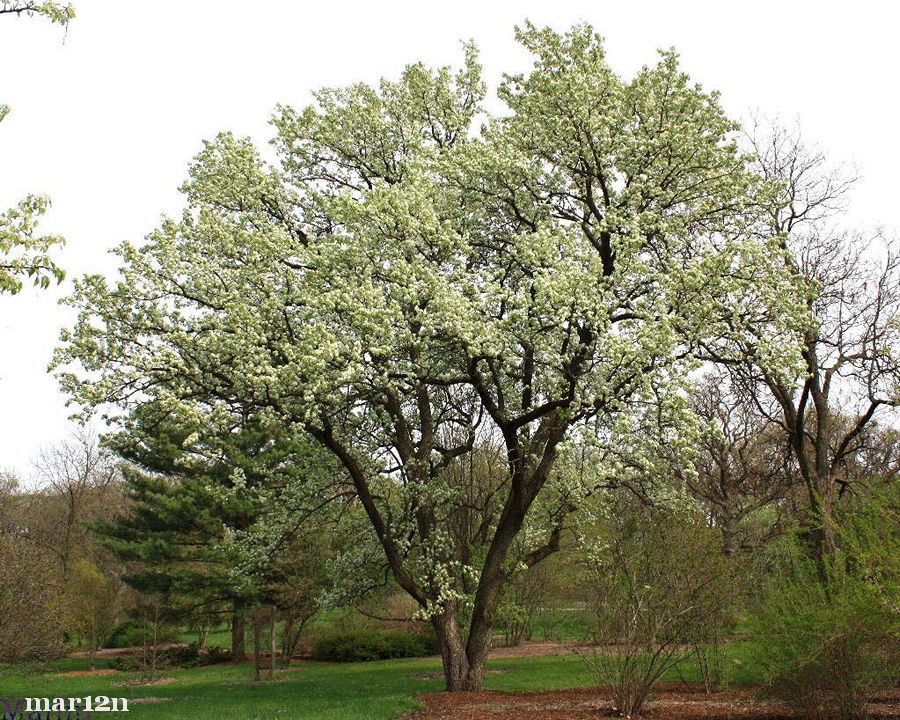
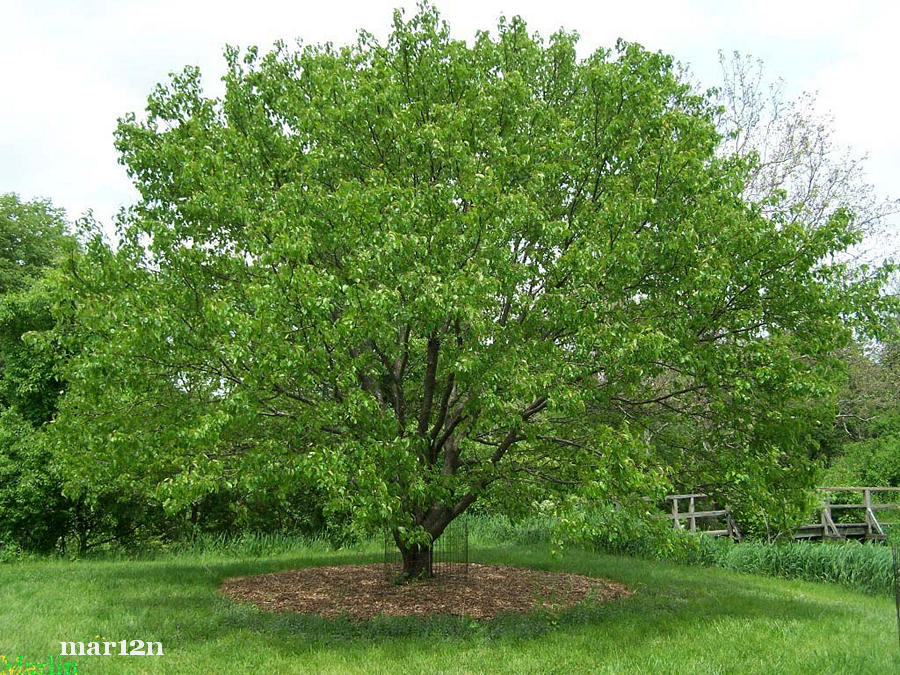
Callery Pear - Pyrus calleryana var. dimorphophylla
Rosaceae – Rose family. Also commonly called Bradford pear. [1]
Callery pear is a rapid-growing, adaptable ornamental or specimen tree often used for its quick establishment and flowering qualities. [2] It can be considered invasive in North America, crowding out native species. [4]
[Cirrus Home]  [Tree Encyclopedia] [Trees Alphabetic Table of Contents]   [Family Rosaceae Table of Contents]
 

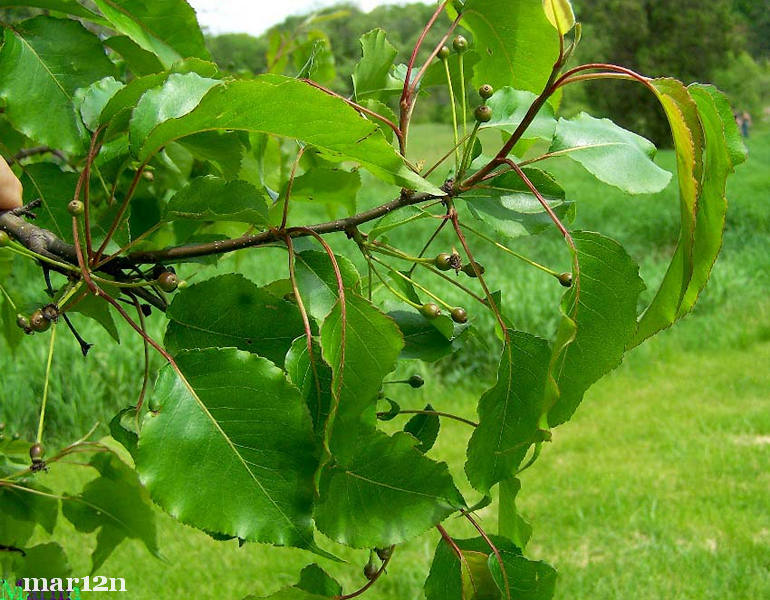
Callery Pear foliage and young fruit

Callery, or Bradford pear is a medium-sized ornamental rapidly growing 30-50 feet tall and 20 feet wide. It takes on an upright, pyramidal form when young, becoming more oval and spreading with age. It grows best in full sun but will tolerate partial shade. Likes moist and well-drained soil but is easily adapted to various stressors, including acidic and alkaline Ph, restricted growth space, pollution, drought, and pruning.

Callery Pear is considered a harmful invasive in many areas. Native to China, Japan, and much of western Asia, it was first brought to North America by the Arnold Arboretum in Massachusetts in 1908 [4]. Widely used in ornamental landscape plantings, it was rapidly propagated across the United States. The fruit industry also used Callery Pear as root stock for commercial pears, as pollen donors in orchards, and in programs breeding pears for fire blight resistance.

It forms dense, often thorny thickets that prevent colonization by native species. Trees are vulnerable to storm and ice damage and are short-lived at 25-30 years, yet are profligate reproducers able to produce fruit in their third year. [4]
Callery pear has a reputation for poor branching habits, leaving itself vulnerable to major windthrow or ice-load damage. Near vertical, co-dominant central leaders with acute crotch angles and extremely weak attachments must be thinned on a regular basis to ameliorate this liability. Branches remaining after this recommended biannual pruning will be stronger and resist storm damage more readily than those in an unattended, overgrown tree. [2]

Flowers in spring are showy, white, to 3 inches inflorescences, mid to late April for about 1 week. Foliage is green to dark green, glossy, alternate, ovate to orbicular, fluttering. Fall color is variable and generally not showy, ranging from purple, orange, yellow to red. Color does not develop until late season, November and December.

Pear has fine-grained wood pink to yellow in tone. It is prized for woodwind instruments and its veneer is used for fine furniture. Pear has one of the finest of textures of the fruitwoods, and was often used in making instruments such as lutes, recorders and - because of its hardness - the jacks of harpsichords.

Callery Pear at Morton Arboretum
Callery Pear at Morton Arboretum, from graft, is 23 years old


The cultivation of the pear extends to the remotest antiquity. Traces of it have been found in the Swiss lake-dwellings; it is mentioned in the oldest Greek writings, and was cultivated by the Romans. The word "pear" or its equivalent occurs in all the Celtic languages, while in Slavonic and other dialects different appellations, but still referring to the same thing, are found—a diversity and multiplicity of nomenclature which led Alphonse de Candolle to infer a very ancient cultivation of the tree from the shores of the Caspian to those of the Atlantic. A certain race of pears, with white down on the under surface of their leaves, is supposed to have originated from P. nivalis, and their fruit is chiefly used in France in the manufacture of Perry (see Cider). Other small-fruited pears, distinguished by their precocity and apple-like fruit, may be referred to P. cordata, a species found wild in western France, and in Devonshire and Cornwall. Pears have been cultivated in China for approximately 3000 years. -- from Wikipedia

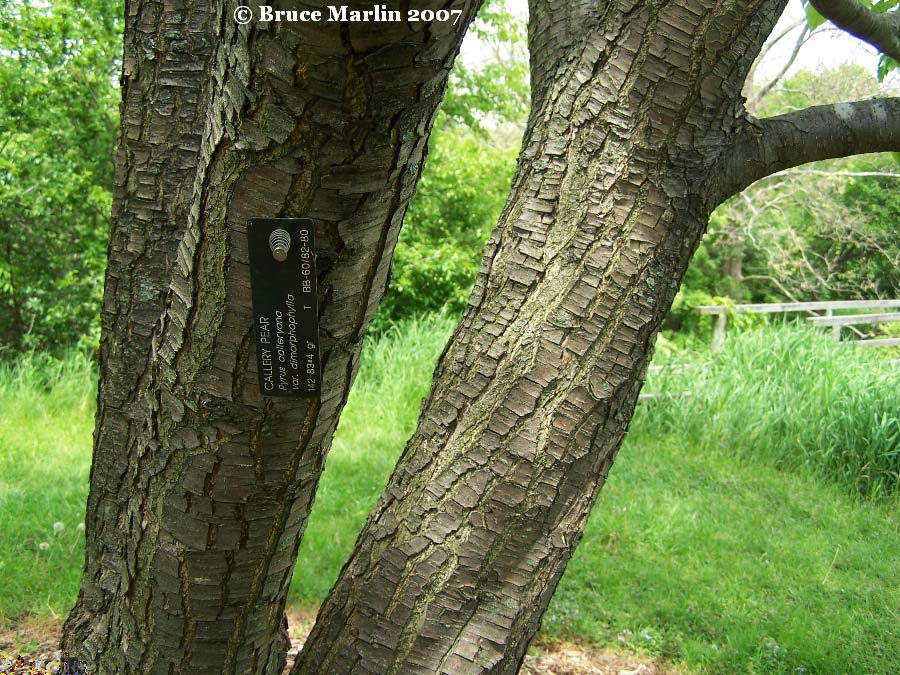
Callery Pear Bark
Callery Pear Bark and Morton Arboretum accession tag

Callery Pear Blossoms
Clusters of white, 5-petaled flowers in bloom April 27, near Chicago

Callery Pear
Morton Arboretum acc. 1400-24*1, from a graft, is 85 years old, and one of the original plantings in 1924.

Camera location41° 49' 5.51" N, 88° 4' 0.6" WThis and other images at their location on: Google Maps - Google Earth
References:
  1. USDA, ARS, National Genetic Resources Program. Germplasm Resources Information Network - (GRIN), Pyrus calleryana Decne.
  2. Horticultural and Crop Science, Ohio State University, Pyrus calleryana
  3. Pronunciation of Pyrus calleryana from University of Connecticut Plant Database
  4. Kaufman, Sylvan Ramsey, and Wallace Kaufman. Invasive Plants: A Guide to Identification, Impacts, and Control of Common North American Species. 1st ed. Stackpole Books, 2007.


       web      www.cirrusimage.com