 |
Tarantula Spiders – Family Theraphosidae Tarantulas are perhaps some of the most recognized (and feared and loathed) Arachnids on the planet. Spider Index | Spider Main | Orb Web | Cobweb |

Custom Search
|
|
Tarantula is the common name for a group of hairy, large spiders belonging to the family Theraphosidae. There are approximately 900 species worldwide. Tarantulas hunt prey on the ground and do not spin webs unless they live in a tunnel, in which case they line their tunnel with web to catch wandering prey. They mainly eat insects and other arthropods, caught by speed or ambush. Most tarantulas are harmless to humans, and some species are kept as pets. Unlike other exotic pets such as pythons, rattlesnakes or chimpanzees, tarantulas do not squeeze to death or envenomate or maul their owners.
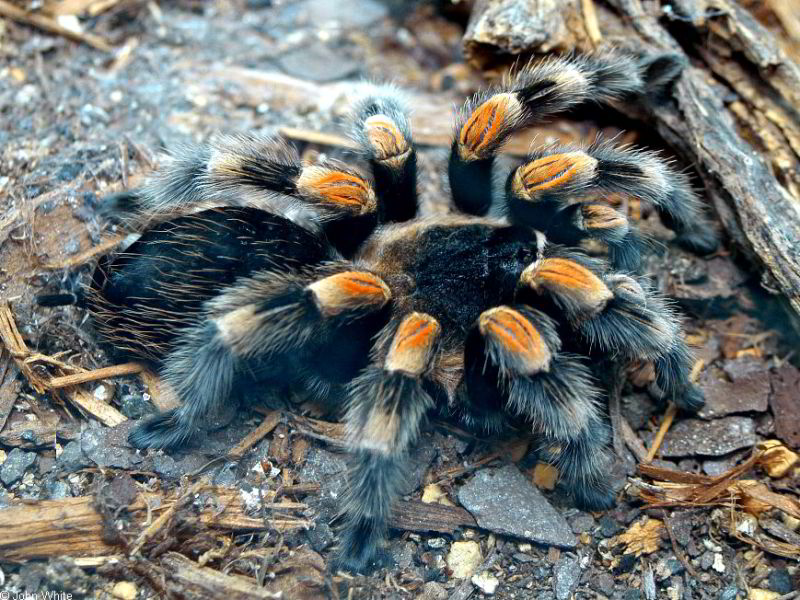 Mexican Red-kneed Tarantula, Euathlus smithii © 2006 John White, used with permission |
|
Like all arthropods, the tarantula is an invertebrate that relies on an exoskeleton for muscular support. A tarantula’s body consists of two main parts, the prosoma or the cephalothorax (the former is most often used because there is no analogous "head") and the abdomen or opisthosoma. The cephalothorax and opisthosoma are connected by the pedicle or what is often called the pregenital somite. This waist-like connecting piece is actually part of the prosoma and allows the opisthosoma to move in a wide range of motion relative to that of the cephalothorax.
Depending on the species, the body length of tarantulas range from 1-4 inches, with 3 to 12 inch leg spans. The largest species of tarantulas can weigh over 90 grams (3 ounces). These are the biggest spiders on the planet, not counting the camel spider. The many different species have fanciful common names including bird eating spider, goliath spider, goliath tarantula. 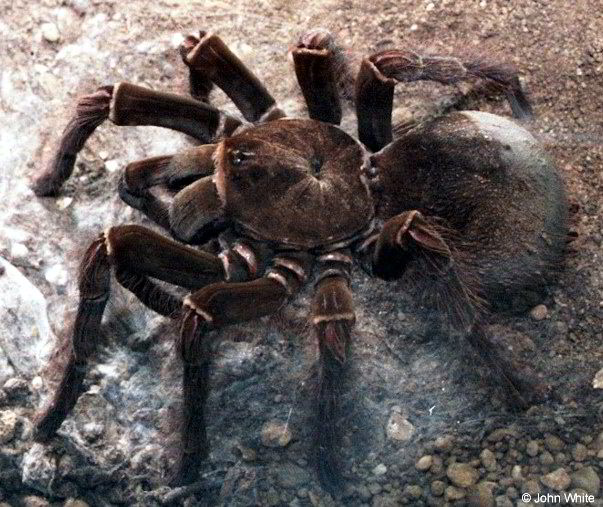 Goliath bird eating tarantula © 2006 John White, used with permission |
|
The eight legs, the two chelicerae with their hollow fangs, and the pedipalps are attached to the prosoma. The chelicerae are two single segment appendages that are located just below the eyes and directly forward of the mouth. The chelicerae contain the venom glands that vent through the fangs. The fangs are hollow extensions of the chelicerae that inject venom into prey or animals that the tarantula bites in defense, and they are also used to masticate (chew). These fangs are articulated so that they can extend downward and outward in preparation to bite or can fold back toward the chelicerae as a pocket knife blade folds back into its handle. The chelicerae of tarantulas completely contain the venom glands and the muscles that surround them and can cause the venom to be forcefully injected into prey.
The pedipalpi are two six segment appendages connected to the thorax near the mouth and protruding on either side of both chelicerae. In most species of tarantula the pedipalpi contain sharp jagged plates, called the coxae or maxillae, which are used to cut and crush food. As with other spiders, the terminal portion of the pedipalpi of males function as part of its reproductive system. Male spiders spin a silken platform on the ground onto which they release semen from glands in their opistoma. Then they insert their pedipalps into the semen, absorb the semen into the pedipalps, and later insert the pedipalps (one at a time) into the reproductive organ of the female, which is located in her abdomen. The terminal segments of the pedipalps of male tarantulas are larger in circumference than those of a female tarantula. Tarantulas, like almost all other spiders, have their spinnerets at the end of the opisthosoma. Unlike spiders that on average have six, tarantulas have two or four spinnerets. Spinnerets are flexible tubelike structures from which the spider exudes its silk. The tip of each spinneret is called the spinning field. Each spinning field is covered by as many as one hundred spinning tubes through which silk is produced. This silk hardens on contact with the air. 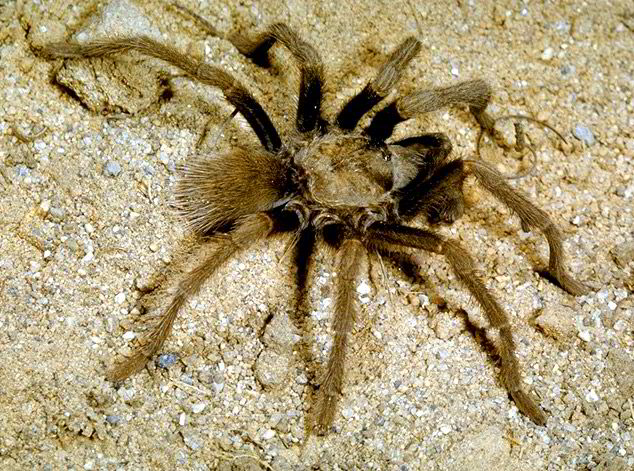 Common Tarantula George W. Robinson © California Academy of Sciences |
|
Tarantulas can make good pets. Many species can be purchased as juveniles for $20-$50. A terrarium with an inch or two of damp ground coconut fiber, or a mixture of soil and sphagnum moss on bottom provides an ideal habitat. (Burrowing tarantulas will require a much deeper layer.) Ambient temperature and humidity vary by species, with most thriving between 75 degrees and 80°F (24 to 27°C) and between 40% and 80% humidity.
Tarantulas can be fed a variety of foods. Tarantulas should not be fed vertebrates on a regular basis as the calcium in the bones will cause complications during molting and may kill the tarantula. A tropical roach colony is a good way to maintain a food supply for a number of tarantulas. The discoid cockroach and death's head cockroach in particular are very easy to care for and will not infest your home if they escape. Maintaining a colony of death's head cockroaches only requires keeping them in the dark, feeding them a handful of dog food every couple of weeks and misting them with water every day or two. — Adapted from Wikipedia |
| Wondering how to get that bug identified? Please see the kind folks at Bugguide.net. (North America) North American Insects & Spiders is dedicated to macro photography of live, wild organisms in situ. |
|
North American Insects & Spiders Explore over 3,000 close-up photos and information on over 700 arthropod species commonly found in North America. Our live insects & spiders have been photographed unposed, in the wild, at various locations in Canada, Mexico and the United States. Spiders Index | Spiders Main | Beetles | Butterflies | Stinging Insects |