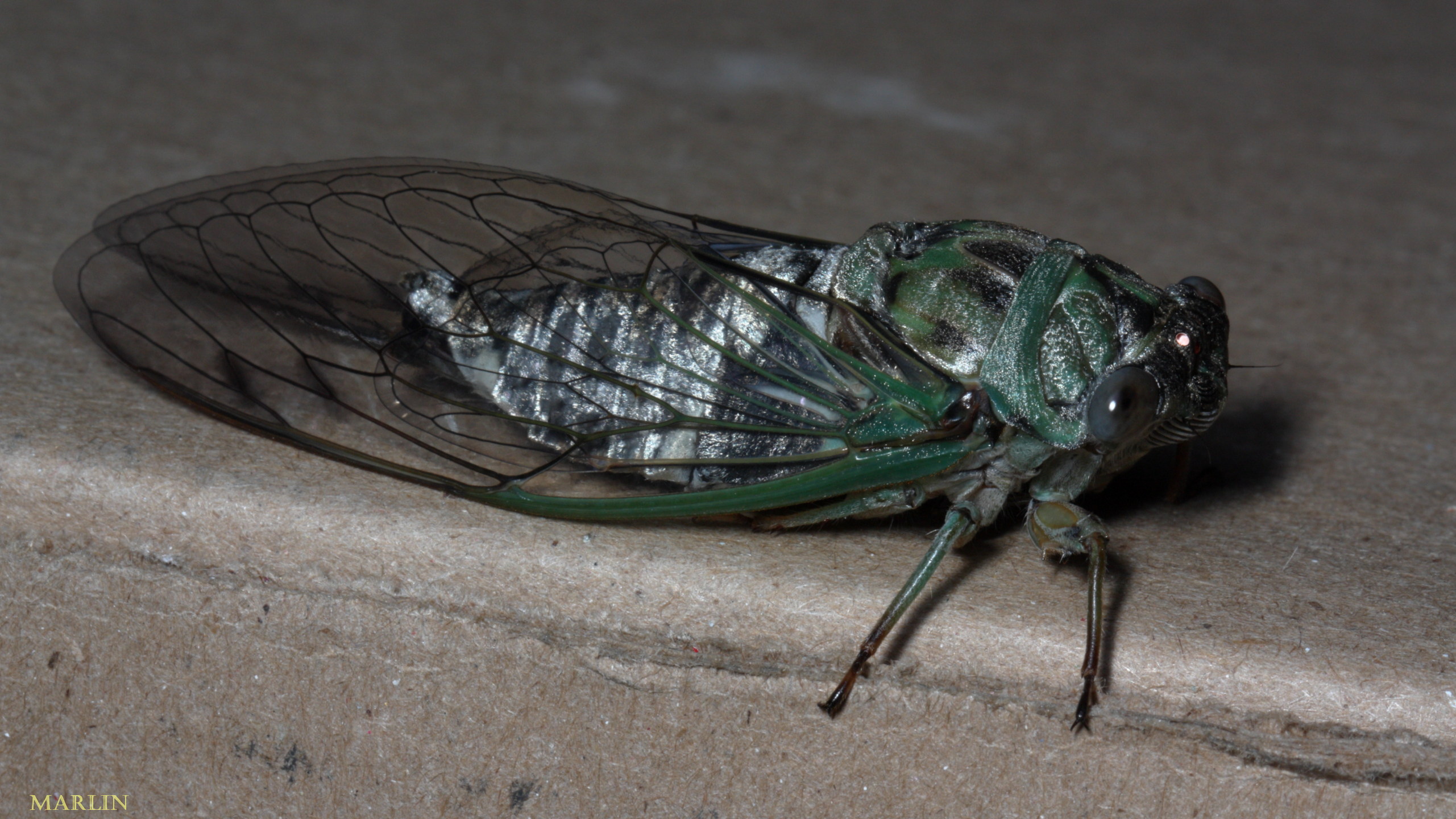
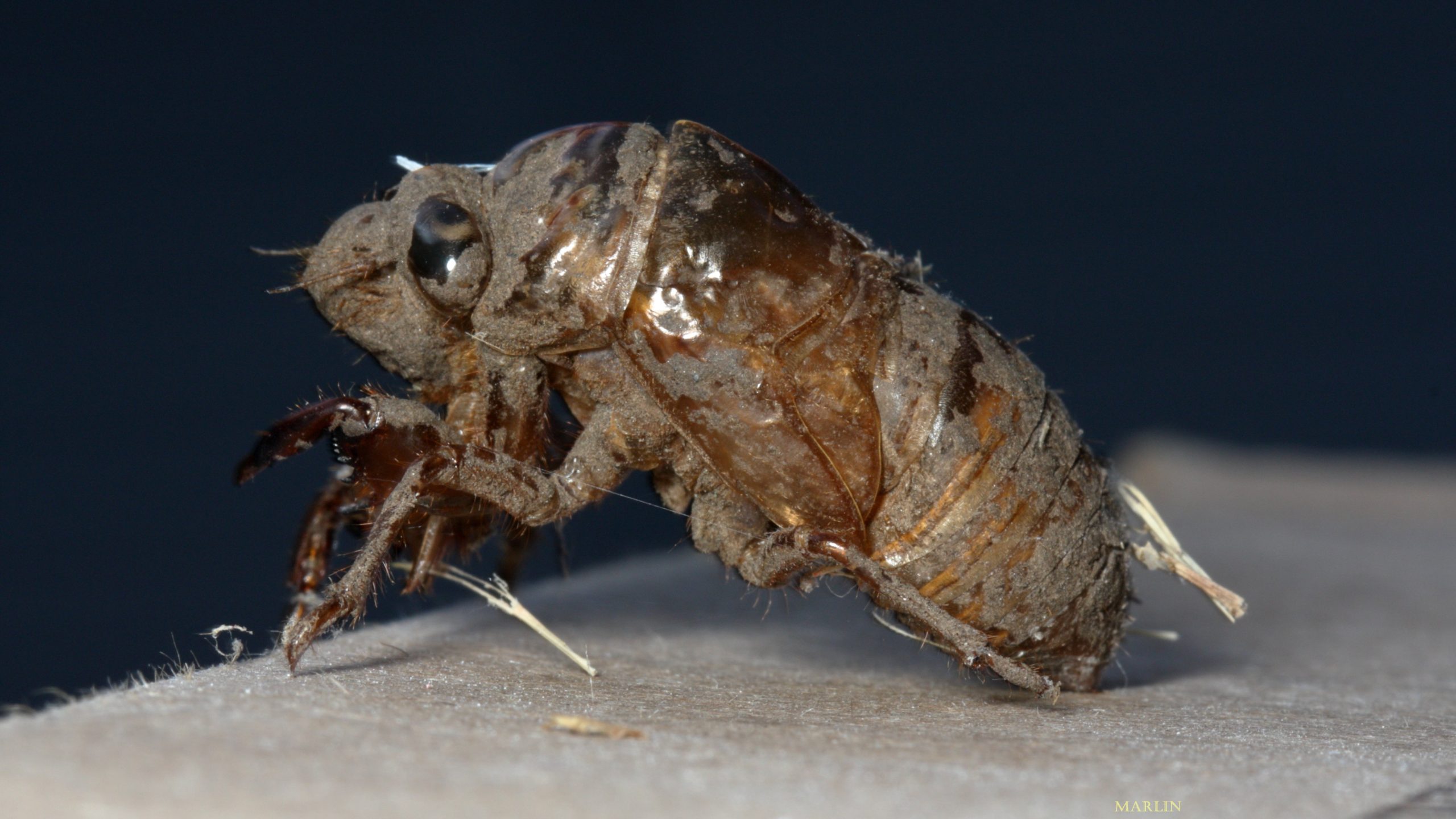
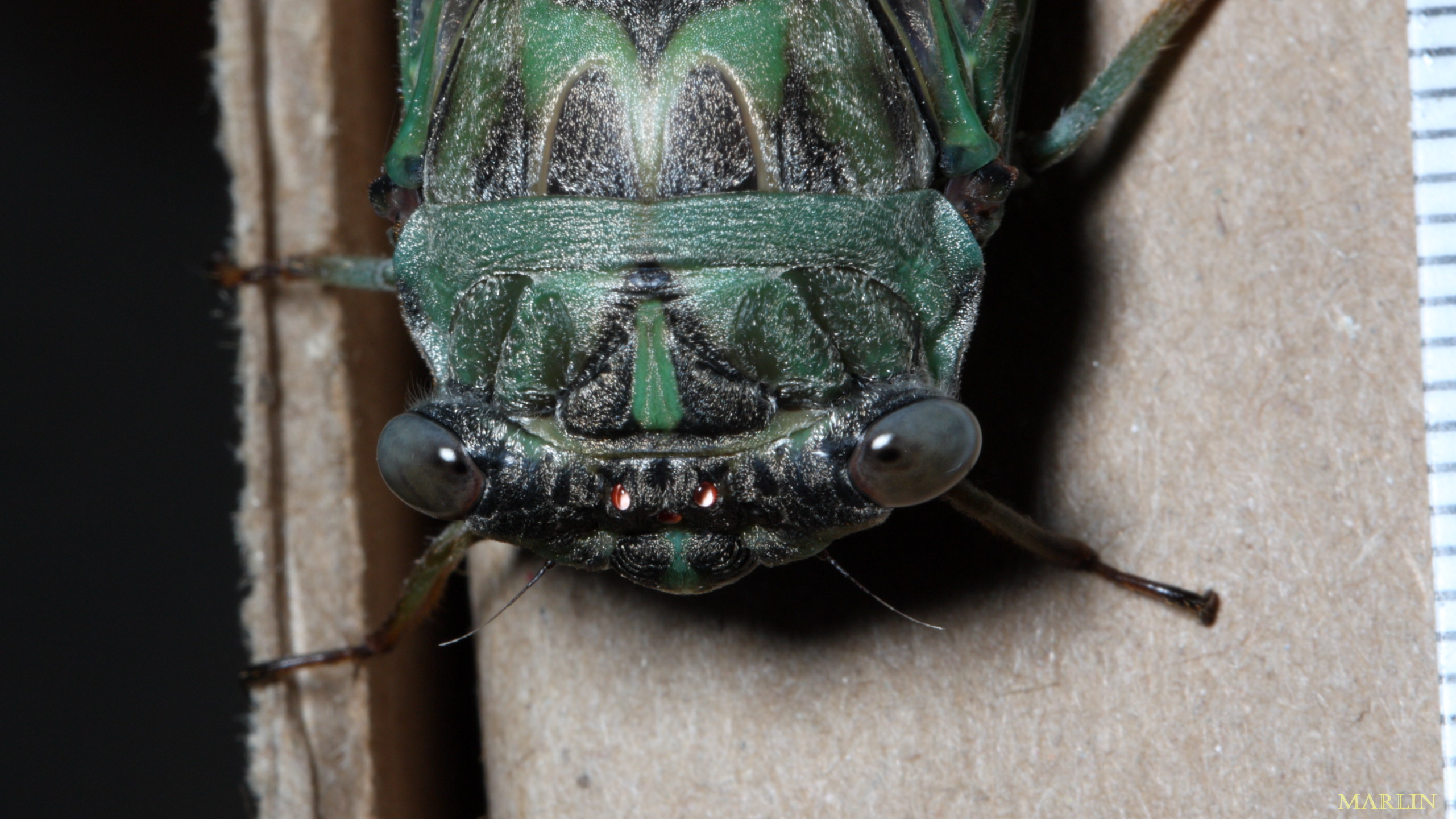
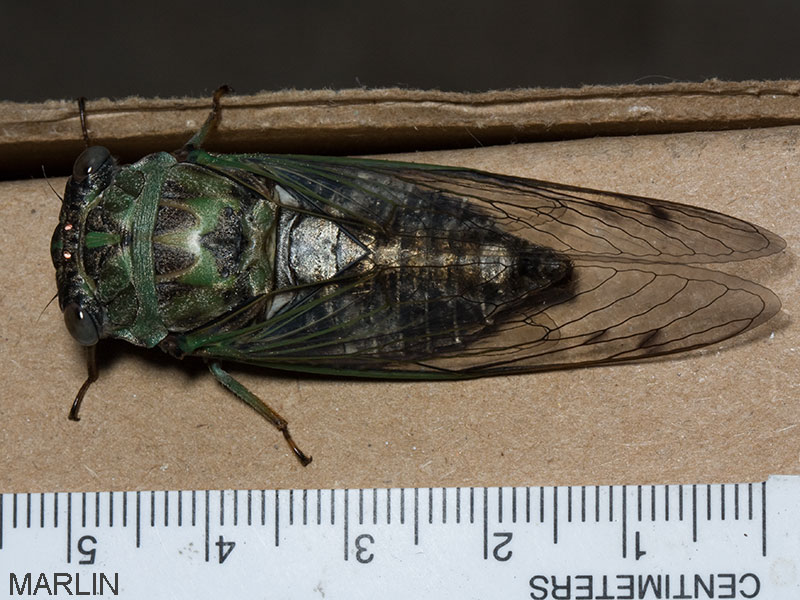
Annual Cicada - Tibicen linnei
Also commonly known as dog day cicada
Suborder Homoptera /  Superfamily Cicadoidea / Family Cicadidae -- cicadas
Live adult cicadas photographed in the wild at DuPage County, Illinois


Annual Cicada Tibicen linnei

The Homoptera have the dubious distinction of being probably the most destructive insects of all. They include aphids, leafhoppers, cicadas, and scale insects: approximately 45,000 species worldwide, 6,000 in North America. Some taxonomists place the Homoptera with true bugs, but the current thinking is, the differences are great enough to place them in their own order.

Homopteran wings are uniformly membranous, unlike the true bugs which have a leathery portion at the base of their wings.  All Homopterans feed exclusively on plants, but their diets vary tremendously, as do their reproductive methods. Many species reproduce sexually, while others do so parthenogenically (without mating). Cicadas and leafhoppers mate sexually, and most females have large ovipositors which they use to deposit eggs into slits they cut in plant tissue. But Aphids can reproduce without having sex, and are among the most destructive of all homopterans - theoretically, one female aphid is capable of producing billions of offspring. All homopterans undergo simple metamorphosis.

Many insects in this order exude waxy secretions which protect them from attack and make them impervious to water; others secrete a sweet secretion called honeydew. Members of the order hymenoptera, the ants, have learned to "farm" aphids for their secretions -- in turn, they protect the aphid colonies from attack by other predators and parasites. This symbiotic relationship is one of the most fascinating in nature.

Annual Cicada Tibicen linnei

There are about 2,000 species of cicadas worldwide, most of them found in tropical or temperate regions. Most of the more than 100 species found in North America have short life cycles, between two and eight years. They are known as annual or dog-day cicadas because they usually emerge during mid to late summer (July and August).

A small number of cicada species have synchronized their life cycles so that they emerge from the ground in their billions only once in every 13 or 17 years. These are known as periodical cicadas but are also commonly called 17-year cicadas, 13-year cicadas, or locusts. They are not locusts, however. The dog-day cicada is dark with green markings. The periodical cicada has protruding red eyes and orange legs; adults have clear wings with orange veins. It is not known how periodical cicadas synchronize their life cycles over 13 or 17 years—or how they manage to count out the years. But by emerging at such long intervals in such vast numbers, as many as 1.5 million insects per acre, according to one estimate, they have evolved an effective strategy to overwhelm predators by sheer volume. The mass emergence of periodical cicadas provides an unlimited feast for birds, snakes, and mammals. Even humans have been known to eat the harmless insects (Cicadas are not poisonous and do not bite or sting).

Annual Cicada

Once the predators have eaten to capacity, there are still millions of cicadas left over to produce the next generation. Predator populations cannot build up in response to such a massive food supply, because the cicadas appear above the ground only once in every 13 or 17 years.

Periodic cicadas are found in eastern North America and belong to the genus Magicicada. There are seven species, four with 13-year life cycles, and three with 17-year cycles. The three 17-year species are generally northern in distribution, while the 13-year species are generally southern and midwestern. Periodic cicadas generally emerge in May and June, apparently when the soil temperature reaches 64° Fahrenheit (18° Celsius). This means that emergences in southern and low-lying areas occur earlier in the summer than in the cooler northern locations.

Magicicada cicadas synchronize their life cycles only in local areas. There are 12 broods, or year classes, among the 17-year cicadas and three broods of 13-year cicadas so that in almost any given year it is possible to find adult periodic cicadas somewhere in the U.S.

Periodic Cicada
See also: Magiciada sp.


Treehopper - Ceresa taurina
Treehopper
Ceresa taurina

Red-banded Leafhopper
Graphocephala coccinea
Acanalonia bivittata
Acanaloniid Planthopper
Acanalonia bivittata

Leafhopper
 Coelidia olitoria
[Homoptera of North America Table of Contents]   [Homoptera of North America Main Page Graphics]
 
Custom Search

© Cirrus Digital