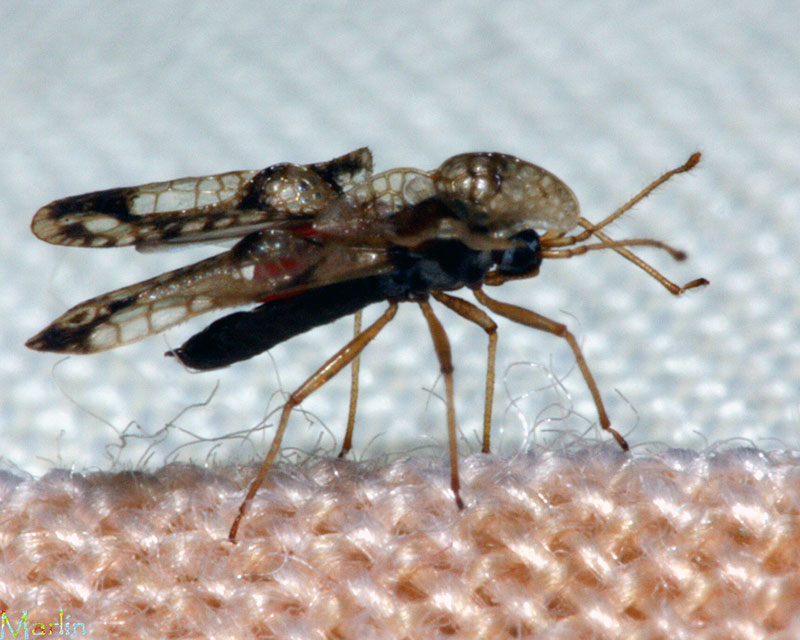
Lace Bug - Corythucha species [2]
Order Hemiptera / Suborder Heteroptera / Family Tingidae
This tiny bug (4mm) has elaborately sculptured wings with lacelike venation.
Live adult bugs photographed in the wild at Allegheny Nat'l Forest near Marienville, Pennsylvania, USA.
[Cirrus Home]   [Bugs Main Page Graphics]   [Bugs Table of Contents]
Lace Bug - Corythucha species
Lace bugs feed on many plants, but each species feeds on a very limited variety of hosts [5]

These adult lace bugs are 4mm (1/8 inch) long with an elaborately sculptured thorax and forewings that form an expanded cover over their body. The adult thorax and forewings have tiny clear cells that form a lacelike covering, hence the name "lace bugs." Many lace bugs are multicolored with a distinctive, species-specific pattern of a dark, pale, and clear lacelike areas. The wingless nymphs are smaller, oval, and commonly have body spines. Adults and nymphs occur together in groups on the underside of leaves [5].

Both nymphs and adults live on the lower surface of leaves and suck juices through slender, piercing mouthparts. This produces yellow or whitish spots on the upper surface of the leaf. As the insects feed, they deposit a hard, varnish-like excrement onto the leaf surface. These are called tar spots or resin spots [1].
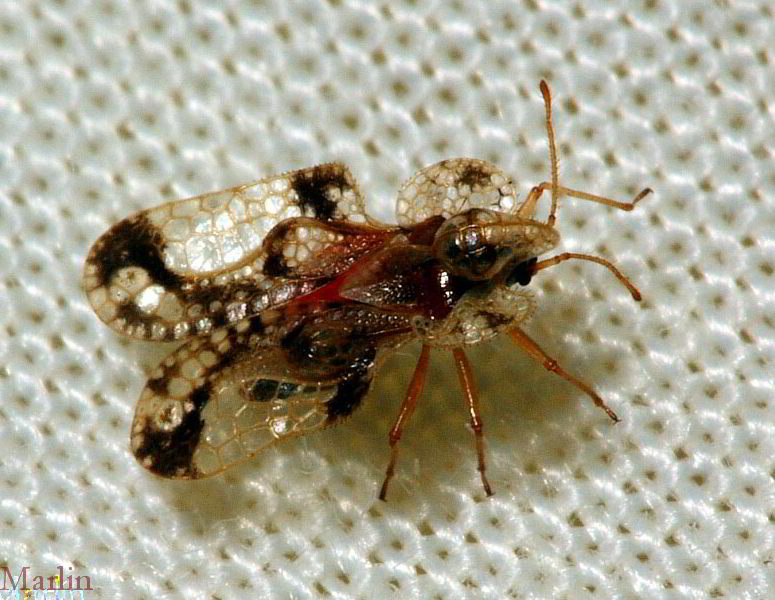
Lace Bug - Corythucha species
Lace Bug hides underneath its elaborately sculptured cloaking device. These are possibly C. cydoniae,
commonly called Hawthorne lace bugs, primarily pests of plants in the family Rosaceae. [4]

Life Cycles and Habits

Lace bugs can be divided into two groups - those that attack deciduous trees and shrubs and those that attack evergreen shrubs. Lace bugs that attack deciduous plants spend the winter in the adult stage by hibernating on the plant under bark or near the plant in leaf litter. Lace bugs that attack evergreens overwinter in the egg stage attached to the leaves.
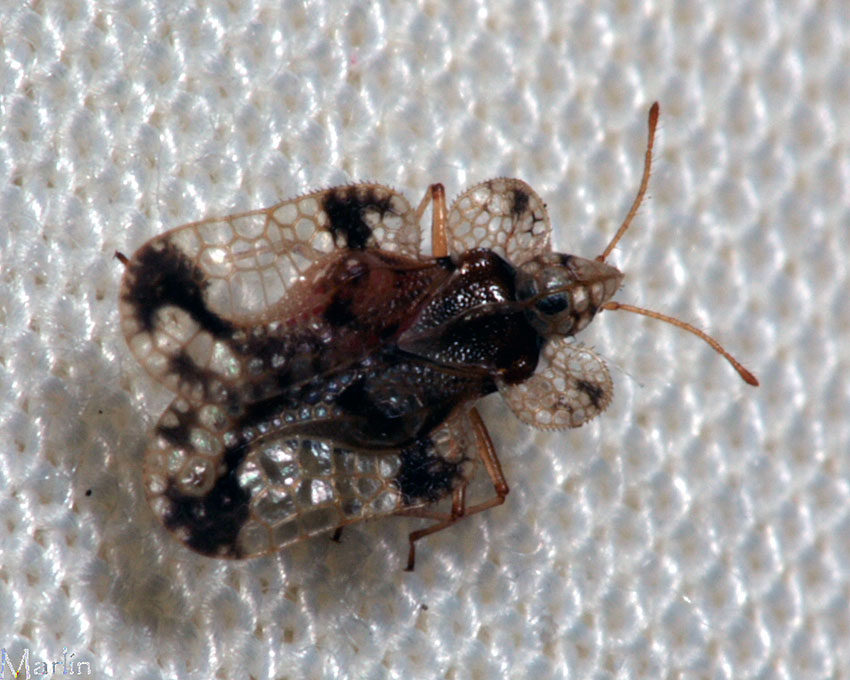
The hawthorn lace bug is one type that attacks deciduous plants. The adults hibernate under loose bark of their host plants as well as among leaf litter. They become active in early to mid-May and return to the new leaves. The females soon begin to lay eggs along the larger veins on the lower leaf surface. The females may lay eggs for a considerable time, often extending into June. The eggs hatch in a couple of weeks and the nymphs cluster together and feed. Each nymph sheds its skin (molts) five times before the adult stage is reached. Growth to the adult stage usually takes three to four weeks. Peak numbers of this pest are usually present in July. Only one generation occurs per year. Related species of lace bugs such as the oak, sycamore and hackberry lace bugs have two and occasionally three generations in a summer.

The azalea lace bug (an example of a lace bug that attacks evergreens) overwinters in the egg stage. The eggs are partially inserted into the leaf tissues along the midvein and are covered with the resin-like excrement of the female. The nymphs hatch in the spring, usually mid-May, after the danger of frost is over. They feed in small groups on the under surface of leaves and molt five times before becoming adults. The adults mate and lay eggs for a second generation by mid to late-July. Often there is a third generation in the late summer and early fall. The Andromeda and rhododendron lace bugs have similar life cycles [1].

Lace Bug - Corythucha species

Lace bugs do not often inflict catastrophic damage to plants. Natural enemies of lace bugs include assassin bugs, lacewing larvae, lady beetles, jumping spiders, pirate bugs, and predaceous mites. These predators may not appear in sufficient numbers until after lace bugs become abundant; their preservation, however, is an essential part of a long-term integrated pest management program.

Millimeter scale, dead bug

Growing a variety of species, mulching soil with organic material, and shading plants from afternoon sun can reduce lace bug damage to shrubs and increase natural enemy abundance. If applying pesticides, using only short-persistence materials such as oils and insecticidal soaps will minimize the number of beneficial predators and parasites that are killed [5].
Lace Bug
[Cirrus Home]   [Bugs Main Page Graphics]   [Bugs Table of Contents]
References
  1. David J. Shetlar, Ohio State University Extension Fact Sheet HYG-2150-91 "Lace Bugs"
  2. Bugguide.net, Corythucha
  3. Alfred G. Wheeler and Sir T. Richard E. Southwood FRS, Biology of the Plant Bugs (Hemiptera: Miridae), 2001.
  4. F.W. Meade, University of Florida IFAS Extension, EENY-080 "Hawthorn Lace Bug, Corythucha cydoniae (Fitch) (Insecta: Hemiptera: Tingidae)" (.pdf)
  5. S. H. Dreistadt, UC IPM Program, UC Davis; and E. J. Perry, UC Cooperative Extension, Stanislaus County,
    University of California Agriculture and Natural Resources (UC ANR) Publication 7428, "Pest Notes: Lace Bug"

Four Lined Plant Bug
Poecilocapsus lineatus
Stink Bug
Family Pentatomidae
Stink bugs
Broadheaded Bug
Broadheaded Bug
Family Alydidae

Family Coreidae
Acanthocephala terminalis


       web      www.cirrusimage.com

[Cirrus Home]    [Butterflies]    [Bugs]    [Beetles]    [Mantids]    [Spiders]    [Bees & Wasps]    [Dragon & Damselflies]    [Moths]   [Wildflowers]
[Fungi & Mushrooms]    [Flies]   [Butterflies of the World]  [Trees of North America]  [Cicadas & Grasshoppers]   [Ticks & Mites] 
© Bruce Marlin