Bedbugs
Human bed bugs are undergoing a worldwide resurgence, especially in developed countries once relatively bed bug free.
The common bedbug is well adapted to human environments. Cimex lectularius is found in temperate climates throughout the world and has been known since prehistoric times. Other species include Cimex hemipterus, found in tropical regions (including Florida), which also infests poultry and bats, and Leptocimex boueti, found in the tropics of West Africa and South America, which infests bats and humans. Cimex pilosellus and C. pipistrella primarily infest bats, while Haematosiphon inodora, a species of North America, preys on poultry.
 Physical characteristics
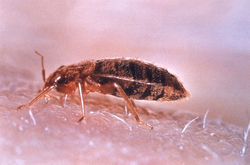
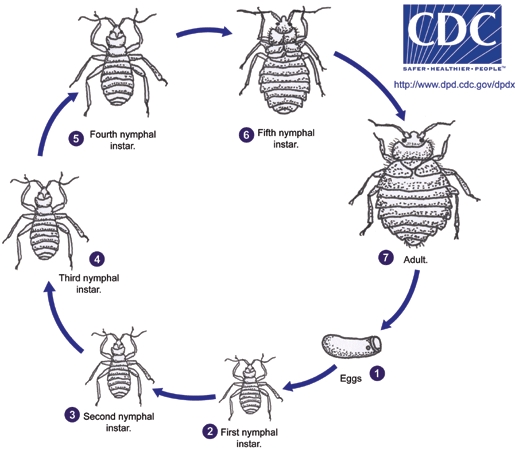
Bedbugs are 5-7 mm in length with vestigial wings. The mouthparts are modified for piercing and sucking. They can live between wooden floorboards, in furniture, in bed frames, in mattresses, even behind peeling paint. Bedbugs grasp human skin with their forelegs, pierce the skin, and inject anticoagulant and anesthetic-containing saliva. Bedbugs feed at night, approximately an hour before dawn. However, if the conditions are favorable, they also feed during the day. Feeding takes 3-12 minutes. Adult bedbugs can survive without a meal for a year or longer. Each female lays approximately 300 eggs in her lifetime. The eggs hatch in 10 days. The nymph stage lasts 6 weeks, undergoing 5 molts.
Successful treatment of a bedbug infestation is often highly dependent on how thorough the pest control professional is. Although the assessment and judgment of the pest control professional should be respected, most treatments cover such areas within domiciles as closets, curtains, outside and inside furniture crevices (dresser and desk drawers, night tables, etc.), as well as the interior of electrical outlets and behind pictures hangings on walls. [3]
Feeding habits
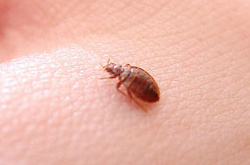
Attracted by warmth and the presence of carbon dioxide, the bug pierces the skin of its host with two hollow tubes. With one tube it injects its saliva, which contains anticoagulants and anesthetics, while with the other it withdraws the blood of its host. After feeding for about five minutes, the bug returns to its hiding place. Bedbug bites are not usually noticed until hours later, when a dermatological reaction to the injected anesthetic begins, causing intense itching, inflamation, and sometimes bleeding.
Although bedbugs can live for up to 18 months without feeding, they typically seek blood every five to ten days. While bedbugs have been known to harbor pathogens in their bodies, including plague and hepatitis B, they have not been linked to the transmission of any disease and are not regarded as a medical threat. Some individuals, however, can get skin infections and scars from scratching bites.
Reproductive habits
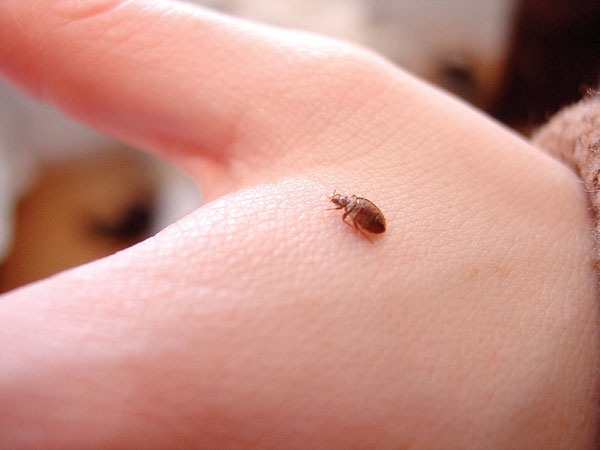
Female bedbugs can lay up to five eggs in a day and 500 during a lifetime. The eggs are visible to the naked eye measuring 1mm in length (approx. 2 grains of salt) and are a milky-white tone in color. A few bedbug species make use of a mating plug, secreted by the male upon withdrawal after copulation, effectively gluing shut the vaginal opening of the female against later males. Among such species, the male impales the female via her abdomen, thus circumventing a mating plug.
Infestations – Method of initial infestation
There are several means by which dwellings can become infested with bedbugs. People can often acquire bedbugs at hotels, motels, and bed-and-breakfasts, thanks to increased domestic and international tourism, and bring them back to their primary domiciles in their luggage. They also can pick them up by bringing home infested furniture, mattresses, or used clothing. Bedbugs may travel between units in multi-unit dwellings. This spread between units is dependent in part on the degree of infestation, on the material used to partition units (concrete is a more effective barrier to the spread of the infestation), and whether or not infested items are dragged through common areas while being disposed of, resulting in the shedding of bedbugs and bedbug eggs while being dragged.
Bedbugs are flat, allowing them to hide in tiny crevices. A crack wide enough to fit the edge of a credit card can harbor bedbugs. In the daytime, they tend to stay hidden in such places as mattress seams, mattress interiors, bed frames, nearby furniture, carpeting, baseboards, or bedroom clutter. Bedbugs are capable of traveling as far as 100 feet to feed, but usually remain close to the host in bedrooms or on sofas where people sleep. They feed every five to 10 days.
Detection of infestations
There has been a spate of infestations in New York City hotels, leading to many online bedbug registries purporting to list recent bedbug hotspots. The presence of the little critters has prodded the media out of their somnolence, since they are not sleeping well these days in NYC hotels. News programs and talk shows have regular bed bug segments these days.
The same unfortunate situation has also engulfed many college dormitories and administration buildings all over the country. It is thought students’ habit of scavenging used furniture has a lot to do with the spread, and their transference of the bugs to private residences. Bed bugs have been found in hospital maternity wards, private schools, even doctor’s waiting rooms! [3]
Bed bugs have also been cited for infestations at many public and University libraries across the United States. It seems the lil buggers like to hide in the books after the person reading in bed falls asleep, and travel to and from the library in the spine or other hiding places in the book itself [5]. The Denver Public library was forced to ban one user over his continuing return of materials that had been infested by bed bugs. The cost to the library was cited at over $12,000 for decontamination and replacement of materials that had to be destroyed [6].
Bed bugs can be detected often by looking for dark fecal stains on bedding. Occasionally an engorged bedbug is killed or crushed, resulting in a visible smear of blood and a sickly-sweet odor. Though bedbug bites can occur singly, they often follow a distinctive pattern of a linear group of three bites, often humorously term “breakfast, lunch and dinner” by those victimized.
The effect of these bites varies from person to person, but often cause welts and swelling that are more itchy and longer-lasting than mosquito bites. Others have little or no reaction to bedbug bites. Those whose bodies do not initially react may subsequently develop symptoms, however, due to an allergic reaction caused by the development of antigens.
With the widespread use of DDT in the 1940s and ’50s, bedbugs all but disappeared from North America in the mid-twentieth century. Infestations remained common in many other parts of the world, however, and in recent years have begun to rebound in North America.
Bed Bug Control
Most pest control professionals require the space be be prepared by residents prior to their arrival for a chemical treatment. If an apartment is not properly prepared, the coverage of pesticides and/or chemical treatment will be impaired. All furniture and appliances in the dwelling usually need to be pulled away from the baseboards [1].
An informal survey of pest control professionals conducted by a pest control professor at the University of Massachusetts stated that 68% of all bedbug infestations require three or more treatments, 26% require two treatments, and 6% require just one.
Steam Treatment Some pest control firms offer steam treatment for mattresses or upholstered furniture. Live steam must be directed onto every surface of an infected bed and its environs. Many people confuse water vapor (which is visible, as in clouds) and steam, which is invisible. The sight of clouds of water vapor emanating from a nozzle provides a mostly cosmetic and placebo effect; once the steam is condensed into water vapor, it has lost 95% of its heat to the surrounding air and has virtually no effect on bacteria or other hardy creatures nearby. The only really effective portion of the steam cleaner is the inch or so directly in front of the nozzle where the steam is invisible, and this needs to be directed onto a surface (or a bed bug or bed bug egg) for sufficient time to actually kill the organism. Indeed, the deposition of water vapor onto surfaces may promote bacterial growth, since moisture is essential for many of their metabolic processes.
Bed Bug Spray: Exterminators will often apply a “contact kill” spray directly on bed bugs found in the apartment (such as a mixture of cyfluthrin, pyrethrins, and piperonyl butoxide), and then spray lambda-cyhalothrin on baseboards and other favorite hiding places. Lambda-cyhalothrin acts as a “slow kill” barrier which kills bedbugs after they cross it, and is usually microencapsulated, making it safe to pets and humans after it dries. Often, deltamethrin is also injected into larger crevices. The lambda-cyhalothrin and the deltamethrin are at their strongest for the first two weeks following their application, but usually retain effectiveness for up to 60 days.
Gentrol and Phantom can also be used for bed bug control. Gentrol contains the active ingredient (S)-Hydroprene, an insect growth regulator (IGR) that disrupts the normal growth development of cockroaches and stored product pests, drain flies and fruit flies, as well as bed bugs. Phantom® uses an active ingredient known as chlorfenapyr. It is non-repellent and relatively long-lasting.
After the mattress and/or box spring or futon has been treated, placing these inside a cotton or a polyvinyl or polyethylene bag is a good idea as a secondary means of defense. The mattress bag serves to reduce this likelihood and in the case of box springs, it seals any remaining insects inside the bag. The mattress bag also protects the mattress from the mess of staining caused when bedbugs aggregate on seams. The bag is a good idea either until the infestation has been totally eliminated or in the case of good quality cotton bags, useful as a permanent protection for the mattress – and also to enable easier control if infestation recurs.
It may be your best option to dispose of all contaminated bedding, including the bed. Be careful to seal the mattress and bedding carefully inside a suitable mattress bag to avoid spreading bedbugs or their eggs while physically removing the articles. [4]
References
- Excerpts reprinted from Wikipedia, “Bed bug“
- Centers for Disease Control, “Parasites – Bed Bugs“
- Centers for Disease Control, “Parasites – Bed Bugs FAQs“
- Goddard, J.A. The Physician’s Guide to Arthropods of Medical Importance. CRC Press. 1993.
- New York Times, A Dark and Itchy Night – Bedbugs hitch a ride on library books Dec 5, 2012
- ABC News, Bed Bugs Hitch Ride On Books, Prompt Library Fumigation Sept. 24, 2009
- Images courtesy CDC