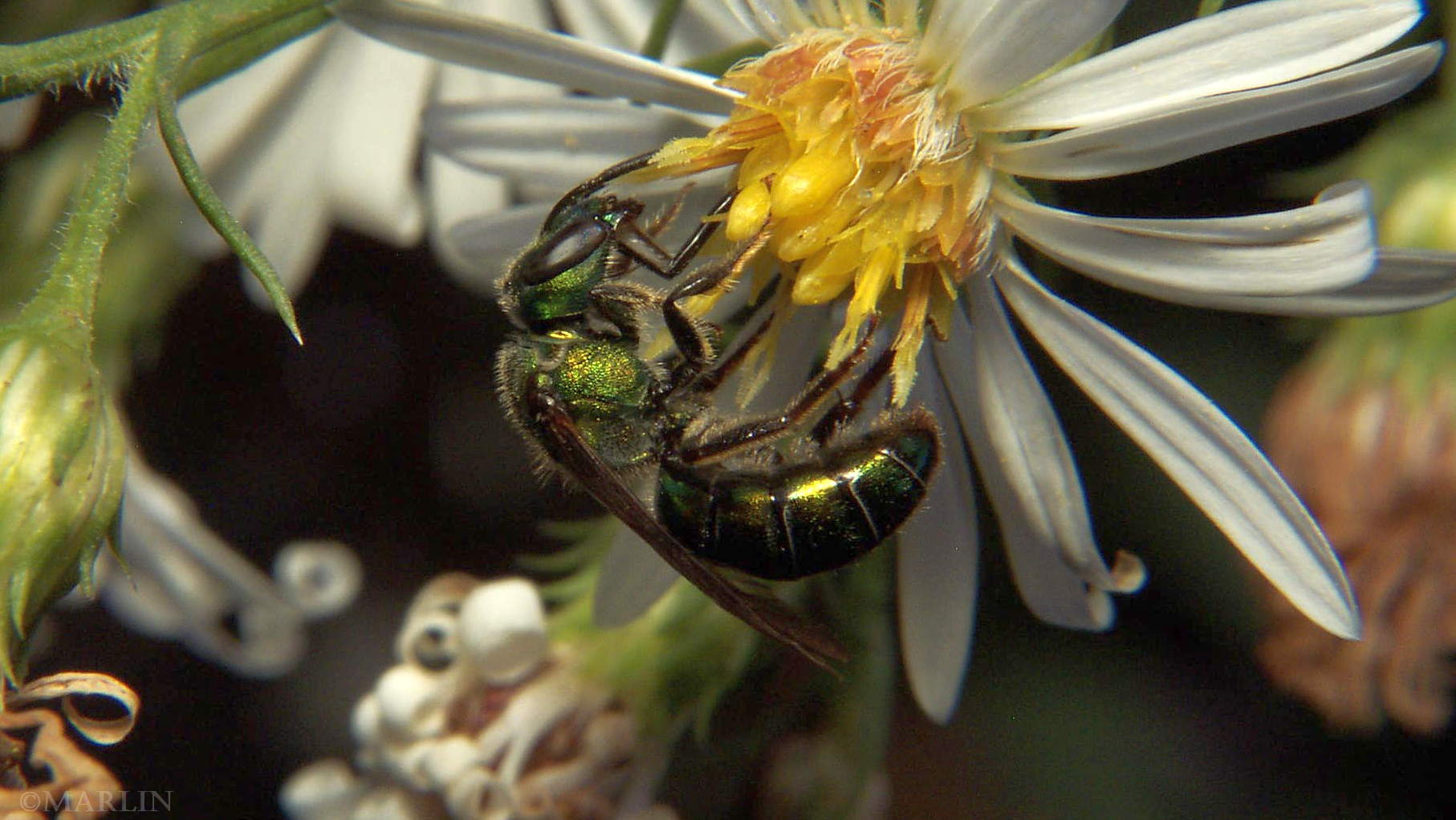
Halictid Bee – Augochloropsis metallica
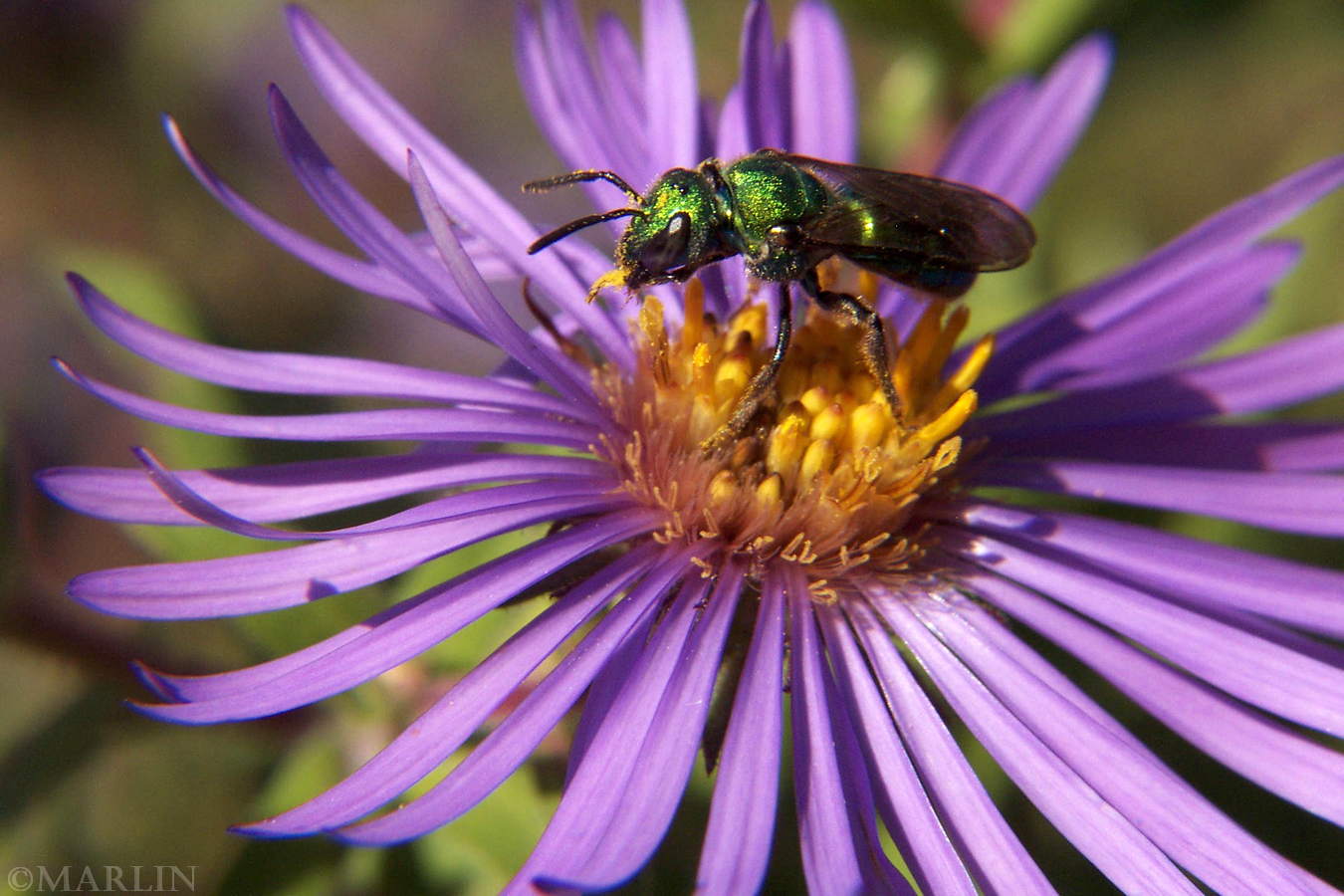
This little green bee is busy eating pollen – actually cutting off hunks of this New England aster flower to strip off the pollen.
There are more than 3,500 species of bees in North America, about 500 of which form the family Halictidae. Most Halictids are solitary bees that nest in the ground. Some species line their tunnels with a cellophane-like glandular secretion composed of chemicals called lactones. Each individual bee has its own unique chemical signature, helping workers return to the nest [4].
In many species, the tongue is long and pointed, adapted for probing into flowers. All bees are covered with hair, to which pollen sticks when flowers are visited; most female bees have apparatus for gathering this pollen; it is combed into a special basket or brush located on the hind legs. Males do not collect pollen and lack these structures. There are a few species, especially the parasitic bees, that have no pollen baskets.
Between 1940 and 1960, as more and more land came under cultivation in the American Midwest, several species of native bumblebees disappeared from the area. A growing shortage of both domesticated (the number of managed honeybee hives declined by 45% over the past 50 years) and wild pollinators perpetuates a vicious circle: fewer pollinators reduce crop yields, requiring cultivation of even more land to produce the same amount of food [2].
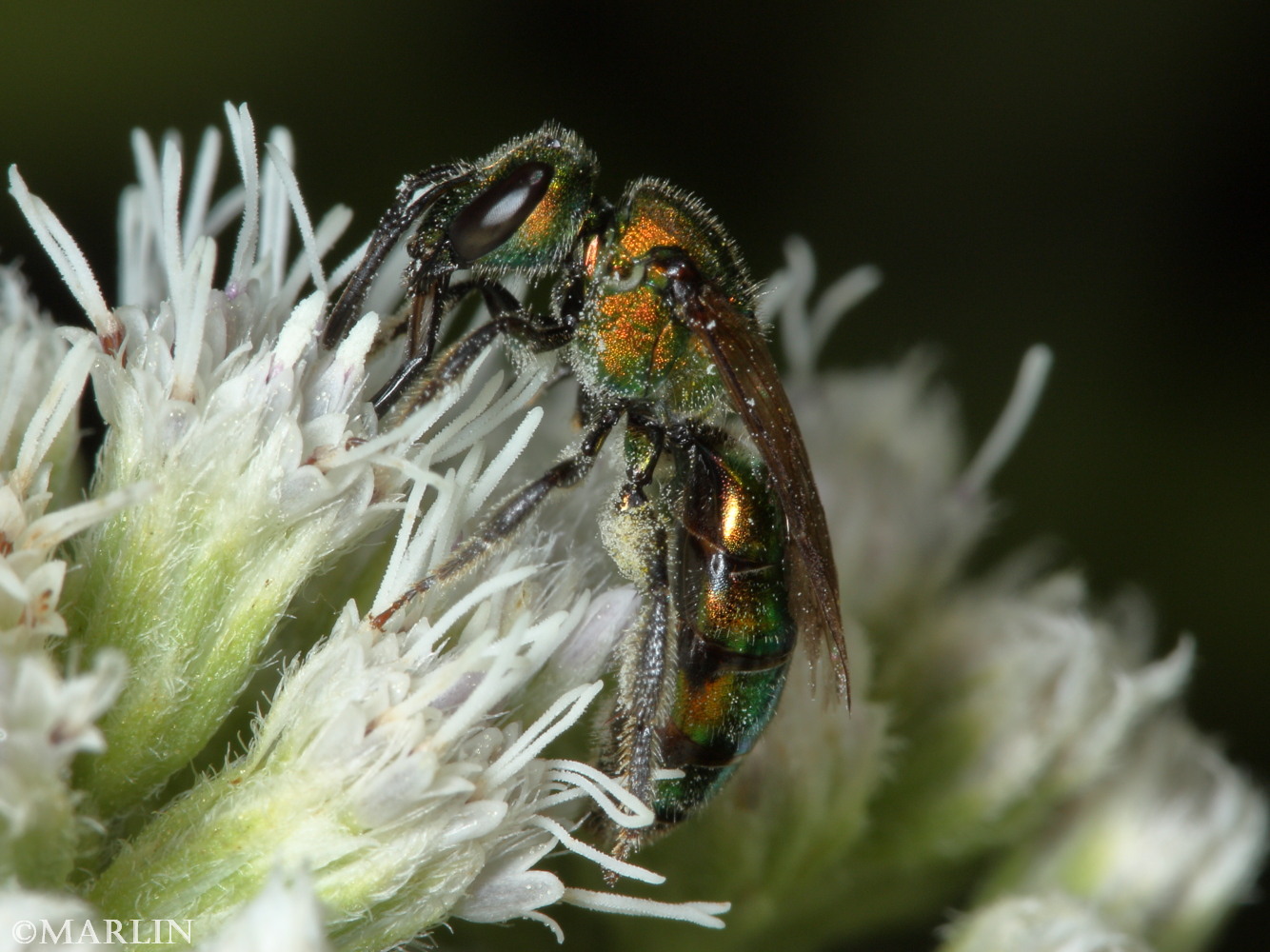
You might also like: Halictid Bee – Augochlora pura
Identifying characteristics for the family Halictidae include:
- As in other families of the superfamily Apoidea, members of the family Halictidae have:
- a collarlike pronotum without projections that reach the tegulae,
- body hairs that are branched or plumose, and
- first segment of the metatarsus often enlarged and flattened.
- 1 subantennal suture (Andrenid bees have 2).
- Front wing with basal vein strongly arched.
- Hind wing with jugal lobe longer than the submedian cell.
- Thorax of some species metallic green like the chrysidid wasps, but halictids lack the sculptured cuticle (1)
References
- John L. Foltz, University of Florida, Dept of Entomology & Nematology, ENY 3005, Hymenoptera: Halictidae.
- Marcelo Aizen and Lawrence Harder, New York Times, “Too-Busy Bees” March 24, 2010
- Science, “Parallel Declines in Pollinators and Insect-Pollinated Plants in Britain and the Netherlands“
- Lisa Schonberg, Mace Vaughan, and Gretchen LeBuhn, The Great Sunflower Project, “Lasioglossum“
Insects & Spiders | Bees & Wasps Index | Bees & Wasps Main | Beetles Index