Eastern Hemlock – Tsuga canadensis

An evergreen conifer with heavily foliaged and upsweeping branches, Eastern hemlock is a North American native. At maturity, it is commonly 60 to 70 feet (18-21 m) tall and 24 to 48 inches diameter. One of the largest eastern hemlock recorded was 175 feet (53 m) tall and 76 inches (193 cm) in d.b.h. Hardy to USDA Zone 3.
Obligate Climax Species: Eastern hemlock is very shade tolerant. Seedlings survive in as little as 5 percent of full light. Individuals are able to survive several hundred years of suppression, and many show numerous growth releases and suppressions. Saplings less than 2 inches (5 cm) may be more than 100 years old. Seedlings are able to establish under dense forest, including sugar maple canopies and can replace that species. Eastern hemlock uniquely modifies semi-permanent soil properties, such as acidity, which favors its reproduction.
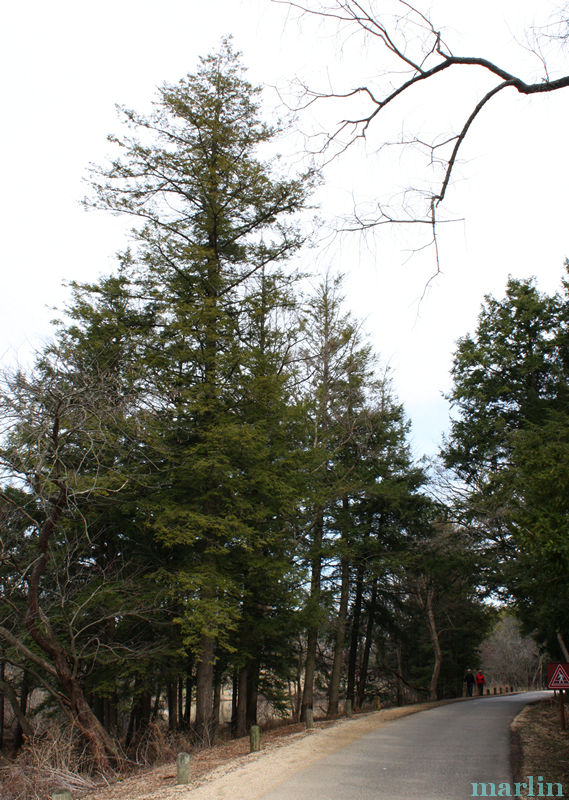
Eastern hemlock is very susceptible to fire because of its thin bark, shallow roots, low-branching habit, and heavy litter deposits. It is possibly the most fire-sensitive mesophytic tree species in its range. However, Eastern hemlock usually escapes fire because it occurs in moist habitats and is often associated with hardwoods which do not readily burn. If a fire starts in a cutover area, a windfall area, or an area with dead standing timber, it may carry into a northern hardwoods forest if there is strong wind. In Michigan, the average return time for severe crown fires in the hemlock-white ine-northern hardwoods type is estimated to be about 1,400 years [63]. In northeastern Maine, the average return interval for fire in spruce-fir forests in which eastern hemlock is a minor component is about 800 years. (2)
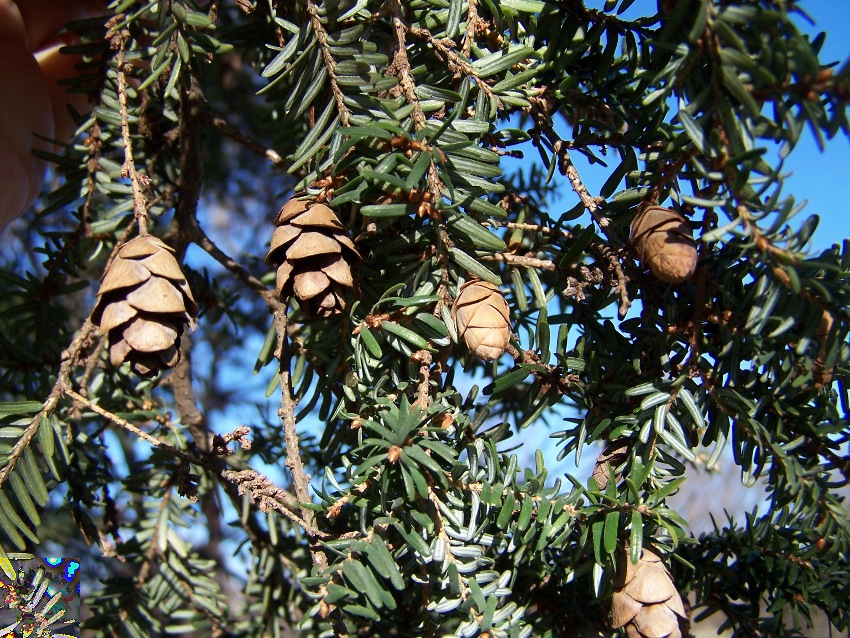
Eastern Hemlock is also commonly called Canada Hemlock and Hemlock Spruce. In the United States, eastern hemlock occurs throughout New England, the mid-Atlantic states, and the Lake States, and extends south in the Appalachian Mountains to northern Georgia and Alabama and west from the mountains into Indiana, western Ohio, and western Kentucky. At its northern limit, eastern hemlock ranges along the southern border of Canada from southern Ontario to Cape Breton Island, Nova Scotia.
Eastern hemlock occurs as a dominant or codominant in coniferous and mixed-hardwood forests. It is often the only conifer present in mixed mesophytic forests of the eastern United States. Eastern hemlock wood is of low value because of brittleness and abundant knots. It is used for pulp, light framing, sheathing, roofing, subflooring, and boxes and crates.
Dense stands of eastern hemlock provide excellent wildlife habitat. Cove forests in the southern Appalachian Mountains provide nesting habitat for many species of birds. The black-throated blue warbler, black-throated green warbler, and blackburnian warbler are especially abundant in virgin eastern hemlock cove forests. Large eastern hemlocks can be climbed by small black bear cubs. In northeastern Minnesota, black bear mothers and cubs spent more than 95 percent of the time in April and May within 600 feet (183 m) of either an eastern hemlock or an eastern white pine (Pinus strobus) larger than 20 inches (51 cm) in d.b.h. Eastern hemlock has high cavity value for wildlife. Large hollow trees are commonly used as dens by black bears. The seeds are eaten by birds and mammals, and in the winter the foliage is browsed by white-tailed deer, moose, and snowshoe hares.
In the winter, eastern hemlock browse is moderately preferred by moose and highly preferred by white-tailed deer. In the summer, white-tailed deer prefer hardwood sprouts and seedlings to eastern hemlock. The seeds of eastern hemlock are not as preferred by white-footed mice, red-backed voles, and meadow voles as red pine (Pinus resinosa) and white pine seeds. (3)
References
1. U.S. Dept. of Agriculture, ARS, National Genetic Resources Program. ‘Eastern Hemlock’
2. USDA Fire Effects Information Eastern Hemlock
Tree Encyclopedia | Tree Index
Trees live longer than any other organism on earth. Trees commonly live more than 1,000 years, and many grow considerably older. Trees have been living on Earth for more than 370 million years, and today can be found almost everywhere from the Arctic Circle to the Sahara Desert. Explore over 2,000 large format pictures of trees in more than 400 species. Family Pinaceae: Pine, Cedar, Spruce, and Fir