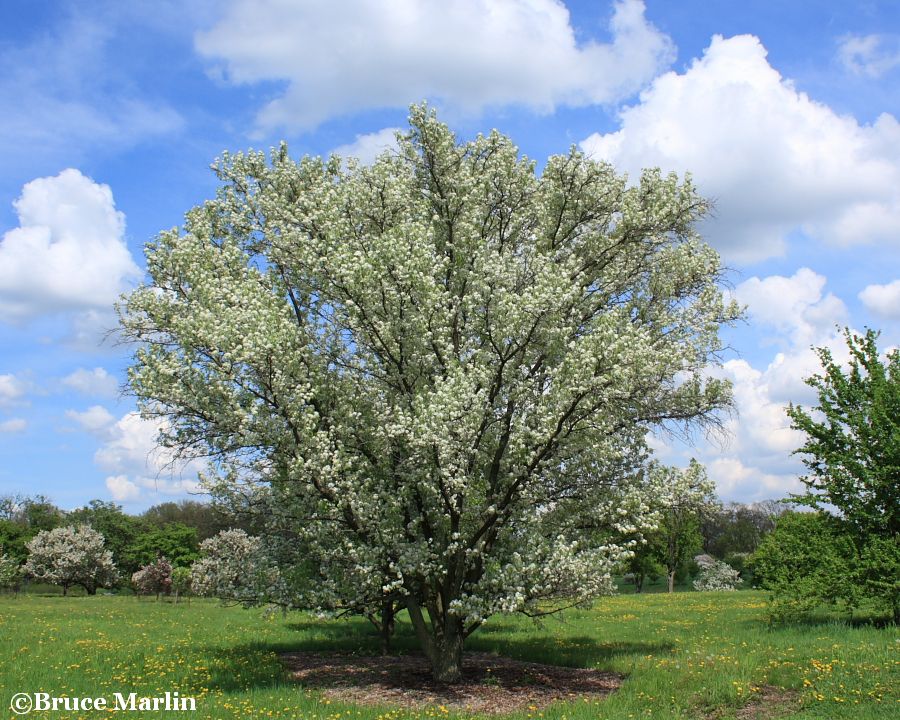
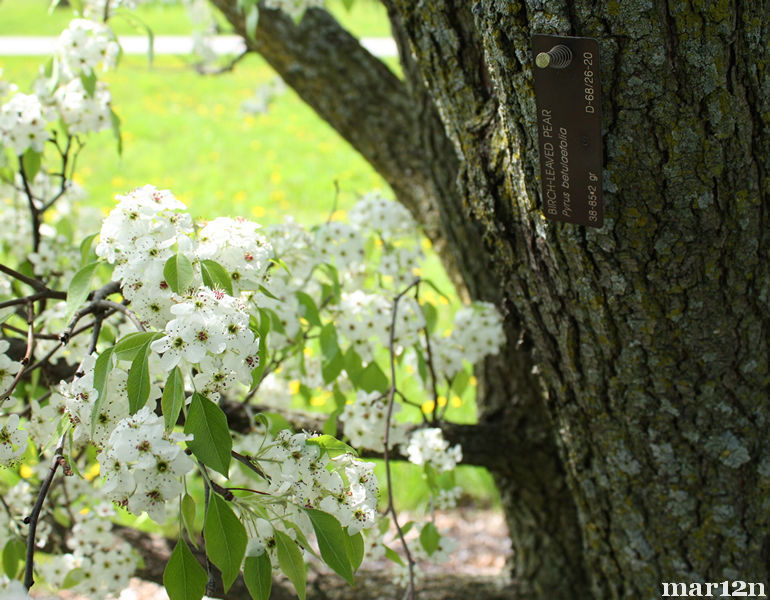
| Birch-Leaved Pear Tree - Pyrus betulaefolia Family Rosaceae - Rose Family; Fruit Trees Height: 25 feet / USDA zones hardy to 5 Tree Encyclopedia | Trees Index | Crabapples | Nut Trees | Fruit Trees Index | |
Pyrus communis pear cultivars are self-incompatible, hence in these orchards inter-fertile cultivars have to be planted. Parry (1976) and Kurennoi (1985) screened the following Pyrus species as potential pollinators: Pyrus amygdaliformis, P. longipes, P. nivalis, P. salicifolia P. betulaefolia, and P. syriaca. At the INRA Angers Research Unit research into pollinators for pear varieties was initiated in 1990. A selection from Pyrus betulaefolia, the P337-41 clone, was subsequently selected as the best candidate. This genotype exhibits very abundant flowering, and a regular and extended blooming period. The latter covers the blooming time for early to late pear varieties. The clone P337-41 originating from Pyrus betulaefolia is recommended as a pollinator for the main varieties grown in France: ‘Williams’, ‘Conférence’ and ‘Doyenné du Comice’. [1] The cultivation of the pear extends to the remotest antiquity. Traces of it have been found in the Swiss lake-dwellings; it is mentioned in the oldest Greek writings, and was cultivated by the Romans. Birch-leaved Pear, from planting, is 24 years old [2] The three minor noble hardwood species are important from an ecological as well as from an economical point of view. They are growing in mixed hardwood forests, often at the margins of forest stands due to competition for light. In mixed hardwood stands with beech as a major component thinning usually favours the minor Noble Hardwood species in order to prevent heavy competition and to reach sufficient size for an economically interesting utilization. |
References:
|
![]() |
Family Rosaceae - Rose Family; Fruit Trees Containing hawthorn, apple, pear, cherry, plum, peach, almond, mountain-ash and whitebeam. Many of these plants are of vital economic importance. The Rosaceae contain a great number of fruit trees of temperate regions, the fruit of which contain vitamins, acids, and sugars and can be used both raw and for making preserves, jam, jelly, candy, wine, brandy, cider and other beverages. Tree Encyclopedia | Tree Index | Fruit Tree Index |